Memories Of / #2

I owe my sincere thanks to an old friend (from the Martin Agency days) and great story-teller, Daniel “Catfish” Russ, for this beautiful memory of France some years back. Please check out Daniel’s blog here. One more thing before I hand it over: Daniel, great last paragraph. Great last sentence. Thanks so much.

About 12 years ago I traveled to France with a friend. We stayed in Paris for about 3 days and were scheduled to go to Coutance at a bed and breakfast on the Normandy coastline. The train out of Paris was late and so we missed our connection in Fouligny. That was the last train out. The conductor told me “Il n’y a pas d’hôtel ici.” No hotels. So I asked if he could recommend a cab company. “Il n’y a pas de taxis ici non plus. Pas un seul.”

OK. So I called a taxi from Coutance to pick us up. It was a 50-minute ride one way.

The taxi shows up, driven by a man who looked like he would rather be retired. It was a Mercedes Benz 500, gold, very comfortable. My French is passable and I learned early on that the French appreciate it when you at least try to speak their language. To be sure, on our first night in, we were staying in a small hotel in Paris in the 14th arrondissement. It was raining and we were famished and so we walked down the street to a small family restaurant called “Restaurant Romandie.” It was run by an extended Romanian family that had lived in Paris since the war. I started speaking French to them. They gathered round and spoke with me and were nice as can be. One of them collected our menus and gave us new ones. I can only imagine that there was a menu for locals and different more expensive menu for tourists.

At the end of the meal, they gave us a bottle of Hungarian red wine. The label said Magyar Voros. I stuffed it into my bag and took it to Coutance a few days later.

Back in the cab. I spoke with the cabbie and told him I wanted to see the Normandy coast. Coutance was near Utah Beach, the western most invasion route for the Allied forces on D-Day. It was there that the US 4th Infantry Division and the 101st Airborne was tasked. I told him that my father was in the United States Army Air Force and that he serviced B-17s. The guy got all choked up and asked if we had eaten. I said no. He called the hotel and asked them to make two dinner plates, that we were going to be late.

As we approached the hotel, he stopped and pointed to a small restaurant that he and his wife owned. I could see through the window and though it was closed, it looked like a woman cooking for two special needs children. I remember that it was on a steep hill that would rival any city street in San Francisco.

He told me that he worshipped Americans because as a small child, he remembered how brutal the Germans were, how his parents hated them. He remembered sitting on a rooftop in the old town with his father and watched as troopships unloaded and barrage balloons were tethered to the fishing docks.

My how times change.

As we got out of the cab, he looked at me and said “Mon père est mort là,” pointing at the beach. I shook his hand and thanked him for his kindness. I tipped him well.

My buddy and I checked into our respective rooms. A small, quiet woman came by with our dinner plates. It was roasted chicken, fried potatoes, salad, a small baguette and a small piece of chocolate. My travel pal then came into my room where we ate. I pulled out the Hungarian wine, given to us by Romanians in France.

I love France. I love the people. Every time I have been there I have been blessed with a moment of grace like this. Coutance, by the way, is beautiful.

I think of this Cabbie that was so appreciative of what we did so long ago. And how sad it was that that the generation of French nationals who once adored us and remembered what we did has all but died out. And how the generation of Americans who did this, and did it right, has also died out. And I think about how much we all need each other, even if we forget that.

(Thanks also to Daniel’s friend McAfee for the beautiful photography.)
Posted in FRANCE, MEMORIES OF | Tagged , , , | 1 Comment

In praise of the “grembiule”

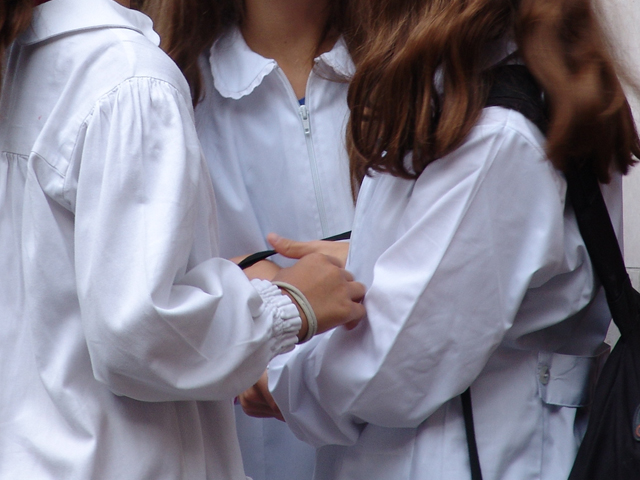
It’s mid-September, and it’s been back-to-school for the past week. As in every country in the world, where children go back to school in the Fall, here too the air seems to change with the shift in our collective energy. Expectations are high, tears flow easily, happiness is unbridled, at night we are bone-tired. The early morning hours are already charged with the coming and going of adult and small feet. School—scuola—is now the centerpiece of our lives. The sidewalks are populated with little persons in the bleached white (girls) and the sober black (boys) of required attire. These are the grembiuli, literally “aprons,” that the elementary school children must wear.

The grembiule in actual fact is a sort of loose over-garment, made of cotton, which either buttons or zips center-front. It features a white collar and pockets, and sleeves which are loosely gathered at the wrist. The boys’ models, black, are shorter, stopping just around the hips. Girls, instead, wear a dress-length version for which they can choose the trim around the color. Names are embroidered over the left-breast. C. Rossi, for example. Or Carlotta R. Or for the families with children in line to enter school, simply Rossi.

I found the grembiule horribly old-fashioned when I came here. But I have grown to love it. Italians are famous for their love of uniforms, and I suppose this is no exception, but it serves several real purposes, far beyond ornament, that you can’t help but admire. It allows our children to go to school with far less regard for how their clothing will be judged, protecting their independence of expression underneath the uniform, while expressing a sort of equality outside of it. All students are regarded as students, on an equal playing field. You go to school to learn, and your uniform expresses this purpose. You’re not on show. You’re not in a looks competition. You’re just—and this, in the end, is a tremendous and beautiful liberty—a child going to school. One can’t help but feel, that inside that white or black sheath, these children’s very right to be none other than a child is being protected.

Posted in ITALY, WHAT WE WEAR | Tagged , , , , , , | Leave a comment

Those tiny, ubiquitous details

One of the things I’ve said over and over about Milan, elsewhere, is that it’s not a typically beautiful Italian city. Not beautiful the way Rome is beautiful. Or Venice. There is a lot of beauty here, but it’s confined to certain areas, or it’s hidden inside courtyards you’ll never enter, or it has to be discovered in situ, cheek by jowl with the far less glamorous. But this act of discovery binds one that much more tightly to the city. Its jewels are hidden, and one who finds them feels richly rewarded.

Beyond that, as with any city (or person for that matter), one realizes that there are elements of beauty that grow out of character. Things that at first glance seem unimpressive grow to be beautiful to the observing eye.

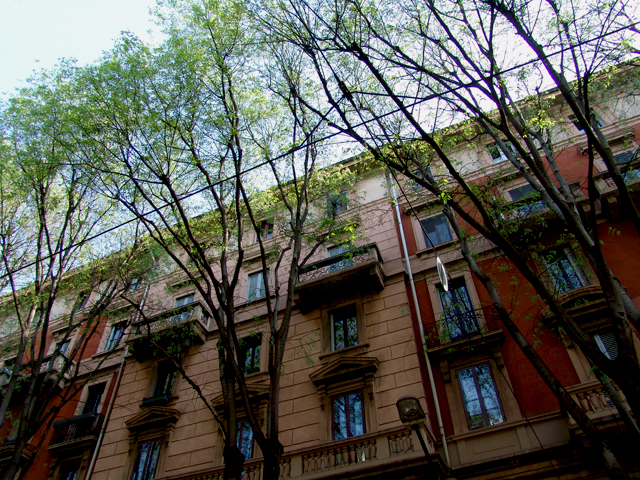
Italians often refer to Milan as a working city, and as such there is a functional honesty to Milan that is not in evidence in other Italian cities. Two of the features that have always embodied this aspect of Milan for me are its street lights and its clocks. I have always loved them, have always felt that like the eyes of a person, they were somehow the windows to the soul of this city. Hints that despite the ornate, the historic, the war-damaged, the sleekly and chicly modern, there is a beautiful and timeless functionality at the core—the heart—of it all.

Posted in AROUND US, ITALY | Tagged , , , | Leave a comment

The hood — Italian style

It’s called the “quartiere”—neighborhood—and, at least in the center of most Italian cities, it includes almost everything you need within walking / shouting distance. This is a truly beautiful thing, which has a profound influence on your life; i.e., you can live easily and comfortably without touching a car. But you can also carry out a multitude of entertaining and necessary transactions every single day with people you come to know and like and who know and like you (wow). Running errands is ecologically friendly and socially gratifying. Here is a schematic representation of the typical Italian neighborhood, including pharmacy, fresh fruit vendor, shoe repairman, butcher, baker salumeria (see previous post).

As neighborhoods aren’t necessarily clearly defined, but rather more like little overlapping and concentric circles, you are likely to have more than one of any of the above in your neighborhood. We have, for example, two bakers, two butchers, and two shoe repairmen. In the next chart, you’ll notice three bars. Bars everywhere. And by “bar” I don’t mean a place to get drunk. I mean a place, open throughout the day, where you can get coffees of all descriptions, aperitivi, hard liquor if you so desire, and most likely hot and cold simple meals (referred to as tavola calda or tavola fredda) at lunch. I forgot to include the all-important pizzeria. There are usually several in or just outside your circle, as well as other small mom-and-pop restaurants, where eating is really quite good.

If you’re lucky, as we are, you will also have hair dressers, banks, and cartolerie nearby. A cartoleria is my personal favorite as it contains everything pertaining to paper, paper supplies, school supplies and office supplies. Some of them allow browsing, but in most cases it pays to ask whoever is working there to help you find what you need. Like New York stores, Milanese stores tend to be small and packed from floor to rafters. Often what you need isn’t at your fingertips, but at someone else’s.

In both charts, you’ll notice the large spaces taken up by markets of various descriptions, parks (also known as public gardens), and schools. These entities tend to be generously scattered through the city in proximity to most neighborhoods. We have a small public garden near us which is the shared centerpiece of four schools, and a large city park which gives onto the historic district, complete with Duomo, castle, etc. These green spaces are true gathering grounds, and tend to be crowded with happy children (and perhaps less happy mothers, though not often) after schools let out in the afternoon.

As for the markets, they come in three varieties. The supermarket, which is a small, cozier version of the American behemoth. The mercato (all’aperto) referred to simply as il mercato, which is an outdoor affair which occurs on predetermined days of the week in each neighborhood. Here, you can buy produce (farm to market), fresh fish, cheeses, dried goods (nuts, dried fruits, salted cod, canned tuna, etc.), and often clothes, shoes and housewares as well. These are festive colorful affairs. The mercato rionale or comunale is an enclosed version of the mercato, open every day and including other specialty shops. These are delightful places to spend your money or just your time. Should you travel in Italy, put these places/experiences on your list. They will not disappoint.

Posted in AROUND US, ITALY | Tagged , , , , | Leave a comment

The salumeria

The pressures of modern life, even here, all but dictate that you can’t always have that perfect home-made meal on the table. (Sorry, Martha.) So you turn to your neighborhood lifeline: the salumeria. This is the place where—for more than you’d spend at the grocery store, but significantly less than you’d spend at a restaurant—you can buy deliciousness, ready for the plate. The better the salumeria, the higher the prices, but I dare say it’s worth it. Pasta dishes, lasagne, gnocchi alla romana, roasted chickens or beef, fish in a variety of presentations, fresh vegetable salads, cold and hot rice dishes, minestre (soups), cheeses, cold cuts or salumi (hence the name), steamed vegetables, desserts. You name it, they’ve got it. And beautifully prepared.

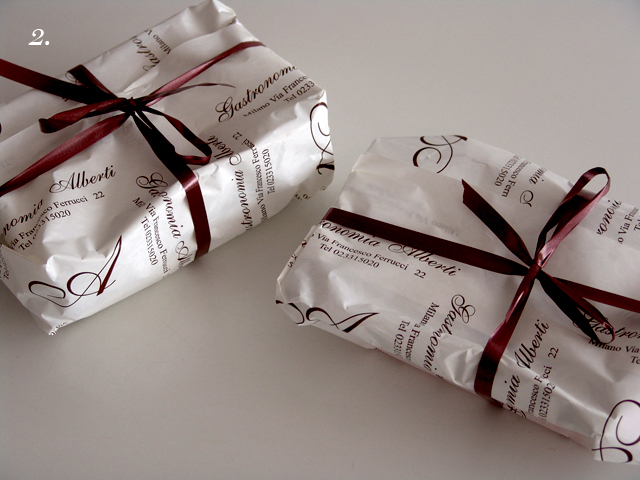
Most neighborhoods have their own. Ours is called Alberti, and it’s run by the family of the same name. The mother, in her late 60’s, sits at the cash register and reigns over the whole affair. An Italian steel magnolia, to be sure. Her adult children concern themselves with client service and management. They know your name. They know what you like. They know how many children you have, where they go to school, and how many dogs you park outside their door. But their familiarity with you never mucks up their professionalism. Only the adult daughter gives me the “tu” and that is because we are both mothers of girls who attended kindergarten at the same time. All the others give me the “lei” (the formal address), and they will do so until the end of our days. Of this I’m sure. Manners as impeccable as their white bags, wrappers and attention to detail.

1. Cold items are put in one bag. Hot items in another. 2. Items within the bag are hand-wrapped in their signature paper, and tied up with brown ribbon. 3. Anticipation. 4. In this case, thinly sliced prosciutto crudo, which I’ll serve with melon. Delish.

Posted in ITALY, SAVORING | Tagged , , , , , , , | 3 Comments

Zzzzzzzzz.

You: Why haven’t you blogged yet today? Me: Because I decided that after my amazing Sunday lunch there was nothing to do but indulge in that time-honored tradition of taking a little nap. You: Oh. Me: But that gives me an idea.

“Schiacciare un pisolino.”

To take a little nap.“Skyah-cha-ray oon pee-zoh-lee-no.” More or less. In fact, more less than more, as this phonetically leads you to a pronunciation with a decidedly American accent, but anyone would understand what you were trying to say.

It’s a funny expression because “schiacciare” means to squash or mash. “Pisolino” is the diminutive of “pisolo” which already means a brief sleep. So if your squeezing out a little little nap, you must really be taking the cattiest of naps. Under the radar. Little more than a wink. Nothing anyone else who isn’t also napping would really take notice of. Etc.

Anyway, ho schiacciato un pisolino and then I woke myself up with the aforementioned caffè scecherato (several posts ago) and that concludes this first episode of “They say.”

An afterthought: On the subject of sleep, I leave you with this from the beautiful book to sleep perchance to dream by brilliant Sicilian photographer Ferdinando Scianna.

Posted in ITALY, THEY SAY | 3 Comments

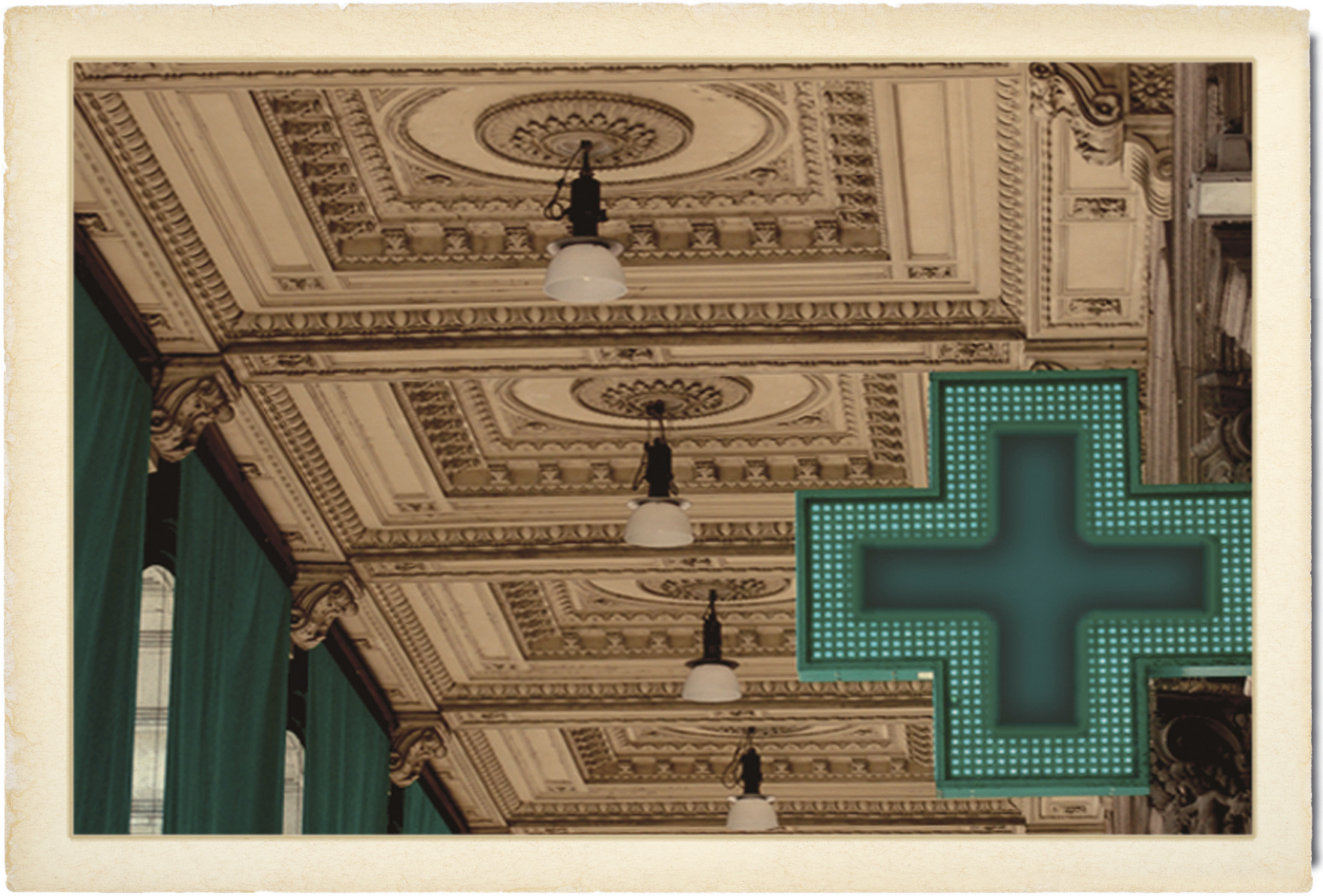
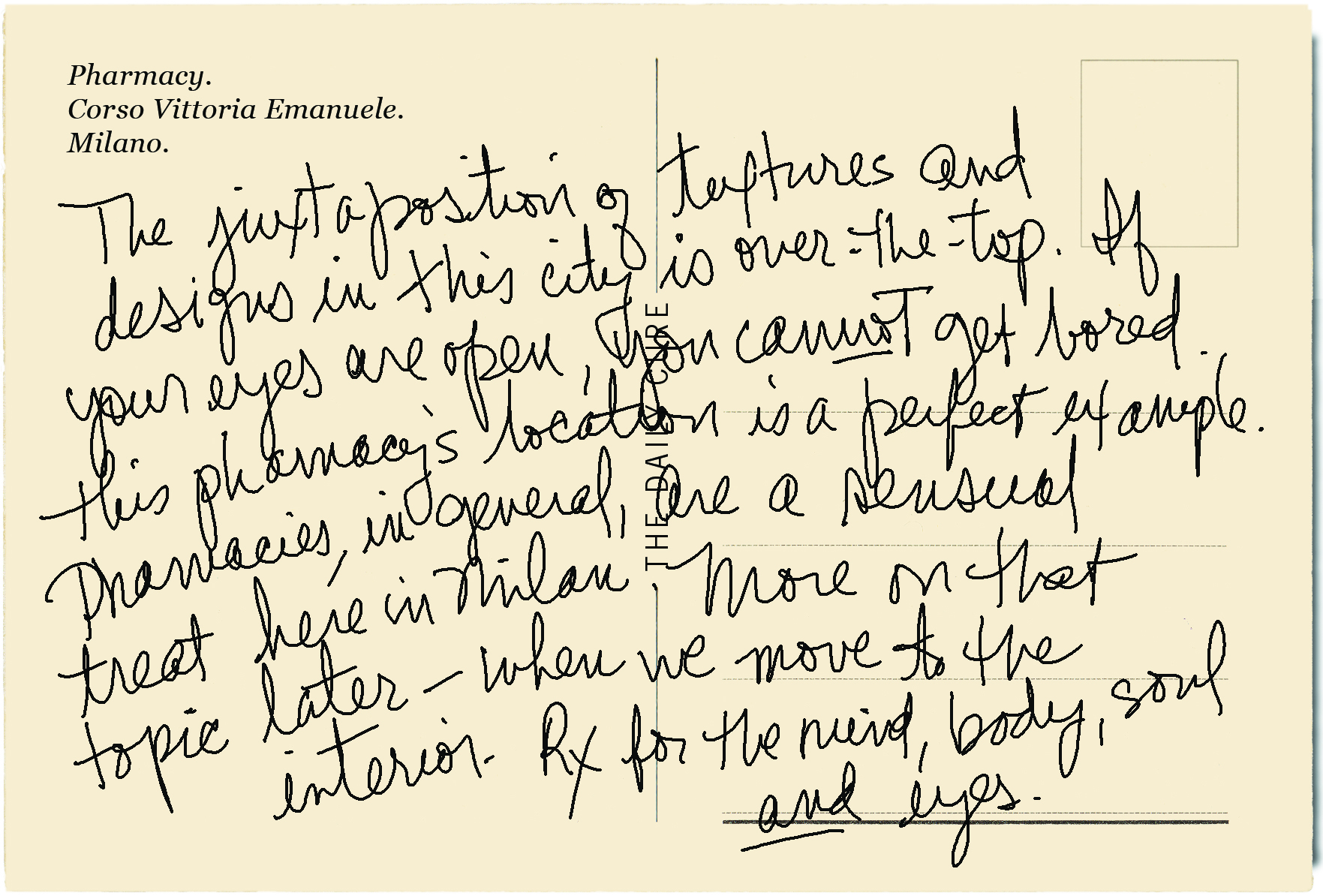
Postcard #2: Farmacia Milanese

[The juxtaposition of textures and designs in this city is over-the-top. If your eyes are open, you cannot get bored. This pharmacy’s location is a perfect example. Pharmacies, in general, are a sensual treat here in Milan. More on that topic later—when we move to the interior. Rx for the mind, body, soul and eyes.]

Posted in ITALY, POSTCARDS | Tagged , , , , , , | 4 Comments

The beautiful street

Growing up in the United States, it never dawned on me how significant the differences were in the “material realities” of the world’s myriad geographic locations. I knew of course that places looked different one from the other. (It doesn’t take many elementary school slide presentations to convince you of that.) But what I didn’t grasp was how profoundly different they felt.

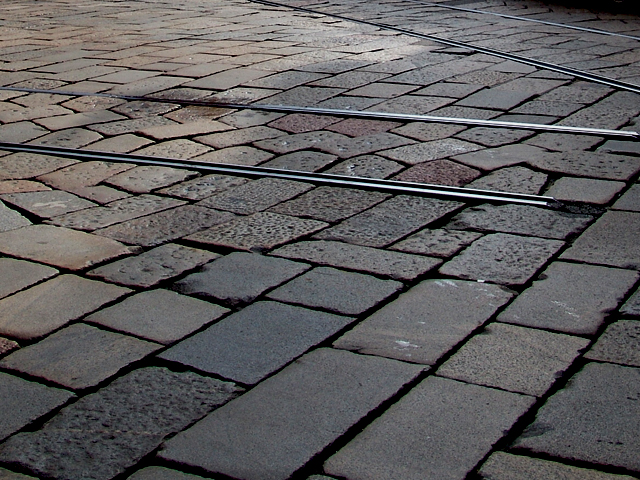
When you leave the United States for Europe, the differences in material realities are significant. More is made by hand. More is made by “materia prima;” i.e. a raw material used as the basis for production, and not itself processed. More is recycled. This is probably nowhere more noticeable than in many of the city streets. And Milan’s streets are no exception.

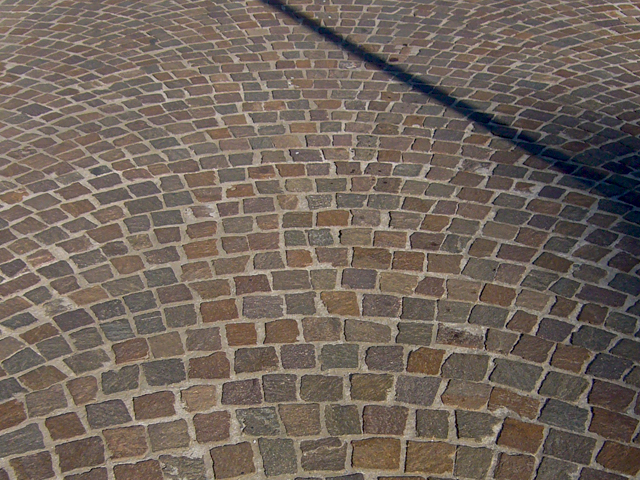
Many streets are still made with stone. I have seen entire blocks of cobbled streets torn up for reconstruction, their paving stones laid to the side like dominoes, each numbered on the bottom so that it can be put back in the proper position. There is a beautiful scalloped pattern used for streets and sidewalks, made from small blocks of vulcanic stone called sanpietrini (literally “little St. Peters”) as they are best known for their use in Saint Peter’s Square in Rome.

These methods take time and back-breaking work. But the results are exquisite. When I walk through this city, I walk on an ever-changing historical narrative, not on a modern, consistently skim-coated version of our human story. And as absurd as it may sound, this proximity to old and new human labor, to “materia prima,” gives me a grounding both literal and emotional that I would be loath to give up. The exact character of the stones and bricks which surround us can make us feel connected to or disconnected from our own human past. I personally do better in an environment where the surfaces are not treated superficially.

The world is short on beauty. And beauty softens the harshness of what so many people are forced to endure. If even the streets can be kept lovely, so should they be.

Posted in AROUND US, ITALY | Tagged , , , , , , , | 5 Comments

New feature: “Memories Of”

This post is the first in a new category of “The Daily {French-Italian} Cure” called “Memories Of.” These posts will be the contributions of others who have lived in or visited either Italy or France, and have a certain memory of what it was like. If you have a story to share, please let me know. For this first, beautiful memory, I thank Anna Harrison, translator of literature and film.

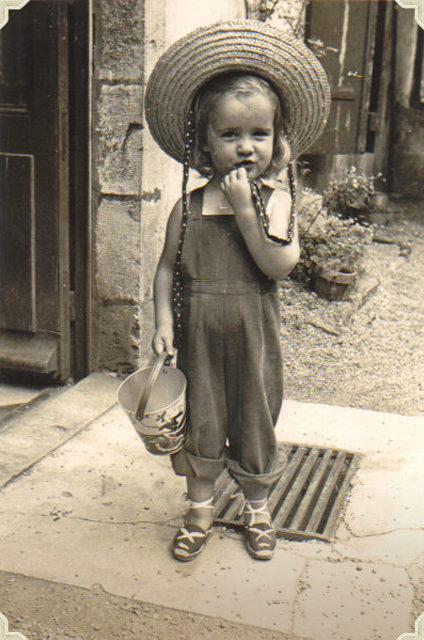
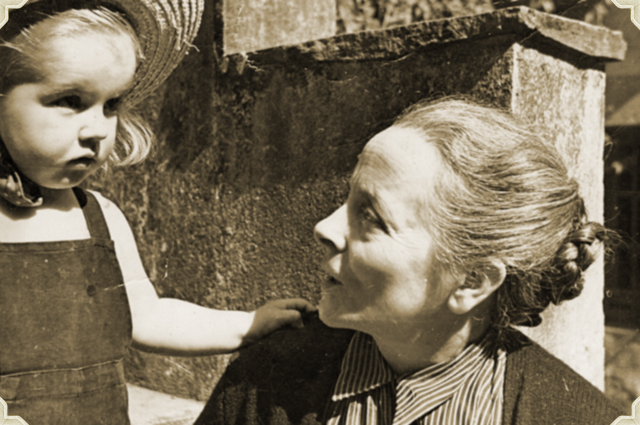
I REMEMBER living for the first five years of my life with my grandmother in Saint Jean de Luz. I remember playing in her sunny garden as she sewed at her window. The comfort of knowing she was there and running to show her a flower or a fascinating pebble or bug I had found. Hearing her acknowledge me and knowing she was always listening, always happy to hear what I had to say or show.

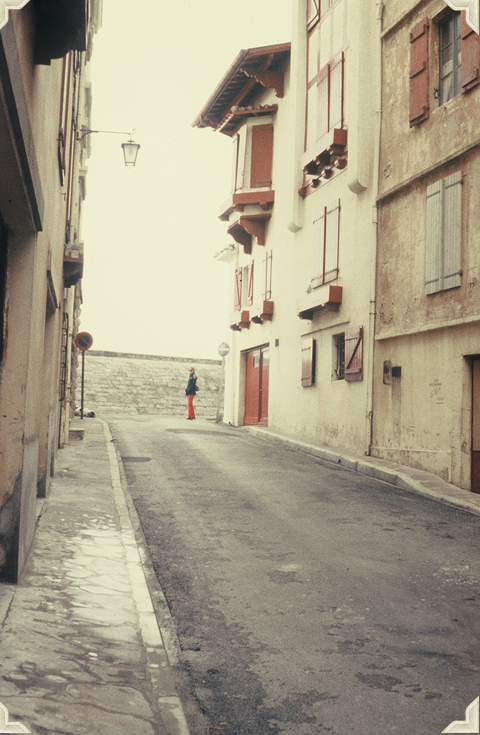
Saint Jean de Luz is a small town close to the Spanish border, just south of Biarritz. It is, in some ways, like many other villages and yet very much part of the Basque Country, or Euskadi, and therefore very distinct and proud of this distinction. The white houses with red trim are the norm (you see a few with dark green or “bleu luzien” trim, but usually it’s red) and the fishing boats, for this was a fishing port first and foremost, are emblematic of this area. The town was known most for having been the place where Louis XIV married the Spanish infanta, Marie-Thérèse. I had my first communion in that church.

What I remember most about St. Jean de Luz are the walks along the “promenade” that edged the beach, holding my grandmother’s hand, looking out over the beautiful bay with the Socoa Fort on the left and the Sainte-Barbe hillside to the right, and stopping to chat with acquaintances along the way. There were also the walks to the market and visits to the port, where the fresh fish were sold straight off the boat by the fishermen.

I remember the amazing aromas that greeted me as I walked down one particular street, leaving my grandmother’s house. There, one after the other, I passed tiny, ancient stores, each with a smell that embraced and lifted me and which I’ll never forget. First the coffee store, with a gigantic coffee-roasting machine right in the center of it, continuously turning and grinding away at the lovely coffee beans. Then, a candy store that smelled of warm caramel and licorice. Finally a boulangerie, and the fragrance of fresh-baked bread! What a joy for the senses. Not to mention that this street was a block from our house and just off the promenade to the beach.

Saint Jean de Luz has changed a lot now. Things have been modernized and built up and many many more tourists fill the town. But it’s still the place where my grandmother rests and will always be a beautiful cherished memory.

Posted in FRANCE, MEMORIES OF | Tagged , , , , | 2 Comments

My streetcar named “Desire”

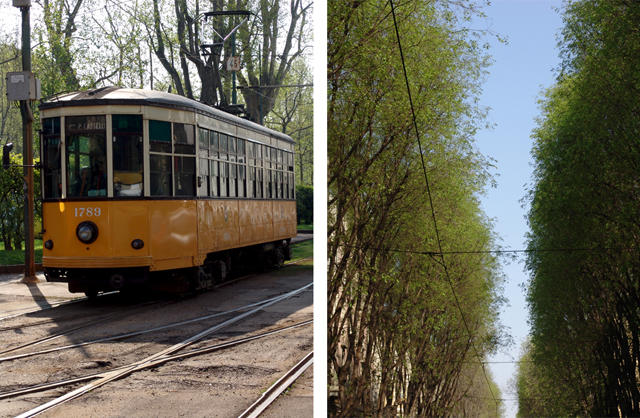
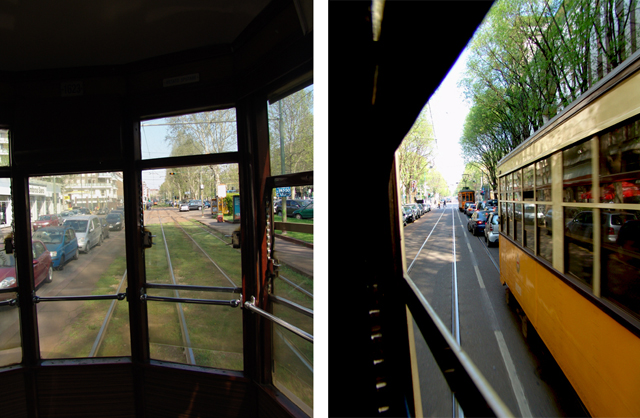
The time I came to Milan and knew it would be in my future, I leaned out the window of my room at the Hotel Spadari and looked down on the old orange trams coming straight toward the hotel, then turning sharply at a right angle, guided by their tracks and juiced by their overhead wires. I fell in love with them before I fell in love with the city, and before I fell in love with the person for whom I moved here.

From that day forward, the Milanese tram has held a special place in my heart and a peculiar power over my mood. This clunky, slow-moving vehicle with its herky- jerky way of progressing through the city quite simply makes me very, very happy. The old ones are the best ones. Orange or deep yellow, with wooden fold down stairs, side-benches, leather straps, and ornate glass light fixtures. The rear of the tram, designated for standing only, features a sort of “bay window” from which one can watch the city slipping away backwards, bending graceful overhead as it does so.

I’ve had amazing conversations on the tram, which I take from time to time with a friend or visiting relative, as they are the perfect backdrop to the natural start and stop of long, winding dialog. Especially the kind aimed at making up for years apart. The changes that occur outside the window perfectly punctuate the jumps from one topic to another. The grace of Vincenzo Monti, the vivacity of downtown (il Centro), the visual anarchy of the further-out neighborhoods, or the somber grey of some of Milan’s oldest facades. A physical journey perfectly adapted to an emotional one.

Final notes: 1. Tram tickets are available at tobacconists and news-stands. Upon entering the tram, they must be validated in the yellow box situated behind the conductor. 2. It is said that the San Francisco streetcar was originally based on the Milanese tram. 3. This post is dedicated to my brother and to Jean.

Posted in AROUND US, ITALY | Tagged , , , , | 1 Comment