Monday: Living the rhythm

Every culture has its own rhythms. We in the US have our 24/7, on the go-go. Spain has its siesta and late dinners. Italy has, well, Italy has Sunday’s decidedly off and—for better or worse—the weekly chiusura settimanale or “weekly closing.” This refers to the half business day a week (different from city to city) in which all or most food-related operations are open, but other commercial enterprises are closed. The second half of the day, the reverse is in effect. In Milan, the chiusura is on Monday. This allows workers outside the food industry to stock up for the week in the morning; and butchers, produce vendors, and bakers (those true heros of society) to run their errands in the afternoon.
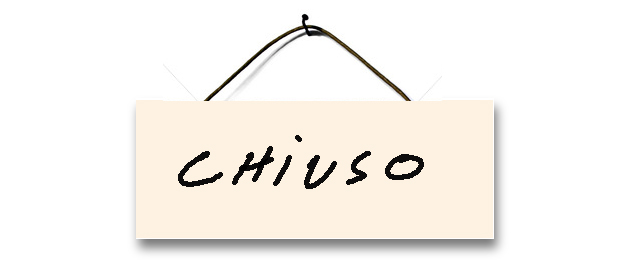
When I first moved to Milan I hated this. In fact, I didn’t at all like the general idea that I couldn’t have what I wanted whenever I wanted it. The desire for immediate gratification seemed part of my very DNA. But I now know that it was not. As with many features of Italian life which I found at first irritating, this too has won my heart. I like living according to a weekly rhythm that breathes and has its own heartbeat. That speeds and slows according to human needs. That serves a common good. That requires one to leave the busy-ness that otherwise consumes a day and to join the rest of humanity in the more sane activity of procuring bread, fresh borlotti beans, mozzarella or ground veal—whatever you need or want—engaging in one-on-one transactions and amicable conversation at every stop.

It’s important to be able to say you are not available. Sometimes you just have to be closed.

Myself included. Here it is, Monday morning, and I’m blogging instead of laying in the day’s supplies. So I leave you now, to go in search of sustenance and to take the pulse on Milan’s citizenry this rainy Monday morning, before it all comes to a close. And my DNA is very happy about that.

[If you liked this post, you might also enjoy “Tranquility.”]

Posted in ITALY, WHAT TO DO | Tagged , , , | 3 Comments

Sunday pizzata.

I know you saw this coming. Sooner or later, this blog was bound to be about pizza, that more or less inevitable comestible, if one is talking about the pleasures of Italy. So, I bow to predictability.

Once a weekend, we head out for lunch. It’s a sanity-preserving maneuver which I’m sure you understand. It’s rarely fancy; the point is to eat anywhere other than home. But it’s almost always, without exception, good. Very, very good. It may well be a cliché that Italian food is excellent, but it’s a cliché that deserves to exist and to be celebrated. Fresh ingredients. Minimal intrusion in the kitchen. What’s better than that?


Above: Mediterranea. Mozzarella. Salsa di pomodoro. Parmigiano Reggiano.
Below: Cetara. Escarole. Anchovy. Black olives. Whole wheat crust.

Today it was pizza. Fresh ingredients were lugged into the restaurant while we ate. Crates full of escarole, arugula, and pomodorini were hoisted over my daughter’s head. This particular pizzeria, Ciripizza, is owned by Italians from the region of Campania, proud of their culinary heritage and dedicated to the preservation of the correct methods of pizza-making. The staff hustles about the tiny restaurant politely, but with the reserve of some southern Italians, for this is, bizarrely, serious business. No one smiles broadly while intoning the Italian equivalent of “Enjoy” as the plate is placed under your nose. No one eagerly asks, “Is everything okay?” even as the first biteful is entering your mouth. No one says much of anything. The transactions are clean and unadorned. It’s assumed that the food speaks for itself. And this pizza doesn’t say, “Enjoy.” It sings opera lirica.

When the bill is delivered to the table, it arrives in a printed pizza, with a pledge—or is it a declaration?—printed on the back, signed by the owner. The earnestness of this gesture would set off alarm bells in most modern diners if the food itself weren’t so spectacularly illustrative of the point they are trying to make. There’s no room for cynicism, when your stomach is full of pure, unadulterated goodness.

[Ciripizza. Traditional, artisinal, Campana pizza. / Campania: The region of origin of the methods and prime materials for making pizza. / All of us — restaurateurs, producers, and consumers—have the duty of defending typical Italian products, respecting the origins from which they come. / Witness: (signature, Alfonso I-can’t-read-his-last-name / Seal: Pizza prepared and cooked in accordance with the traditional, Campano method / Map.]

Posted in ITALY, SAVORING | Tagged , , | 2 Comments

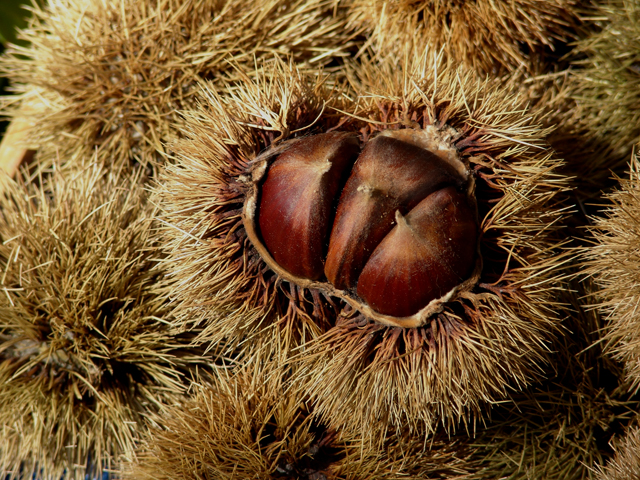
Chestnuts. Castagne. Caldarroste.

They’re here. Falling from the trees Spilling from boxes at the fruit and veg vendor. Bursting from their spiny skins. Bulging in the rough, burlap sacks that the street vendors buy in bulk. Each one a miniature work of art, a talisman. A sign of good luck, to put (and inevitably forget) in one’s pocket. Chestnuts—everywhere—chestnuts!

Though there are many recipes using chestnuts (castagne), the best way to enjoy them, if you are one who loves them, is undoubtedly roasted over a fire. Hence the regional nickname, caldarroste. Hot. Roasted.

[Speaking of “hot” and “roasted,” a quick story: One evening, shortly after moving to Milan, I was home alone, and our apartment began to fill with a sharp, burning smell. I checked the wires, light fixtures and kitchen appliances. The fire—for surely there was a fire—was not in our unit. I threw open windows to see if perhaps the smoky odor was seeping in from the outside. No, it was inside. Obviously someone had started a fire in their kitchen, so I ran downstairs to alert the doorman. I banged on his door, my heart racing (I wasn’t sure how to say any of this in Italian). He opened in his old man’s, tank-style undershirt, and looked at me with a mixture of concern and amusement. I waved my arms around doing my best imitation of a raging blaze, and pointing at my nose to communicate “Smells like fire.” He laughed, repeated the word “castagne” five or six times loudly to my language-deaf ears, and pointed to his own kitchen from which a healthy smoke was emerging. He and his wife were roasting chestnuts.]

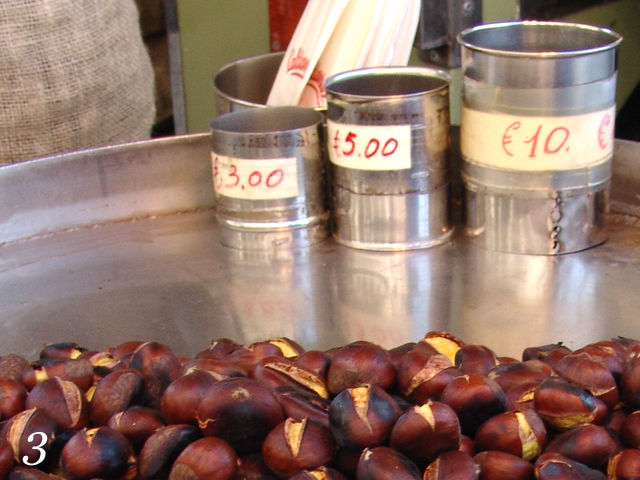
If you’re not equipped to do this at home, on the street is the way to go. 1. Find a vendor. You’re looking for a small truck, a 4- or 3-wheeled job, parked outside a school at day’s end, or along crowded piazze and outdoor walking malls.

2. Breathe deep. The odor is peculiarly pleasing: a nutty, singe-y, steamy smell (once you’ve learned to distinguish it from the common burning house). 3. Choose which size serving you’d like. Most vendors have three little tin cups, ranging from small to large, each marked with the associated price. He’ll measure out your chestnuts in the size of your choice, then deliver them to you in an ingenious white, paper tube, folded in the middle so that it holds the caldarroste on one side, and your discarded shells, as they accumulate, in the other.

And last, but not least, be thankful that Autumn has returned, and with it, those warm comforts that sustain us even as colder winds are blowing into town.


Posted in IN SEASON, ITALY, SAVORING | 2 Comments

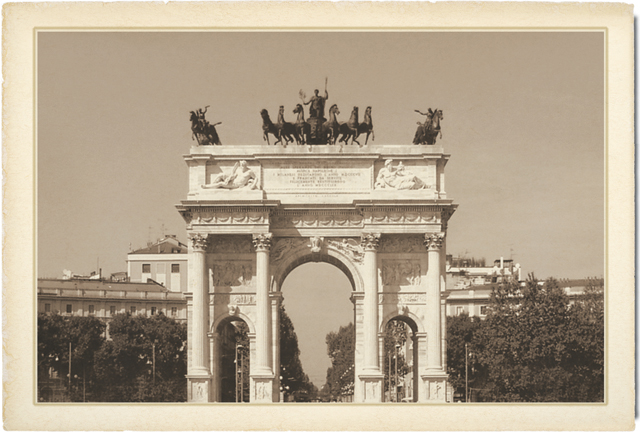
Postcard #3: Arco Della Pace

[Most postcards that you find at the tobacconists are old, dusty, sepia things that depict the city’s monuments from a distance. They are cool, funky artifacts and they definitely capture that stately remove that—over time—becomes invisibility. I wanted to make a postcard of this monument—which I see every day—that let you stand under it too. Just look at that marble!! Nothing invisible about that.]


[You might also enjoy my last Italian postcard.]

Posted in ITALY, POSTCARDS | Tagged , , , , | 2 Comments

Milan color story #1

Ochres and terracottas.

These colors seduce my heart in the first days of Autumn. Perhaps because of the bittersweet interplay between their inherent warmth and the weakening power of the sun. (We cling to warmth wherever we can find it, don’t we?) Perhaps because they seem to spring from the ancient earth itself. Or perhaps because they are still, to my eternally American eyes, the colors of an ongoing adventure deeper and deeper into this older world that—for me—is perpetually new.

These colors spring from minerals, rocks, dirt. From oxides and imperfections in stone. When you see a yellow wall, you don’t just see a blanket of color. You see pigment, ground into paste. There is an obstinate depth to the colors that speaks of process, history. They are not the clean, crisp colors of modern times, but the dense, opaque ones of years past. They wear dirt well, sometimes becoming even more beautiful with the ravages of time, climate, and pollution.


Italians love these colors. They speak directly to their hearts, to their love of sun and the earth that is under their feet. Their earth. Their home. And I have grown to love them too, I who avoided yellow like the plague, who couldn’t see terracotta (literally “baked earth”) with any sort of understanding whatsoever. Now, they are good friends to me, these colors. Winter is coming. Milan’s predominant palette (the grays) will reign supreme. And these warm beauties, like broad brush strokes deftly left here and there by a cunning painter, will lift our spirits come heavier skies.


[You might enjoy comparing this to “The importance of blue.”]

Posted in AROUND US, COLOR, ITALY | Tagged , , , , , , | 8 Comments

Can I come in?

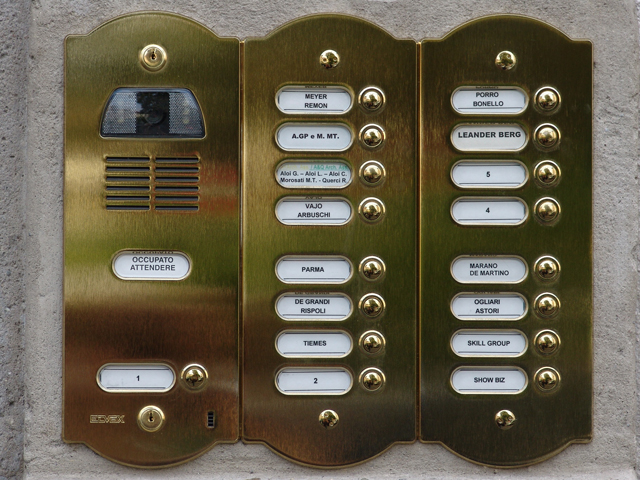
It’s a memory: I don’t live in Milan yet. But I’m visiting the city with one of my best friends, Keith. We’ve had a couple cocktails too many, and we’re roaming the swanky Via Senato aimlessly going I-don’t-remember-where. Keith’s eye, ever on the lookout for a dramatic catalyst, is caught by the bling of a brass installation next to an imposing double wooden door fit for a castle. It’s the building’s “citofono” or buzzer—that singular instrument of passage given or passage denied which separates you from any building’s residents after the doorman’s gone off duty.

Keith reads through the names until he finds one he likes. “Ah, Versace! Yes, these are old friends of mine!” Then he buzzes and fakes the following conversation: “I’m here for my fitting! Let me up at once!” We laugh like the drunk idiots we are, then cruise to the next door, where we pick another name, buzz another buzzer, spin another tale.

I rarely confront a citofono without remembering that night, and how, in many ways it was the beginning of my own story here—my own real story, where I did indeed gain access, eventually starting a life on the other side of the buzzer.

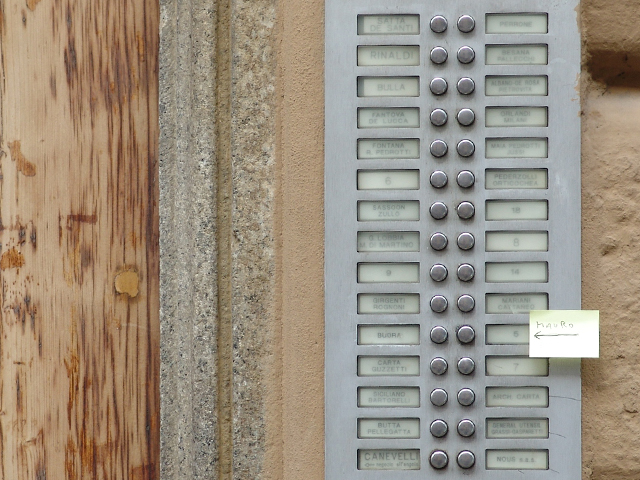
While many Milanese apartment buildings—palazzi—have doormen, many others do not. But they all have the the citofono. Some are old-fashioned and ornate, adorning equally old and ornate buildings like bejeweled lapel pins. Others are modern, hi-tech affairs. Others are gray and sad with names missing, indicators of empty units or persons desperately in need of not being found. Some have video cameras that “see” you. Others require that you use only your voice to identify yourself.

In any case, they put you on a tiny stage for one. You buzz, you wait, and when you hear the voice on the other end (Sì?), you perform. It’s quick and usually painless. If you’re responding to an invitation, sometimes a simple Sono io will suffice. “It’s me.” If not, you may be required to go into more depth. Your name. Whose parent or child or second cousin you are. Why you’re there. What you’re delivering. And then, usually, there it is: that heavy, reassuring click—the disengagement of moving metal parts—inside the door which declares that you have successfully gained entry. And then, yes then, you are no longer on the outside, but on the inside. And things look quite a bit different there.

But I’m not sure that being on the inside is quite as perfect as staying on the outside, looking at the names, knowing that every one represents a life or a web of interwoven lives—the stuff of human drama unfolding even as you stand there imagining it. In that instant before you yourself cross the barrier, not only are the drama and its players on the other side up to your own imagination, but—as my friend Keith demonstrated—so are you. “Tell Donatella I’ve got places to go and people to see, and I can’t be kept waiting another minute…”

Posted in AROUND US, ITALY | Tagged , , , , | 2 Comments

Tranquility

I have spent much of this blog writing about beautiful things, beautiful features, emphasizing the role of the editorial eye in maintaining a sense of well-being. But the truth about Italy is that its most beautiful possessions are in the soul of the people.

These people are innately kind, for the most part. They care how each other feel. And there are words, commonly used, that transmit this concern for the emotional well being of others. The most beautiful to me, in its male and female form, is—

Tranquillo. Tranquilla.

You hear this all the time from family members, from friends and even from Italians in passing who seem to understand that perhaps it’s not your best day, you’re having an “off” moment. A cashier who knows you need an extra second to count out the exact change she’s asked you for, will say it. “Tranquilla, signora.” Take your time. The person behind you waiting to board the old tram who realizes you’re having trouble navigating the steep stairs with your shopping bags or your children or a disobedient coattail.

Just that simple, poetic adjective, giving you permission to breathe deeply and take the time you need. I’ll repeat it for good measure, for you, so that you too can stop and take your time. Leave this for a moment. Get a coffee, or a tea. Breathe. Stare into space or between the lines.

Tranquilla. Tranquillo.

Of course the beauty of this word to my ear is a trick of adaptation, for the literal translation in English is “tranquil,” a word rarely used outside literary contexts to describe the human state, but laden with poetic, almost spiritual significance. But in Italy, the notion of tranquility is wide-spread and very, very important so that this word, this very notion, is a part of the daily vernacular. It’s a sought-after way to feel. A common goal. Something that people wish for others, even strangers.

The full expression is the adjective preceded by the infinitive stare which means “to be” as in “to remain.” It’s the state of being expressed in these English constructions: “to be good,” “to stay still,” “to stay calm.” Stare tranquilli.

To a male friend, I would say, “Stai tranquillo.” Or just, “Tranquillo.” To a sister, “Stai tranquilla” shortened to “Tranquilla.” To an older woman, “Stia tranquilla. Tranquilla, signora.”

Just writing it makes my heart rate slow.

It’s a concept that’s shared in all moments of life. In the small rushed ones as well as in the momentous ones. It’s as well suited to the trivial stresses as it is to the plate-shifting upheavals—those wrenching chapter beginnings and endings—that mark life’s passage. It can be accompanied by a nod of understanding, a glance off to the side (as if staring directly at you would just contribute to your anxiety), or a warm hand placed lightly—humanely—on your arm.

There is time here. Time to breathe. Time to love. Time to feel what you need to feel. Time to shake it off. Time to get used to the first day of school or the first day of spring or the first day of life without a person you loved. There is always time. So you take it. And this is where you find your tranquility which you so deserve, just by nature of being alive.

Posted in ITALY, THEY SAY | Tagged , , , | 4 Comments

p.s. Easy rider rentals

As mentioned in my previous post, bicycles are available throughout Milan for easy rental. I’d said they were free. And while this is completely and utterly in error, it is true that they are priced very reasonably. Please see the BikeMi site for further, correct information.

You may be wondering why I even mention this. If this site is dedicated to all the small details about Italy and France that make me happy on a daily basis, why on earth would I be mentioning bikes that I’ll never be renting. (This isn’t a tourist blog, after all.)

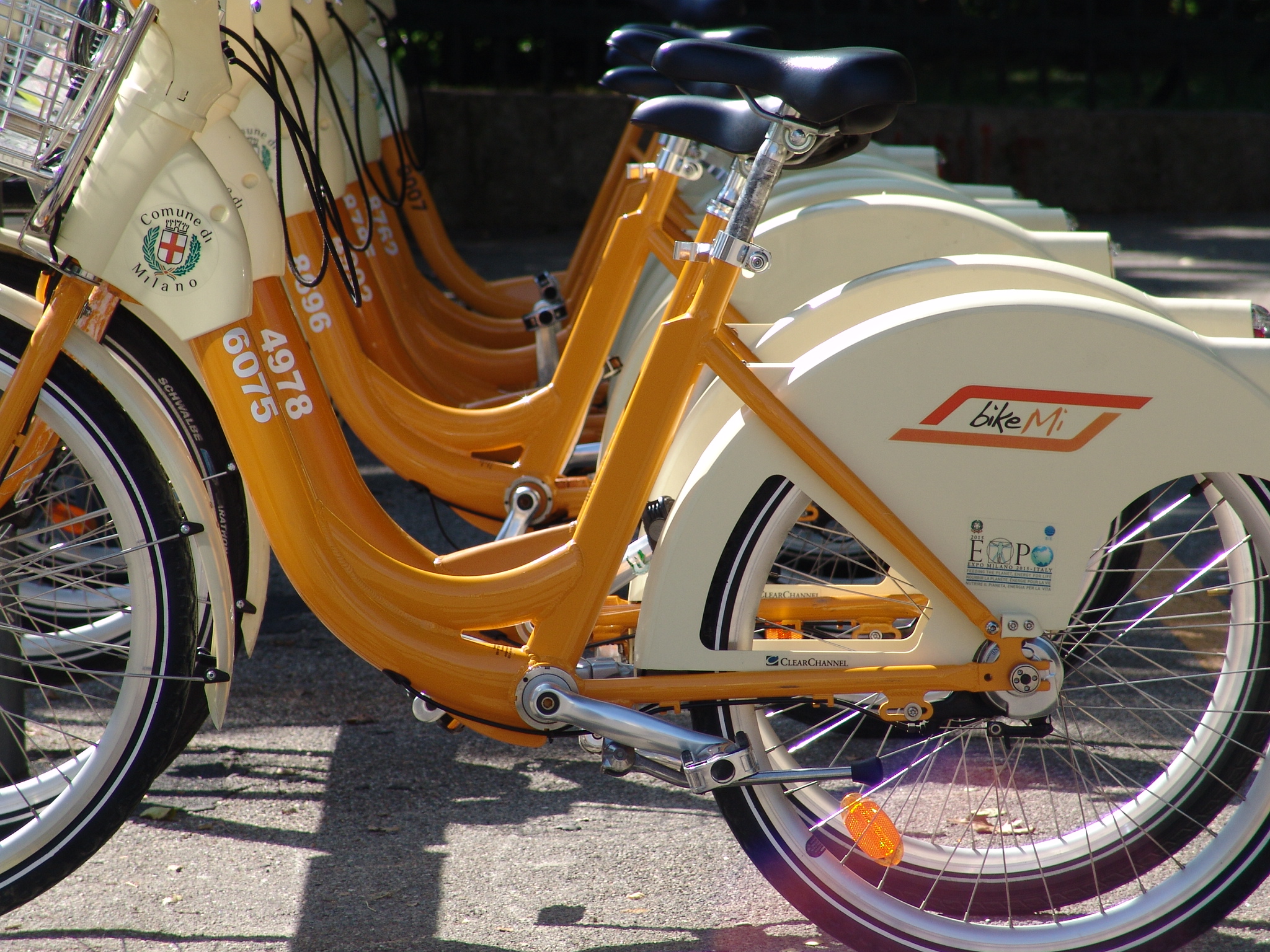
I mention it merely because sometimes it’s what something represents that means the most to you. I’m thrilled to know that these bicycles are simply there. I’m thankful to live in a city that has this mentality, that thinks an investment of 1000 euros a bike is money well spent. I’m peculiarly proud when I see other “converts” pedaling their way through this city, getting to know it from two wheels the way I am. And I’m relieved that every empty rack represents another person who isn’t using a car. Besides that, I love the particular yellows that they are. That old, pale yellow teamed with ochre, reminiscent of this city’s past and the old trams which circulated the city once upon a time.

Posted in ITALY, WHAT TO DO | Tagged , , , | Leave a comment

Easy riders, easy does it, Milanese style

One of my greatest joys in adult life is doing what I did as a ten year old—ride a bike. And I do it every day. It’s the preferred mode of transportation around here, as far as I can see. Traffic is dense, parking is virtually impossible. Ergo: Drive a car? Why?

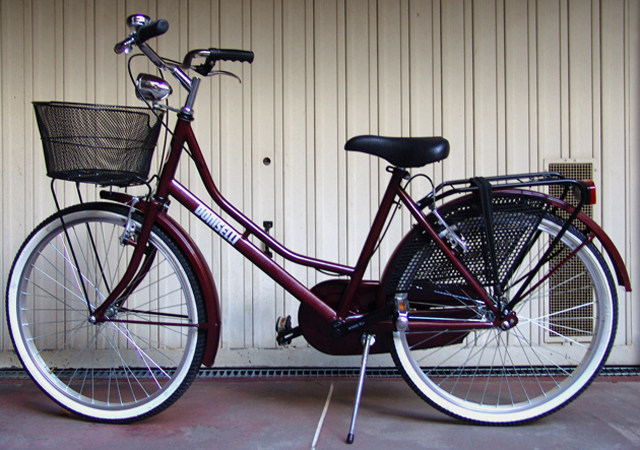
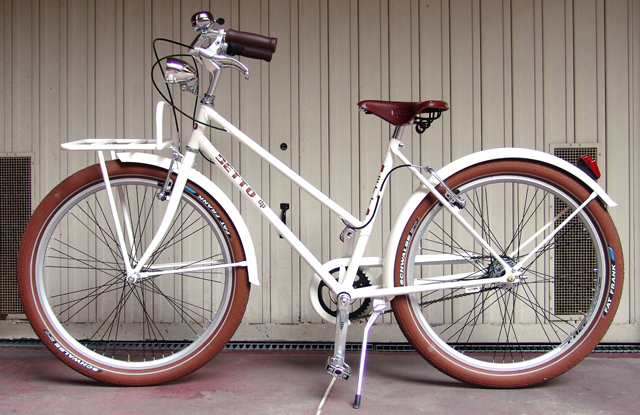
Additionally, the scale and topography of Milan are perfect for getting around on two wheels. And then there are the aesthetics of the vehicles themselves. I’m not knocking the bikes you get at the large sporting centers. I’ve had my share of transportation made in China. But there’s something deeply appealing about a velocipede that didn’t roll off the assembly line, one that adheres to a certain design sensibility, one that fits you like a well-tailored Milanese suit. Milan has its share of boutique bicycle manufacturers; in our household, we are enjoying the wares of two of them: Doniselli and Detto Pietro. It’s not my desire to crow about brands in this weblog, but these people deserve the credit they are due for their art as well as their craft.

While both makers churn out a full line of all types of biciclette, we tend to chose the “easy rider” varieties, the Dutch versions. And Doniselli does this bike beautifully. Ageless, gracefully proportioned. Just a perfect bike for cruising around town, in pants or skirts, heels or ballerina flats. Functional, fashionable. Flawless.

This Detto Pietro is a jazzier take on the same aesthetic, with fatter tubing and tires, luxurious leather and chrome appointments, and a front mounted basket rack. This bike “sits” like a Harley or an easy chair. No slumping forward over your handlebars. No dull ache between the shoulder blades. No stress. No bother. And equipped with a Shimano internal gear-shift, almost no sweat. Fashion accessory? Undoubtedly.

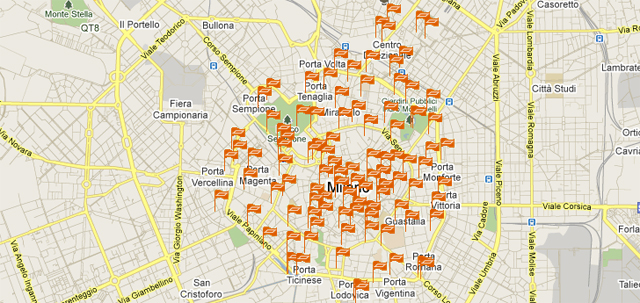
If you’re visiting Milan and lugging a bike back in the luggage wrack isn’t on your agenda, the Comune di Milano “rents” bikes for free. They are located around the city, near the major tourist destinations and train stations. If you see a row of light orange-yellow bikes, you’ve spotted them. Take one, and go!

Posted in ITALY, WHAT TO DO | Tagged , , , , , | 3 Comments

In season: Uva Americana

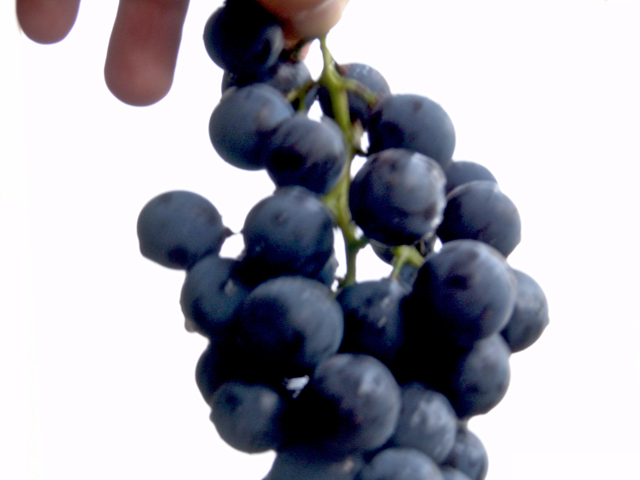
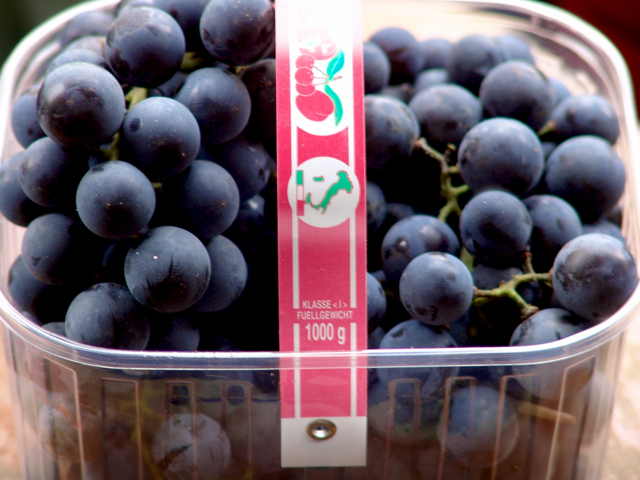
It’s the time of the vendemmia or grape harvest, and in all the markets now you can find this irresistibly, seductive fruit. A pulp, sweet at first, sour if you bite into it, which pops out of a rather thick tart skin. Delicious, addictive. Nature’s “SweeTart.” This is the Uva Americana or “American Grape,” also known in Italy as Uva Fragola or “Fragolino” because of its strawberry overtones. This vine originating in North America survives well in Italy’s northern climes. And thank God it does, because it is one of September’s greatest sensual pleasures. If the taste doesn’t overwhelm your senses, its appearance will. Deep purple, the color of sensuality itself, dusted with what appears to be a permanent morning mist. Don’t be shy when buying them. A large “vaschetta” (or little tubful) will disappear before you know it.

Posted in IN SEASON, ITALY | Tagged , , , , , | Leave a comment