The staff of Italian life

A quick note to my readers: As you may have noticed, I’ve not been around much in the last few months, even announcing once or twice that I was “back” when in reality I wasn’t. That was wishful thinking blogging on my behalf. Suffice it to say that my family has been through a longish health ordeal which has ended happily. (Enough said.) I can’t promise that the Daily Cure will be—as it once was—daily. But I am, finally, able to turn my attention once again toward those small things in life that give so much pleasure. In fact, fully appreciating them seems a fitting way to give thanks.

It seems a cliché. But it’s true: pasta is at the center of life here right next to family and conversation-as-an-art-form. And it happens that whether you choose fresh pasta (pasta fresca) or dry, packaged pasta (pasta asciutta) is not so much a matter of economy or culinary sophistication as it is a matter of taste. They are different. They absorb different sauces differently, as do different pasta shapes. And they exalt* different ingredients differently. In the mood for white truffle? Shave it over a fresh egg pasta, tossed lightly in butter. More in the mood for olio, aglio, peperoncino? My preference would be dry spaghetti.

Inside the dry pasta category, the Italian market is saturated with different brands, but two giants dominate the field: Barilla and De Cecco. Barilla, known and available the world-over, is low on my personal list of favorites. De Cecco, omnipresent in Italy and available in some U.S. supermarkets the last time I shopped there, is much higher. Why? Because of the way they cook. Barilla absorbs water over the cooking time (tempo di cottura) such that when the exterior is just right, the interior is al dente to the point of crackling. When the interior is right, the exterior is soggy. I find that De Cecco allows for a more even absorption of water giving one, in the end, a degree of al dente consistent through the thickness of the pasta.

Detto quello—that said—there are two smaller brands on the march, which have won my heart and stomach: Garofalo and Rummo.

Garofalo has found the balance between what appears to be an artisanal product and a sophisticated graphic approach to its packaging and marketing that I find difficult to resist. When you like a cellophane wrapper as much empty as you do full because of the typography it wears, that tells you something about the power of the designer. But we mustn’t fault Garofalo for realizing that pasta, tradition, and goodness in the plate are sexy. They’ve let us have all three with an excellent product adorned by a cool, black script. And it’s not, in this case, smoke and mirrors. It’s families-old tradition swathed in modern sensitivity.

Not to be outdone, Rummo is claiming its place too. Quietly, confidently, with perhaps a more serious outward link to the way things have always been done in Benevento, outside Naples. Five generations of Rummo’s have worked the wheat that grows in the fertile ground of the Sannio and Calore Rivers. And they’ve married the family name to their signature process, Lenta Lavorazione (slow processing). This term has to do primarily with the extended kneading time of the pasta which exalts (there’s that word again) the inherent qualities of the wheat, but which speaks also to an underlying “slow” philosophy in food, life and all things worth savoring.

Rummo’s website features lovely, clean expanses of white with simple displays of the 96 shapes of pasta they produce—each named and numbered. All the pasta companies name and number their products, but there is something about the purity of Rummo’s presentation that says a thousand times “love.” These people love pasta. They respect it. They feel uniquely privileged to produce it.

Rummo’s seriousness appeals to me. But I have to applaud the well-placed wit of Garofalo: Instead of printing a bland cooking time on the Italian package, they suggest the number of minutes required for ‘a figliata, which more or less means “birth.” Spaghetti and its extended family aren’t cooked, my friends. They are brought to light. Born. Given life. And in turn, they do the same for us. One fork-full at a time.

*Exalt: Italians love to use this word when discussing food. To my ear it has an archaic, Biblical ring to it. But I’ve grown to love it, as good traditional food requires our deepest reverence and the most rigorous mining of our poetic resources to do it justice.

[If you enjoyed this post, you might also like “Salt” in which it is revealed that one should never forget to put adequate sea salt in the pasta water!]
Posted in ITALY, SAVORING | Tagged , , , , , , | 11 Comments

The trick to being prime minister

Berlusconi is in the crosshairs again. This time for cavorting with young escorts, even though, as he said in his own defense, it was in a strictly amicable and—here’s the clincher—”elegant” way. Berlusconi? Elegant? Will oxymoron’s never cease?

As the papers are gleefully dissecting his latest social gaffs and political shortfalls, they can’t help but notice and dedicate precious column inches to the fact that Silvio seems to have a problem with growing old gracefully. We knew that his hair had a certain painted-on quality, but did we realize too that he was using an ultra-light Chanel moisturizing cream, a “French” foundation (brand not mentioned), and a bit of bronzer or cipria dorata?

According to the Corriere della Sera (“L’estetica di Berlusconi,” September 13, 2011), il Cavaliere, as Berlusconi is called, is convinced, of “the moral value of retouching” by which is intended plastic surgery. In a weak attempt at irony, he claimed that he’d wanted to resist “lifting” but that his then wife Veronica had insisted on an “aggiustatina.” (You have to love the understatement of the Italian diminutive in cases such as this: an eensy-weensy adjustment.)

Berlusconi is quoted as saying: “I admire women who undergo these operations. They are even more beautiful because they’ve earned their beauty.” And, “Every morning in front of the mirror, I look at myself and repeat, ‘I like myself. I like myself. I like myself.’ Remember, if one likes one’s self, others will like him too!”

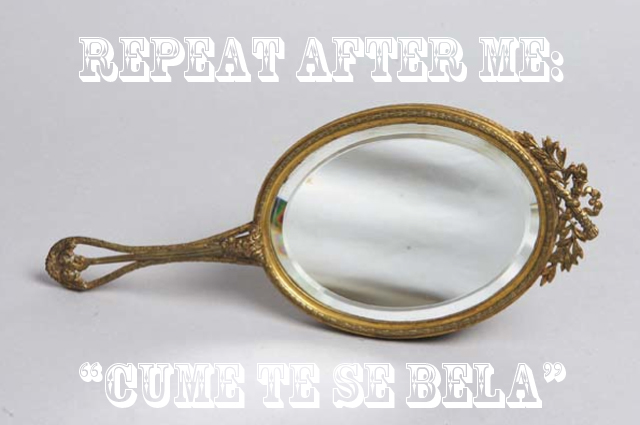
Supposedly he comes by all this self-“esteem” genetically. His aunt Marina, now in her 80’s, is said to have stood in front of a mirror in a flowered dress, paying herself compliments when no one else was inclined to do so: “Marina cume te se bela!” Strong dialect which probably needs no translation. Marina, how beautiful you are!

I agree that self esteem goes along way, but gosh, I never knew that closer attention to my make-up might actually sway great power in my general direction. But then again, I shouldn’t overlook the truth revealed by the Italian language itself on this front:

Trucco is “make-up” in Italian. But it’s also “trick.”

Obviously, a little trickery—or is that just a strategic swipe of eye liner?— can go a long, long way. So, Ladies, Gentlemen—make yourselves up! And may the world be none the wiser as you take it by storm.

[NOTE: This post was written by a woman without a particle of make-up on her face, but if the Prime Minister Kit works for you, she is really happy and suggests that you might also like the Laundry Hanging Kit to put the finishing touches on your “Italian-ness.”]

Posted in ITALY, WHAT TO DO | Tagged , , , , , , | 4 Comments

Back-ish

What has happened to “The Daily Cure”? you might ask—although you probably don’t. All our lives swirl and smolder, occupying our attention with emergency and splendor, such that the musings of a blogger are likely the least of our concern.

I myself have wondered what happened to “The Daily Cure” even though I am its creator. How could I so feverishly write a blog for a period of time roughly equal to human gestation, only to one summer lose the thread completely?

Ah such is creativity. It comes, it goes. It’s over-sensitive and suffers if Life applies too much pressure. And that’s exactly what my life has been doing—orchestrating difficulties large and small that have sapped my energy and stolen (temporarily) my will to write and photograph.

The Daily Cures of my months in France were still present, and I tried to soak them up in a catch-as-catch-can way. I just didn’t have the spare time or energy to share them. And that lack of available time and mental space was the main problem—in fact, the defining feature—of this summer. Things were hectic, scary, administratively heavy, organizationally complicated, and personally draining.

I am, however, happy to say that many of the roadblocks have been sorted out or are very nearly sorted out, and I am looking forward to a “back to school” season that may well be more restful than the vacation that preceded it. I have a couple more significant bumps to ride over, around and/or through. And when I’ve done that, I hope to get back to you with some degree of regularity.

To those of you who have inquired about my well-being: Thank you so much.

9 Comments

Confession #6: The air we breathe

You can’t see it, of course, but air is one of the defining ingredients of a place. It can inspire as much longing or nostalgia as a certain type of bread or the view from a window in a room that used to be yours and no one else’s.

I remember with a pang that can only be called “heartache,” even though my heart is fine, flying back to Atlanta after I’d moved to Amsterdam, and exiting the airport into an obstinate wall of humidity. I wept, on the spot: I was getting close to “home.” Driving to Chattanooga—the town where I was born—in my rental car, the humidity grew. Approaching the initial curves that take you up Signal Mountain, I opened the windows and let the hot moisture in. A pudding of air, too dense to breathe. But I sucked it in joyfully. Tears again. Now I was all the way home.

I don’t love humidity; in fact I hate it. But that air was the air I grew up on, was nurtured on. It fed the cells of my brain and my heart and my guts. I miss it, the way one misses—in the most profound existential sense—the womb. Breathing that air even though I would no longer want to live in that place is the very essence of “going back.”

Since then, I have breathed the air of various adopted homes. The air of Virginia (very similar). The air of Oregon. The air of Amsterdam. Milan, Italy. And Burgundy, France. I have a complex relationship with all of them. The air of Milan, heavy like that of Chattanooga, is even weightier: it contains within it all the challenges of adulthood, second chances, leaps of faith and abiding love. Mountains bound the plain on which the city lies so that air moves in and out of it unwillingly. Gray skies tend to sulk and stay, loiter and linger. This is air that will eventually make a philosopher out of you, regardless of how frivolous you may be. You have no choice but to come to intellectual terms with “the way things are.”

Burgundy air, like Oregon air, is somehow fresh and alive. Moods shift. Change is afoot. Paradoxes exist easily. We are small under the sky that contains all this air and at its mercy, but this reality is a liberation. It’s comforting to know that you are just a speck on a cloud-raked, rain-washed, sun-drenched stage. The moisture isn’t cloying, it’s cleansing. Wet/dry. Cold/hot. Sun/rain. The grapes love it, and so do I. I’m a moody person, myself (apologies to the patient people who love me), and these shifts in the air around me suit me fine.

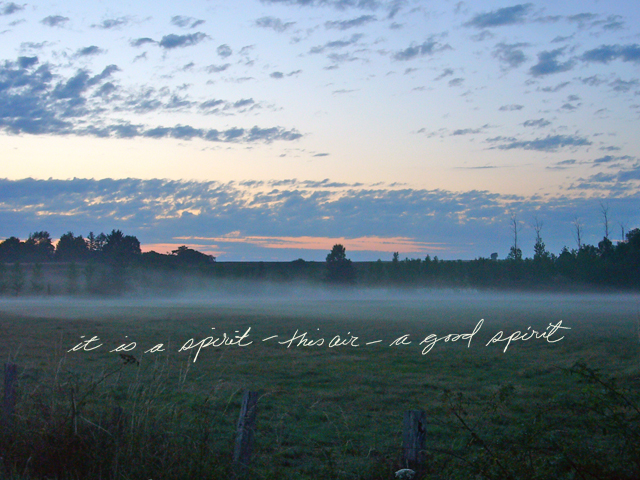
Early in the morning here, as the first light of day creeps into the sky, the air moves into the window and around the room like the chilly ghost of a cat. It wafts and insinuates, curving around your exposed arm and the nape of your neck—a cool current of life or the life-after. Or maybe it’s the life that came before, from whence we came. Who knows? It is a spirit, this air. A good spirit. It settles unsettling dreams, calms nerves, refreshes brain cells and sends you back to sleep—back to one more wordless, infantile vision—before it is really time to face another day on this Earth.

Which air is mine? Which do I claim? I can’t answer. It is comfort, in my confusion, to know that around this spinning ball we call home, they all mix and mingle and become one.

[If you enjoyed this post, you might enjoy “The all important far nienteas well.]

Posted in AROUND US, FRANCE | Tagged , , , , , , | 4 Comments

Let there be light, Part 2

Shortly after my last post.
9:30 p.m.
The light come on—
a glow warm as hope in the doubt-ridden night.

And that brings to mind another poem I love:

Hope is the Thing with Feathers

Hope is the thing with feathers
That perches in the soul,
And sings the tune without the words,
And never stops at all,

And sweetest in the gale is heard;
And sore must be the storm
That could abash the little bird
That kept so many warm.

I’ve heard it in the chilliest land
And on the strangest sea;
Yet, never, in extremity,
It asked a crumb of me.

—Emily Dickinson

Posted in AROUND US, FRANCE | Tagged , , , , , | 1 Comment

Let there be light

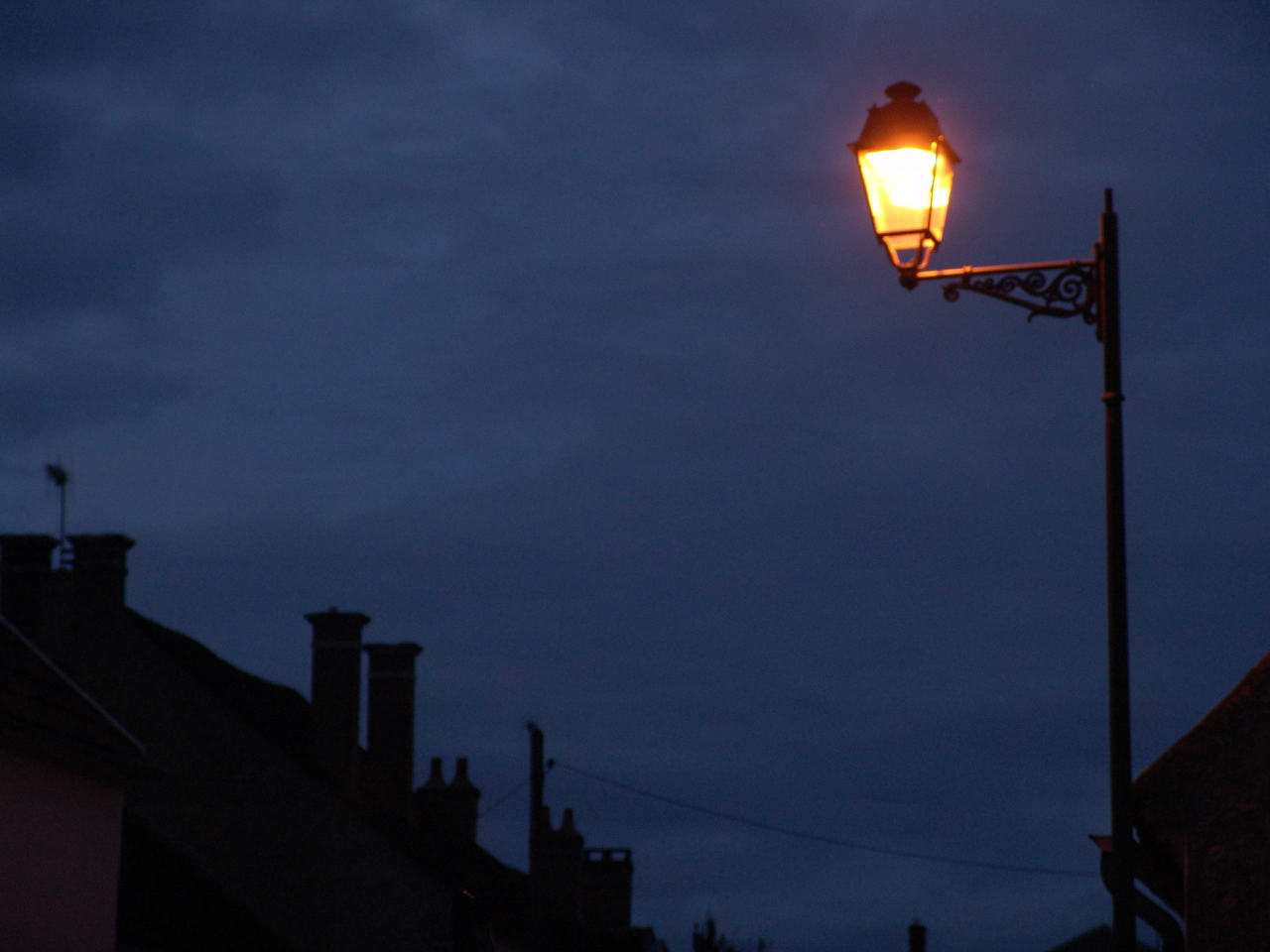
When darkness asserts itself, they come on—at first, a faint pink glow. At midnight, they go out leaving the town blanketed in pitch-blackness.


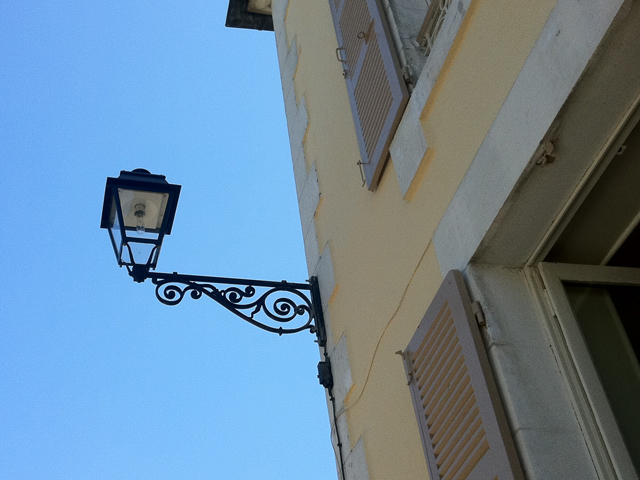
Inside these rustic houses are high-speed internet connections. But outside there are streetlights reminiscent of a long time ago. If it weren’t for their long-life bulbs (standard in Europe), you could imagine them containing flickering gas flames. I look at them and remember a poem my mother read me when I was a child:

The Lamplighter

My tea is nearly ready and the sun has left the sky.
It’s time to take the window to see Leerie going by;
For every night at teatime and before you take your seat,
With lantern and with ladder he comes posting up the street.

Now Tom would be a driver and Maria go to sea,
And my papa’s a banker and as rich as he can be;
But I, when I am stronger and can choose what I’m to do,
O Leerie, I’ll go round at night and light the lamps with you!

For we are very lucky, with a lamp before the door,
And Leerie stops to light it as he lights so many more;
And oh! before you hurry by with ladder and with light;
O Leerie, see a little child and nod to him to-night!

—Robert Louis Stevenson

Posted in AROUND US, FRANCE | Tagged , , , , , | 4 Comments

How long is a piece of wire?

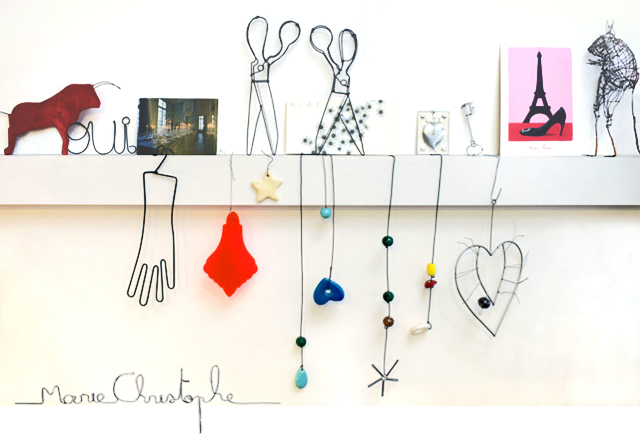
Yesterday’s discovery (thanks to France 24) was French wire artist, Marie Christophe. I’ve always loved the notion that you can create, or at least imply, three-dimensional mass by using a material that approximates a line (a two dimensional reality). This woman is a master.

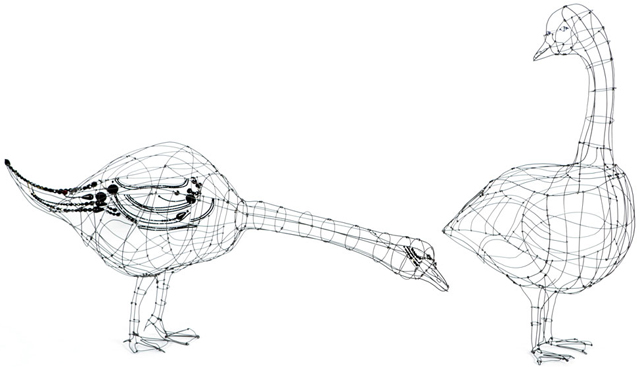
Having clumsily attempted, myself, to construct a fish out of wire last summer, I am stunned by the elegance of her curves, the cleanliness of her line. (My “fish” ended up being a tangled mass.) Using wire together with jewels and beads, she makes furnishings, objects and artworks, both small and massive—”massive” being misleading, as even her most voluminous pieces are nothing much more than air.


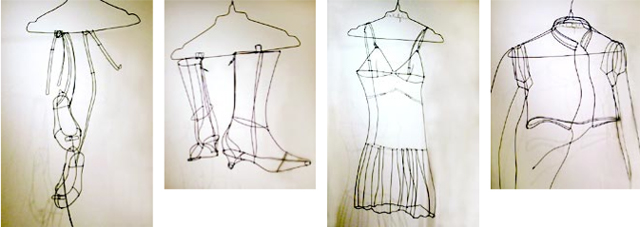
I love these birds. A birds skeleton, itself, is a work of tensile strength and lightness. So the wire is a perfect substance with which to pay it homage. And the dress hanging on the clothes hanger—why do I love that so much? I suppose because wire is the opposite of cloth, and yet she has given it the supple grace of an un-ironed shirt, while ironically tipping her hat to what fashion design is all about: structure.

Posted in FRANCE, SO NOTED | Tagged , , , , | 5 Comments

Roofscapes

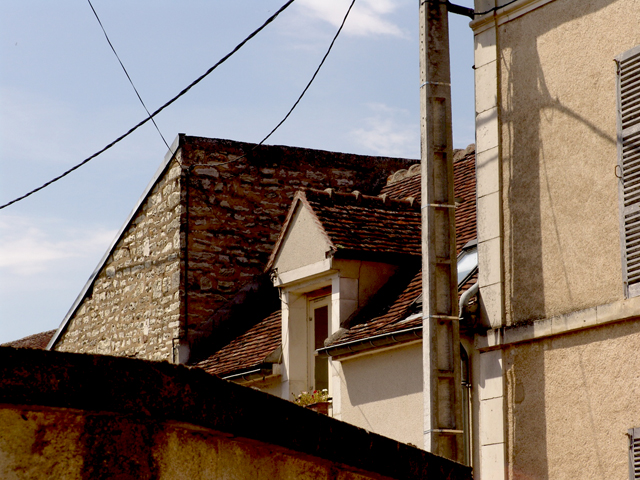
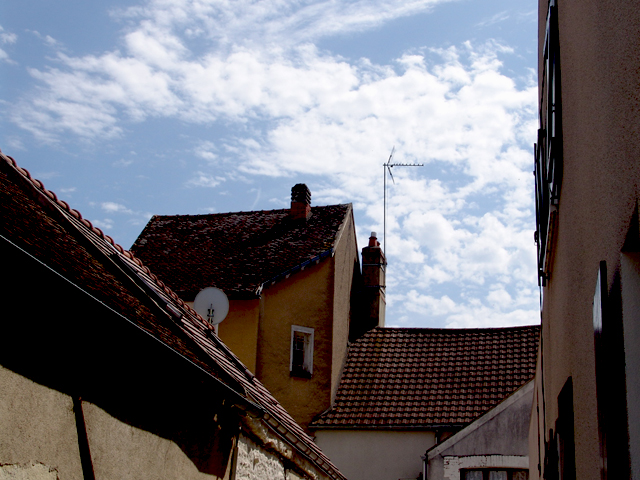
Whenever you find yourself in a foreign country, it is the things that are completely normal (so normal as to be invisible) to the natives that are, to you, the hallmarks of Wonderland. I’ve walked through the streets of this tiny Burgundy town for 13 years now, and I’ve never grown tired of staring at the rooftops. Their irregular and unpredictable angles. The way they stack up against the sky like the elements of a cubist painting. The lean of things that once were plumb (or maybe never were).


This is not America. This is not what I grew up with. And so, surrounded by this, I feel as if I’ve been transposed molecule by molecule into a fairy tale. And yet, it is completely real. Here, under these roofs, children grow up and grow frustrated. People age and die. The news, piped in from around the globe, is watched with horror and indifference just as it is viewed elsewhere. Class divisions persist. The grand live in grand houses. The poor in poor ones. And yet to me—despite those inequities—it all adds up to something magical. I feel at home here in this stone, mortar and tile fairy tale.


Rooftops and skies have inspired artists forever. Cezanne painted them. Camille Pissarro too. Thomas Hart Benton. And, in 1999, my friend and artist Peter Wegner, created this amazing series of photographs: “Buildings Made of Sky.” His subject matter is meticulously shot, reproduced and presented. It is art. This blog is not. But I can’t help but feel akin to him in this endeavor. His eye was seduced by New York. Mine by the opposite. And yet both were trying to share stories of geometry, shape, and negative space.

Posted in AROUND US, FRANCE | Tagged , , , , , , | 2 Comments

Postcards #13 – 17: The French countryside

One postcard won’t do. But one of those perforated, accordion folded jobs will. From me, to you. As they say, “Wish you were here.”


*Photographed this past Spring.

[If you liked this post, you might also like this: Merry-sur-Yonne.]

Posted in FRANCE, POSTCARDS | Tagged , , , , , , , | 4 Comments

Doors

Pee Wee Herman once said that he loved fruit salad so much, he thought he’d marry it. I’m already married, but my monogamous bliss may be under attack even as we speak by an equally unsuitable suitor. “The interloper?” you ask. Why, none other than a bunch of wooden doors.


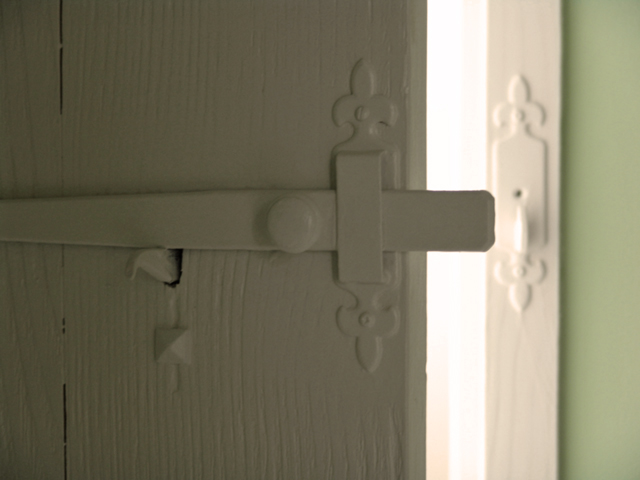
I really must give credit to the French carpenter who understands perfectly when finesse is required and when it is not. We talked with him at length about what we envisioned, trying crudely to put our thoughts and instincts into approximately correct French. We gestured and mimed about plank width and degree of finish; we considered various types of latch and hinge. I don’t think we communicated particularly well, but he understood nonetheless, and created doors that have become none other than objects of my love.


I leave you with this:

Doors

An open door says, “Come in.”
A shut door says, “Who are you?”
Shadows and ghosts go through shut doors.
If a door is shut and you want it shut,
why open it?
If a door is open and you want it open,
why shut it?
Doors forget but only doors know what it is
doors forget.

—Carl Sandburg

Posted in FRANCE, IN THE HOUSE | Tagged , , , , , | 7 Comments