Spring storm

Post #6 from our Easter week in Burgundy.

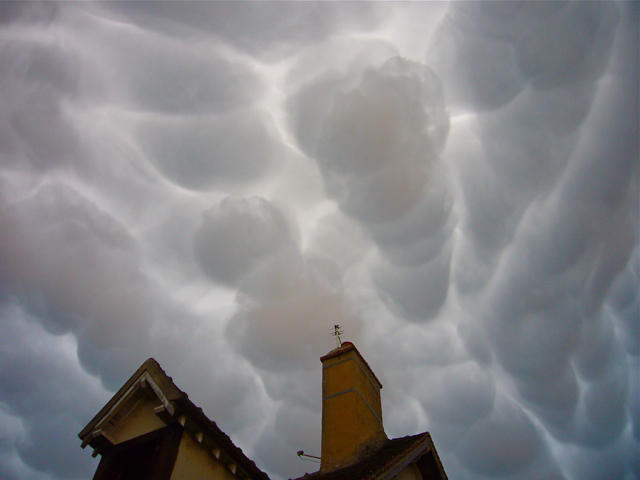
Everything smells different right before it hits. The light changes. The temperature drops. Things are hushed, then windy. The gray grows in intensity overhead, while underneath roiling clouds, beiges turn to gold. The children start to dance and sing. We are, after all, electrically wired beings and this event is as much inside us as it is outside.


I love these moments before the rain starts. Or the hail. Or the lightening and thunder.
Everything is turbulent. Air as well as emotions. We feel happy, ecstatic (there’s that internal electricity again), as if our internal coils have been let loose from being wound too tightly all day under listless, humidity-laden skies.

This storm reminds me of one we had last summer, the likes of which I personally had never seen. It scared me, but it was too thrilling not to watch with its fake-looking, Dr. Seuss clouds. I always tell myself that if anything serious should hit, we’d take cover in the cave and drink wine until either the storm is over or our nerves can handle whatever comes next. Isn’t that what wine cellars are for?


Posted in AROUND US, FRANCE | Tagged , , , | 6 Comments

Pissenlits / dandelions

Post #5 from our Easter week in Burgundy.

NOTE: I can hardly look at a dandelion
without thinking of World War II,
of hunger, of doing without,
of survival and—despite all that— of happiness.
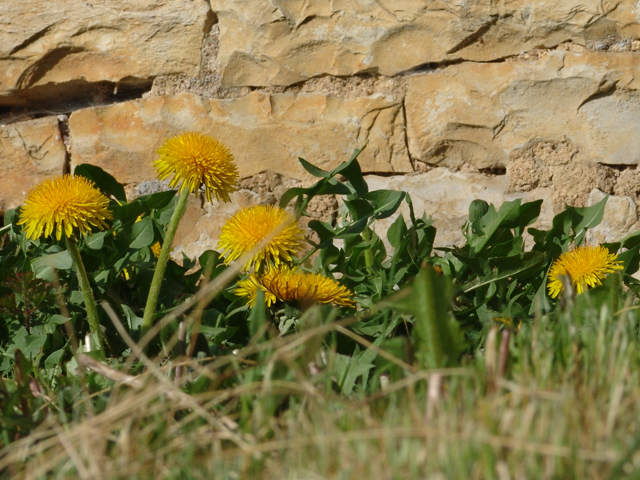
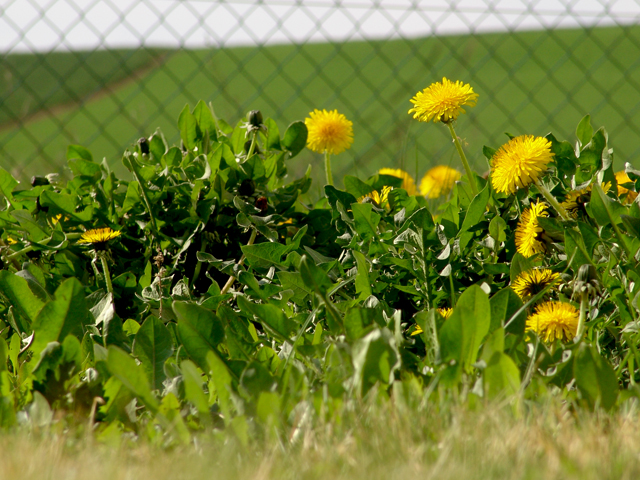
I think, whether we like it or not, wars often become the great shared chronological landmarks of our lives—massive common containers of memory and loss and fear. More so if we live on their front lines. Less so if we only see their wreckage and life-stealing cruelty on TV. But there they are. Standing, for all of us, immovable markers of time. You never forget where you are when you see the first bomb of a conflict drop. You never lose that sickening realization that a person, like you, sits under its devastating plunge to earth. Here we, mankind, go again.
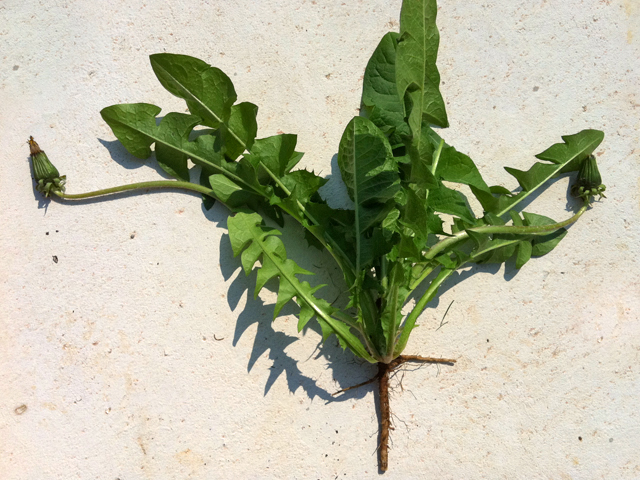
My mother-in-law lived through World War II in the French countryside, escaping the bombs that were feared to fall on Paris. The friendships she formed during those harrowing years are strong today. As would be her instincts not to waste food, to preserve what you have, to appreciate the gifts that nature gives you if Alzheimers hadn’t messed with her mind, her world order, every memory she had, and even with those instincts about value.

Whenever she saw dandelions pushing up in the fields, gutters and sidewalks of our little Burgundy town, she would bend down agilely to gather them up. No beauty—even in the form of a weed—would be wasted on her watch. She would hold them out for me to examine, stroking the leaves free of dirt like fine merchandise. “We would eat these,” she says. “We would eat whatever we could find.” Pause. “They’re good sautéed. A little bitter, but very good. You can add pancetta (she speaks to me in Italian even though she’s French) if you have it.”
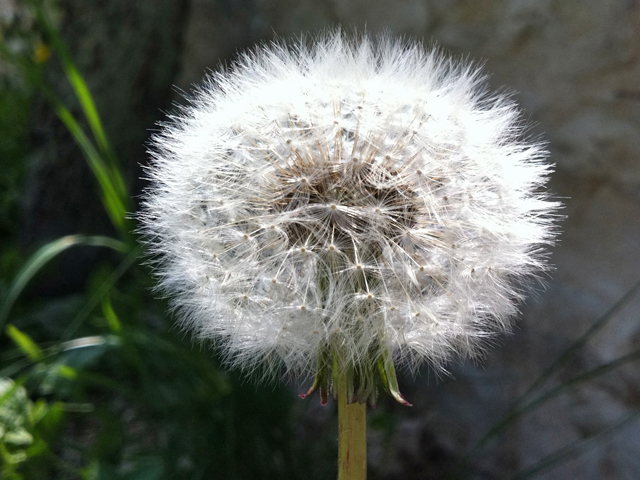
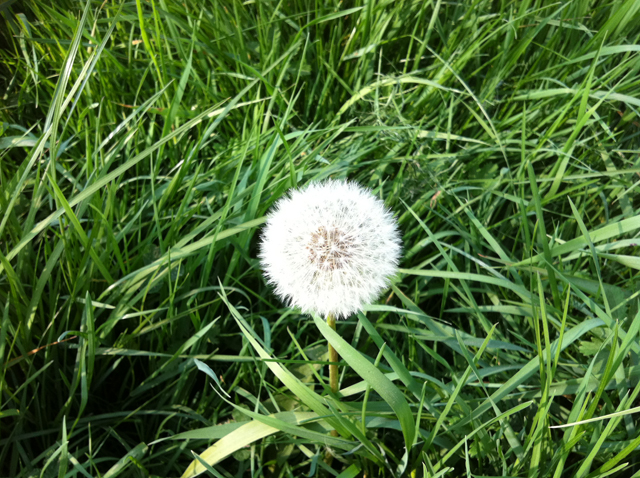
I don’t see a dandelion today that doesn’t remind me of her. Of her war. Of her life here during those difficult years. Her memories have somehow become ours, inseminating themselves in our minds, so that we don’t forget something we didn’t live through, if such a thing is possible. One memory multiplying itself over the generations, like the flower itself. This Easter, the otherwise green fields were full, already, of the white wispy leftovers that dotted them like a healthy cotton crop. Millions this year. How many million more, next year?
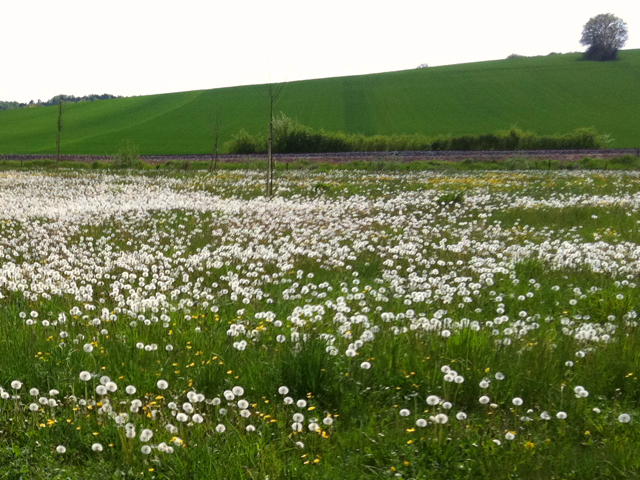
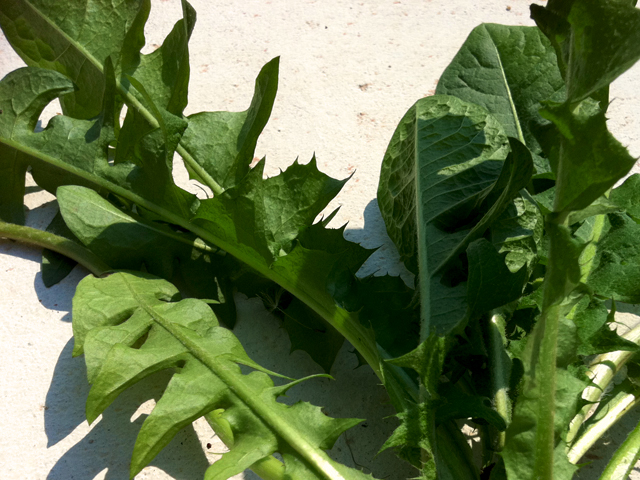
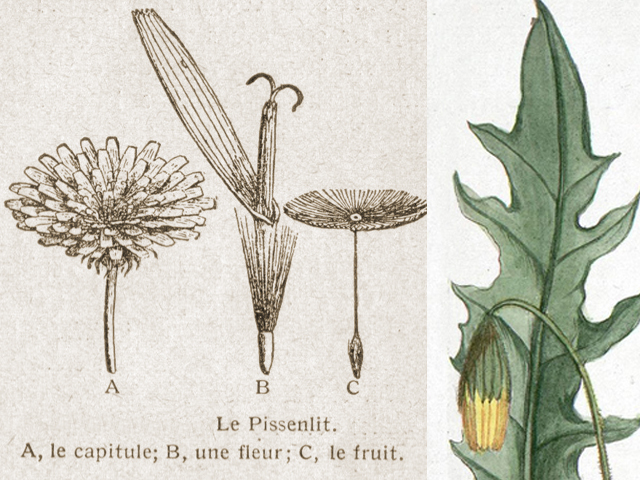
Pissenlit the flower is called in French. Or, similar to English and Italian, dent-de-lion. Nothing in the flowering weed category could be more banal, yet these ubiquitous yellow buttons pack an emotional punch with me, when I see them growing there next to the stone wall and think of her picking them as a child and eating their leaves for dinner.

But why not? They are edible. You can see that in “finer” restaurants, where they make up part of the wild green salad. Even Mark Bittman of the New York Times in his book How To Cook Everything weighs in with a very Italianate version of dandelions (Italians prepare spinach and other greens like this, minus the stock and the lemon wedge): Saute garlic and hot pepper flakes in olive oil and cook for about 1 minute. Add dandelion greens (the younger ones are tenderer and less bitter) and 1/2 cup of stock (chicken, beef or vegetable), and cook covered until wilted and just tender, but still firm. About 5 minutes. Uncover and continue to cook until the liquid has evaporated and the greens are quite tender. About 5 minutes more. Taste for seasoning. Add salt and red or black pepper to taste. Add minced garlic if desired, and cook for a minute more. Serve hot with a lemon wedge.

And gratitude. That would be a good garnish as well. “Thanks that there are no bombs dropping here, now. Thanks that I can eat what grows under my feet. Thanks for all of it.”

Posted in AROUND US, FRANCE | Tagged , , , , | 4 Comments

Let’s take the road less traveled by

Post #4 from our Easter week in Burgundy.

Pull on your old jacket and your rubber boots. The weather is undecided and last night’s rain has left things saturated with wetness and a deeper hue. The snails and slugs will be crossing our path, hoof marks will be fresh and deep if we spot any.
Leave with empty pockets; they will be full when you come home. The heart-shaped stone, the futuristic seed pod, the purple wildflower which will inevitably wilt but who cares?—these things will fascinate our eyes and seduce our fingers. We will pluck them up hoping that doing so will help us remember…

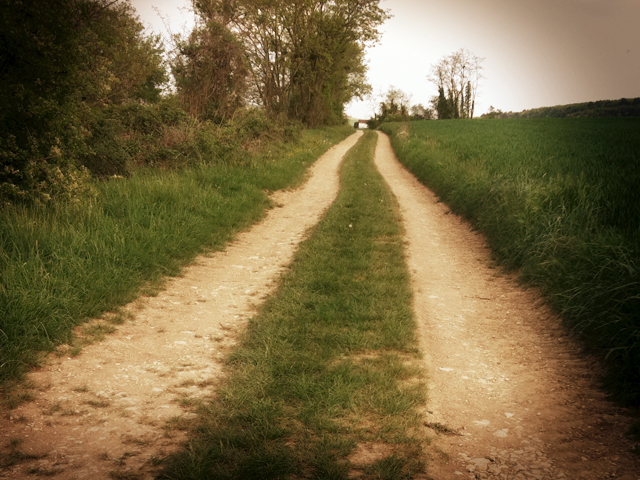
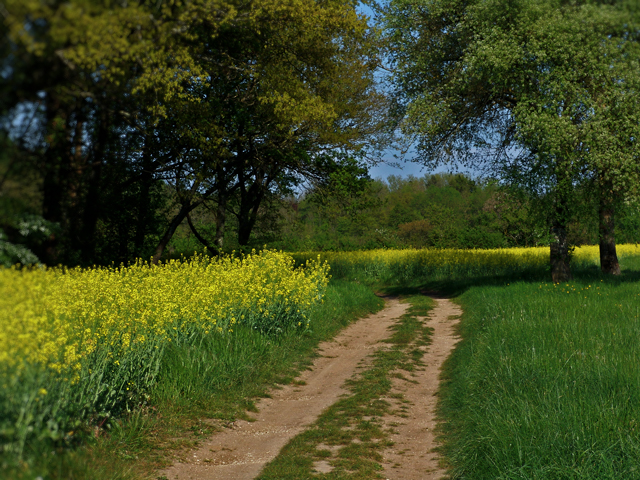
On one side, the fields with their lovely symmetry rise toward a stand of trees and continue ad infinitum out of sight. On the other, parallel to our path, run the railroad tracks where we left the penny last year, hoping to see it flattened by the passing train.

Ahead of us and behind us, the reason for our outing: Two parallel paths, two dirt ruts– the doing of the farmer’s tractor. Impossible not to heed their call. Impossible not to put down computers, books, all those things that make us busy and occupied, and instead pick up the leash and call the dog. Our legs were made for walking, and this is our chance. Two dirt ruts. Side by side and forever parallel. One for me, one for you. Are you coming? Say, “Yes.” If poems speak the truth, it will make all the difference.

The Road Not Taken

Two roads diverged in a yellow wood,
And sorry I could not travel both
And be one traveler, long I stood
And looked down one as far as I could
To where it bent in the undergrowth;

Then took the other, as just as fair,
And having perhaps the better claim
Because it was grassy and wanted wear,
Though as for that the passing there
Had worn them really about the same,

And both that morning equally lay
In leaves no step had trodden black.
Oh, I marked the first for another day!
Yet knowing how way leads on to way
I doubted if I should ever come back.

I shall be telling this with a sigh
Somewhere ages and ages hence:
Two roads diverged in a wood, and I,
I took the one less traveled by,
And that has made all the difference.

—Roberto Frost

Posted in FRANCE, WHAT TO DO | Tagged , , | 4 Comments

Self portrait: The passerby

Post #3 from our Easter week in Burgundy.

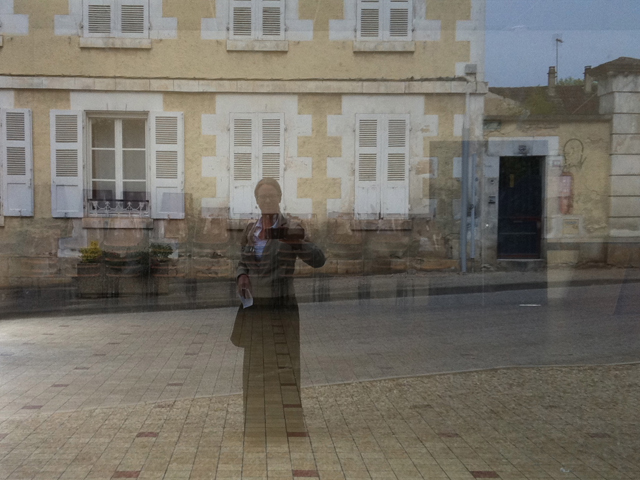
Not always, but often, I take a picture of myself reflected in a window or mirror not out of vanity, but out of some existential need to prove that “I was there”—there in Oporto or Mauritius or Savannah or the Maldives or my bathroom in Milan.

I see this woman getting older, I see her eye glasses changing, I see her taste in clothes remaining relatively steady, her posture is probably even better than before. Time goes by, yoga happens, and before you know it, it matters whether you slouch or not. I see her edited into settings she never dreamed of as a child. I see her passing through, passing by. Moving forward, pausing to take a look at where she happens to be. I don’t say “happens” lightly. But maybe I should…”the incredible lightness of being” and all that.

But this time, the camera and the window have played a telling trick on me: they show me ghostlike layered over-under-into the background. The Universe is playing with photoshop again to prove its point: “Charlotte, you’re not as in control of what and who you would become as you thought you were. Aren’t you glad?”

Yes, I am. Glad. And very, very grateful.

Posted in AROUND US, FRANCE | 8 Comments

One potato

Post #2 from our Easter week in Burgundy.

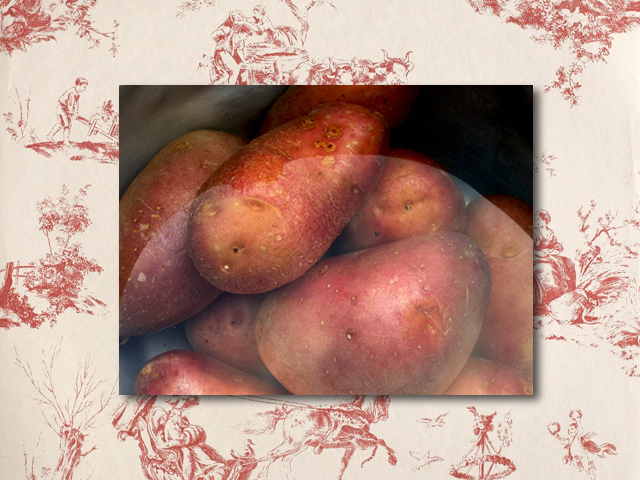
I’ve always loved potatoes. And thirteen years of pasta and rice haven’t dimmed my passion. What, really, fills the cracks better than that earthy packet of starch?

It’s no surprise, then, that after le pain and le buerre, my preferred ritual foodstuff in France is the boiled red potato. If any single food reminds as that all soil is not created equal; that tastes, textures, and nuances are the rightful provenance of specific places on our planet; and that the French concept of “terroir” and the Italian designation DOC are truly significant, it’s this small red tuber.

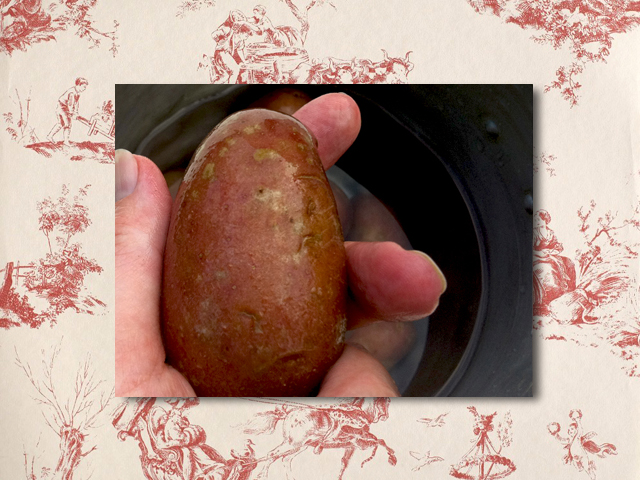
I challenge you: buy a red potato, boil it in lightly salted water, and bite into it. It won’t be like this one. It may be good, great even. But it won’t have the same sweetness. It won’t have exactly the same starchiness or lack thereof. Its skin won’t split and retreat from your teeth in precisely the same way. It will tell a different story, a tale of different dirt.

You may say I exaggerate, but I’ll deny it: I’ve never eaten a better potato. (OK, that enormous potato, wrapped in foil and baked deep in the hot ashes of Pitty Pat’s Porch 30 years ago at the South Carolina coast was right up there, but what is a food, ideally, if not the culmination of an experience of a particular place? So right here, right now, this is the best potato I’ve ever had the privilege of eating.)

Posted in FRANCE, SAVORING | Tagged , , | 3 Comments

Transitions: Follow the yellow brick road

We went to France for Easter, to follow the work on our barn renovation and for me to try and finish my book. Progress was made on both fronts, but completion was a fleeting objective. Days were full with the usual wonderment of the place. I’d like to share some of that with you here.

If our lives like movies are art-directed, then our trip to France this time was set-decorated by a stylist with a shameless passion for yellow. Edit: obsession.

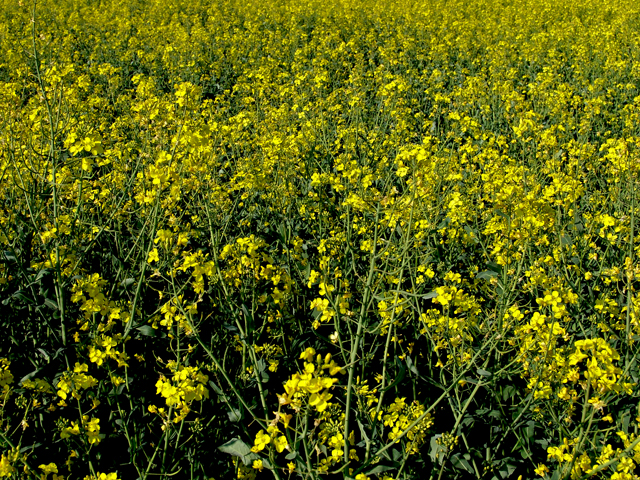
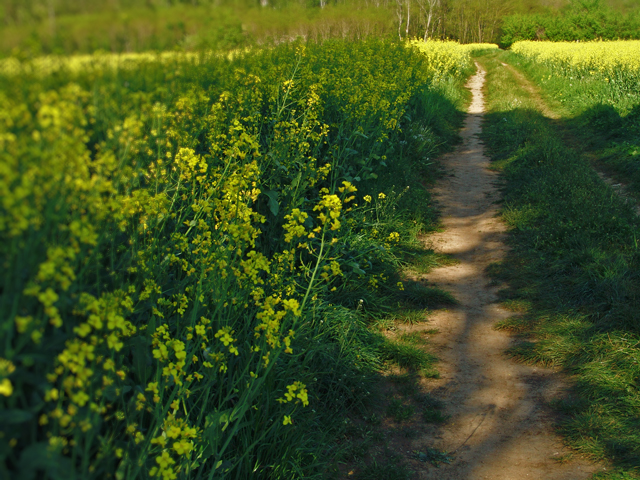
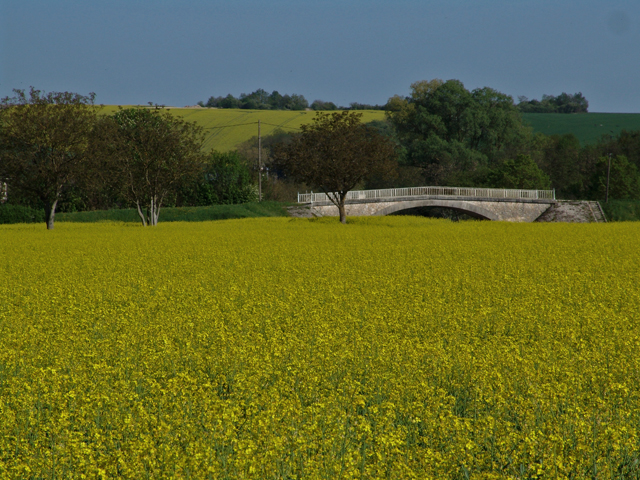
Just south of Dijon it started. And it didn’t stop, not even at the Nitry exit. I discovered it even in the fields of our own small town, tucked behind the canal along the bike path I like to take toward the mill, and in strips high up on the hills above the “neighborhood chateau”. But yellow isn’t a commodity crop, and farmers aren’t in the business of harvesting colors. So what is this sun-drenched carpet?


When I first saw this yellow stuff blanketing the rise behind our barn, I assumed it was mustard, planted between crops of winter wheat and corn. It emits a mustardy odor and the profuse yellow flowers are befitting the romantic notion that it ends up on our table in lovely earthenware pots and ornately labelled jars. But according to the town butcher, it’s “colza,” or rapeseed, the mustard-related seed that’s used to make Canola oil and bio-fuel.


The aroma is over-powering—sweet, slightly medicinal, bordering on cloying. And the color, the purist iteration of yellow, deserves mention in my favorite book on color, “I Send You This Cadmium Red” by John Berger and John Christie. It’s the color of technicolor roads to follow, of adventures unfolding, of a dubious wizard’s answers to nagging questions and of mile after mile of a well-cultivated weed. There’s nothing to do but go where it leads, and marvel at its brilliant hue.

Posted in FRANCE, TRANSITIONS | Tagged , , , | 6 Comments

Closed for Easter and for writing

Dear Friends, I’m closing “The Daily {French-Italian} Cure” for seven days of Easter holiday a.k.a. “Trying to Finish Writing My Book While in France.” That sounds terribly smug and pompous for a zillion reasons—not to mention cliché—and I apologize. It’s just that I am and have been trying to write an account about moving to Italy, what it was like, and what a complete clutz I was at getting the hang of being a foreigner in a foreign land. (If any of you know anything about digital publishing, please let me know.)

I’ve been “writing a book” forever, and saying so gets old. I’d like to take it out of that horrid progressive tense and put it squarely in the past. Done. X-ed off the list of things to complete before I die. So now I have witnesses who are all entitled to say with crossed arms and cynical expressions: “So, did you finish that ‘book’?” I will also read, observe, and hopefully come back with fresh material for you all. Have a wonderful, wonderful week. I will miss you.

An excerpt. Click to see larger version.

Posted in FRANCE, WHAT TO DO | 6 Comments

Crispy memories

This past Saturday we ate at Trattoria Ponte Rosso. The lunch was simultaneously satisfying, light, inventive and delicious—almost the same adjectives I would use to describe the place itself, tucked into one of those ancient, slightly sagging buildings on one of the old canals of Milan. We will definitely be going back (without the children). My minestra di primavera (spring soup) was a symphony of seasonal delicacies: fava beans, baby peas, artichoke, and asparagus. And my husband’s almost-vegetarian fritto misto hid surprises not commonly found in such dishes: apple slices, sweet potato, a down-sized arancino*, and zucchini flowers stuffed with mozzarella and anchovy.

But it was the start of the meal that set the tone: two striated constructions, featuring as their primary building blocks croccanti di parmigiano. Parmesan crisps. One was layers of crisp, puntarelle dressed in the traditional fashion with the addition of slivered sun dried tomato, and smoked swordfish. The other was layers of crisp, thin-sliced artichoke in a light dressing, shavings of bottarga (tuna roe), and orange. I never understood if the essence of orange came from actual thin slices or simply from the use of juice in the dressing, but it was decisively present and a perfect balance to the pungent saltiness of the bottarga.

As we ate these texturally rich salads, it dawned on me that with the exception of the bottarga and the smoked swordfish, we were enjoying ingredients and preparations that we eat commonly. But they were made more special by the parmesan crisps, which are, in fact, as the Italian say un bel niente. A big nothing, literally, but in this case, let’s say, “No big deal.” I’ve cruised around on the internet, only to discover that they are quite simple to prepare. One method is to grate smallish heaps of parmesan cheese onto a baking sheet covered with parchment, then leave them in a hot oven until browned. The other method is to grate the cheese in a non-stick frying pan and, once browned on the underside, to flip it with the help of a spatula to brown the other. The resulting golden, chewy mass becomes crispy when it cools. And there—apparently—you have it. Probably easier described than done, but surely nothing that a little practice can’t master. In any case, the effect on the dish and in the mouth is much greater than the difficulty required to prepare it, and with a little creativity you could lift quite normal dishes to an entirely different level.

A final note: The restaurant’s website speaks rather eloquently about the philosophy of the cuisine, placing heavy emphasis on the role that memory plays in the preparation of their dishes. As Italian cooking ranges in its most exquisite expressions from the work of great chefs to the daily labor of mothers and grandmothers in the kitchen, it is a cuisine kept alive by those who dip again and again into personal knowledge and instinct about “how things are done” (tradition) while, inevitably, giving it their own mark. So memory is as critical an ingredient as individual interpretation, if not more so. The memory of the chef goes into the final preparation, but the memories of the consumer are sparked at the table. What did the parmesan crisp bring to mind? What wordless memory did it conjure? Putting it into words would be like describing a dream after waking—dull, inaccurate and beside the point—so I won’t. Suffice it to say that while I was living this particular dream, the experience was rich.

Trattoria Ponte Rosso
Ripa di Porta Ticinese 23
Milano
Telephone: 02.8373132
Cellular: 366.6396924

*An arancino is a Sicilian concoction: a breaded, fried rice ball often filled with cheese or meat.

Posted in ITALY, SAVORING | Tagged , , , , | 6 Comments

Hurry up and wait

A few posts ago, I was inspired by the Trattoria Milanese (via Santa Marta 11, Milano) to write about tomato sauce. Remembering with mouth-watering fondness that meal and wondering, already, when I can hope to repeat it, I am trying to content myself with thinking about the menu, the decor, and the staff’s particularly pleasing way of treating the clientele. (Yes, this is a hearty endorsement.)

Their menu includes a category of dish you sometimes see in Milanese restaurants regarding “piatti da farsi” or—more commonly— “piatti espressi,” in other words, dishes that are made upon request.

The language, in this case, has always interested me. Maybe because of the use of “express” in English to refer to services that are typically speedy and ever speedier so that we never have to suffer anything but immediate gratification, or maybe because I wasn’t paying close enough attention in Latin, I assumed the first time I encountered “piatti espressi” that that they were dishes that would arrive soon after being ordered. My husband set me straight subito (immediately). He informed me that the phrase had nothing whatsoever to do with speed, and that I might, in fact, have to wait longer for it, as it was being made expressly for me.

Aha. And so we can now understand also that a caffe espresso is a coffee that more importantly than being delivered quickly, is made—beginning to end—on the spot for the person who’s requested it. At the Trattoria Milanese, this concept is probably most frequently applied to risotto alla milanese (rice prepared with saffron and veal stock). It is such a common order, that shortly after saying “Hello” the wait staff ask you if you will be having any. That way your “express” order can be placed immediately in the kitchen. It takes about 20 minutes to prepare, and God forbid you should suffer the wait. That’s what antipasti are for.

Posted in ITALY, THEY SAY | Tagged , , | 1 Comment

Confession #4: The risks involved

Dear you (plural), it has been called to my attention by a recent comment I received that blogging—especially this sort of daily blogging—carries risks. Not seismic risks, but small risks of another sort altogether. The first risk is that in the effort to write daily (which is largely a personal, experimental choice) the chances of my not writing well or of not producing anything of consequence are relatively high. I thank ALL of you for being the patient guinea pigs in that experiment.

The second risk is that in choosing explicitly to focus on detail—i.e. small observations—I double that risk. Writing about the perfection of a chocolate egg could potentially lead someone to believe that I am engaged in a laughable pursuit of navel-gazing, or that I don’t give a damn about world hunger, earthquakes, nuclear meltdowns and the tragedy of man’s inhumanity to man, finding instead that sugar glazing is somehow more newsworthy than universal healthcare or other important and debatable topics. I don’t. Quite the opposite.

It’s just that in the midst of global warming, rampant war, and countless superior commentaries on other things that interest me (architecture, design, art and literature), I find it useful to express myself in this way: finding beauty (great or small) where I can, appreciating the human gesture, and observing and describing with openness whatever pulls my spirits up. Sometimes, my comments will be useful to you. Sometimes they won’t. Sometimes they will be laughable failures (I’ve already put a few of my posts on that list).

One could say, I suppose, that in a way, I’ve demonstrated the good and the bad of the Italian plight: As so much in Italy malfunctions, spectacularly compromising the chances for individual success, mobility and achievement—need I say more than the words “Berlusconi,” “mafia,” “corruption” and “hegemony”—we are driven more and more to find our happiness in the beautification of the quotidian, the softening of the social, and the amplification of the small human act of kindness and/or gentility. What has frustrated Italians for centuries has also lead them to make an art out of living that is recognized the world over. Neither this blog nor the chocolate egg is the apotheosis of this achievement, but both, I think, are created in the spirit (and hope) of putting something decent and unharmful into the world.

I hope that’s the spirit in which you take it. And to the person who left the comment (which I did not have the courage to publish): Whether I misunderstood your intent or not, thank you for inspiring me to make this clarification. And now, as I always do on Saturday: Doors closed until Monday.

Monday
“Wisteria”
If all the world’s a stage,
this is the most romantic stage prop.
(Read this.)

Tuesday
“All things rubber”
In which we appreciate rubber stores in general,
and Moroni Gomma in particular.
(Read this.)

Wednesday
“Hugs and kisses/abbracci e baci”
In which we notice that there’s
a lot of public snogging going on.
(Read this.)

Thursday
“Postcard #12: Furniture 500”
On patio furniture made
from the original Fiat 500.
(Read this.)

Friday
“Chicken eggs”
On my love for the annual appearance
of chocolate chicken eggs.
(Read this.)

Posted in CONFESSIONS, ITALY | Tagged | 8 Comments