Chicken eggs

My first full year in Milan, I was surprised in early April to see a large basket in my local bakery filled with a bed of straw and a pile of white chicken eggs. I wanted to buy some, to remind me of home and perhaps to dye some for Spring. I’d moved from a white-egg United States (I’m sure this is changing here and there) to a strictly brown-egg Italy, and these pure white orbs, even though I prefer the idea of brown shells for some inexplicable reason, struck my heart.

The brown chicken eggs I've grown accustomed to.

I asked the white-capped woman behind the counter how much they cost, and she said 4,000 lire (roughly 2 euros) each. Stunned, I asked why, to which she replied, “Because they’re made by hand of high quality dark chocolate, molded, glazed and dusted with sugar.” After a short pause in which I stood dumbly, staring in shock at the beautifully deceptive eggs, she added, “Next week, I’ll have a delivery of colored ones.” I went back the following week, and bought four: pink, yellow, mint green and robin’s egg blue.

Spot the imposters: white, yellow, acid green and peach.



Milan is simply blooming in a pastel explosion of Easter eggs. Everywhere you turn, Caffarel, Venchi and Lindt eggs—milk chocolate, dark chocolate, with or without crushed hazelnuts, with or without gifts inside—fill the windows of pasticcerie, bakeries and bars. Tiny, medium-sized, large and enormous, wrapped in foil, patterned paper, silk, and voile—they are indulgences to be sure, but they are no match for the exquisitely humble impostors that disappear from bakery baskets almost as soon as they appear. Obviously, I’m not the only one who knows how pleasurable it is to crack them open with an assertive whack, watch the glaze crack off in tiny fragments like a real egg shell, then bite into the dense resistant chocolate.

They crack open like real eggs, only they require a little more effort.


[If you’re partial to chocolate, you might also enjoy “A new (old) love for the chocolate lover,” in which I discover il cioccolato di Modica.]
Posted in AROUND US, ITALY | Tagged , , , , | 3 Comments

Postcard #12: Furniture “500”

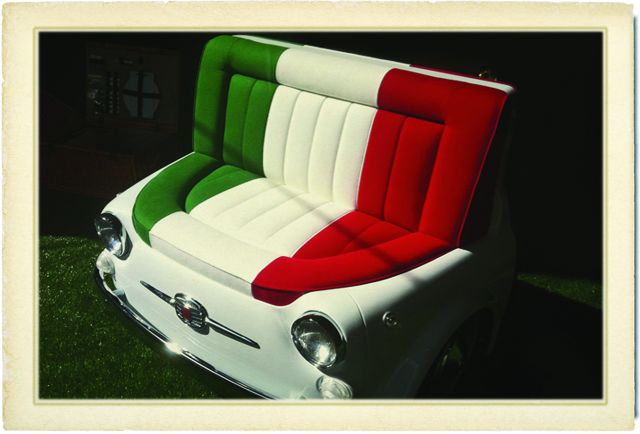
[Perhaps not the most sophisticated design—but charming none the less: A picnic scene built around furniture made from the original Fiat 500. The Japanese were all over it. “Cin-cin!”]

Fiat 500 bar.


Fiat 500 seat.


Seen at "Fuori Saloni," via Durini, Milano.

Posted in ITALY, POSTCARDS | Tagged , , | 3 Comments

Abbracci e baci / Hugs and kisses

Birds are doing it. Bees are doing it. Flowers and dogs and trees are doing it. Every park bench is taken. Every hidden corner. It’s happening astride motor-scooters at 45 kilometers per hour. In bus windows. On city monuments. Everywhere you look—even inside the dark recesses of your own imagination—the kiss and the embrace have taken over. Stolen kisses. In-the-open kisses. Innocent and x-rated kisses.

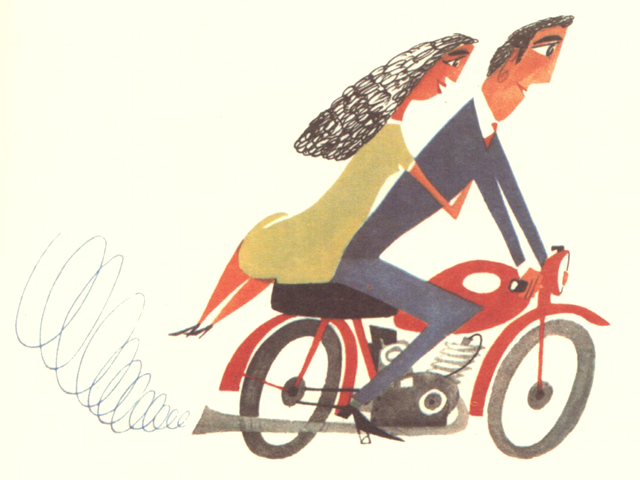
Illustration: M. Sasek from his book, Rome.

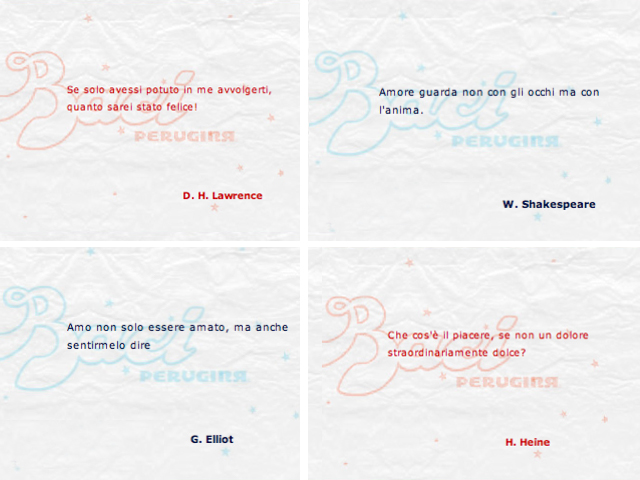
When I first came to Italy, my love gave me chocolates. Not only the fine Swiss kind, but also Perugina “Baci,” those innocent mouthfuls that say so much in just the right way at the right time. Each chocolate comes wrapped with a message. I saved them all and pasted them into my sketchbook. These choice observations on love, romance, friendship and the kiss are now available on line; you can send one to your heart’s desire, or you can, like me, simply browse them and marvel at the literary genius that describes this universal phenomenon.


Upper left: “If only you could have wrapped yourself up in me, how happy I would have been.”—D. H. Lawrence. Upper right: “Love looks not with the eyes but with the spirit.”—W. Shakespeare. Lower left: “I love not only to be loved, but also to hear myself say it.” —G. Elliot. And my favorite, lower right: “What is pleasure, if not an extraordinarily sweet pain?”—H. Heine.

There is nothing like a kiss. Nothing. Nothing like the thought of one. Nothing like a real one. Nothing like the memory of one. Nothing like one planted on your lips when you least expect it. Nothing like the desire for the one that might still be out there with your name on it. Nothing like the first one. And nothing—nothing—like the last one…

Posted in AROUND US, ITALY | Tagged , | 6 Comments

All things rubber

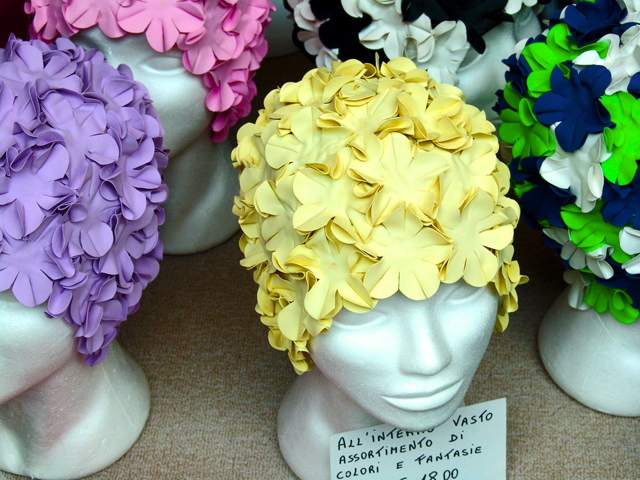
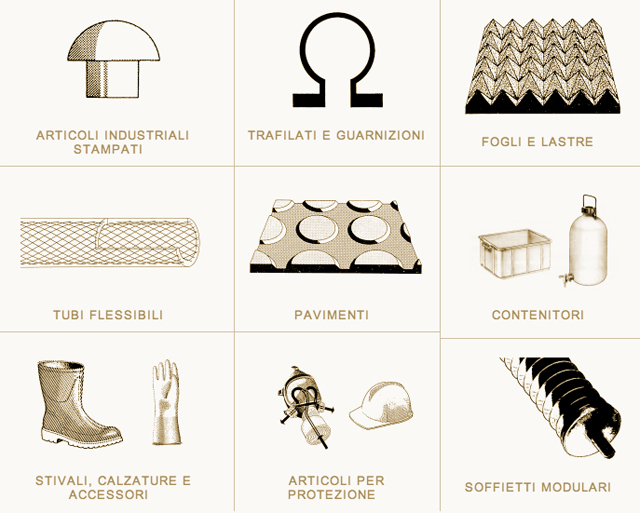
It’s a short leap from wisteria to bathing caps, don’t you think? And from there to rain boots, rubber tubing, textured floor tiles and file cabinets. Perhaps this seems a stretch to you, but in the world of all-things-rubber, stretchiness is a given. I’m talking generally about the merchandise of one of Milan’s more amusing types of specialty shops—the rubber store—and more specifically about the king of them all, Moroni Gomma.

The first rubber store I ever laid eyes on had one ancient mind-boggling window display of brightly colored gum boots, rubber slippers for walking on the sea bottom and garden hoses. I didn’t make the connection. I asked my boyfriend: “What kind of store is this?” His reply—ever to the point: “Rubber.” Hmmm. Okay. “But this isn’t the best one,” he said, warming to his theme. “That would be Moroni Gomma, in Chinatown.”

Some time later, I went there, and was instantly enchanted. The store sits unglamorously at Via Giusti 10, simply filled with things that serve a rubbery or plasticky purpose. And like many Milanese stores that are nothing if not “true to themselves,” it convinced me after 5 minutes of browsing, that although it wasn’t glamorous in the conventional sense of the word, there was something terribly chic about it. Design and functionality being at the heart of most of the products, the lack of ambience quickly fades into insignificance. It’s just a fun place—what can I say?—though the people who work there tend to take rubber seriously.

If the Via Giusti store, much like a hardware store, fascinates me into wanting things that serve a technical purpose I can’t even identify, the new, flagship store in Corso Matteotti, 14 appeals to the fashionista in me. It too places an emphasis on design and function, but it is filled— floorboards to rafters—with items of a much less technical and more domestic nature. They’ve also allowed themselves to wander out of the realm of rubber into all other materials. It’s beautiful, chic, clever, expensive and worth a gander. But my heart belongs to the other store. Everyone and their brother sells “a little bit of everything,” but few are distinguished by focusing their efforts on products made from the sap of a tree.

Posted in ITALY, WHAT TO DO | Tagged , , | 3 Comments

Wisteria

Milan is not what I dreamed of when I thought of Italy before coming here. It lacks the golden light of Tuscany. The ochres of Rome. The romance of Florence and Venice. It is a “working” city—urban, almost industrial by Italian standards. I have grown to love it, with its hustle and its sense of design and its commitment to modernity and getting-the-job-done, but I crave softness and grace and romance sometimes. And sometimes, I find them—in a single vine:

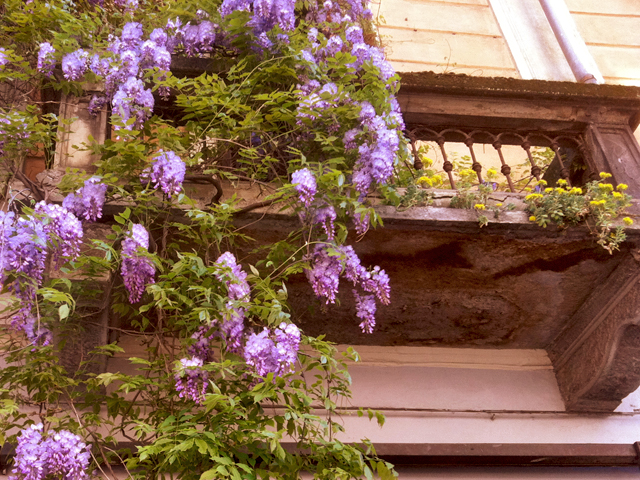
Wisteria (glicine, in Italian) doesn’t have a ubiquitous presence in this city, but it appears here and there, usually rising from the ground in ancient trunks and hanging from balconies and architectural overhangs in dense, theatrical swags. It perfumes the air, shades pedestrians, and softens whatever surface hosts it.

There’s an enormous vine across the street from our house, clinging to an old building that houses a restaurant (Trentino cuisine) on the ground floor. The vine rises next to the dear, little eatery in two or more intertwined trunks, and rises up to the fifth floor, taking over balconies and downspouts in its climb up. I look at it everyday now, knowing that sooner than I’d like, the beautiful flowers which hang like phantom bunches of grapes, will wither and blow away. I thank it for dressing the stage of my continual comings and goings with an unabashed romance befitting the reason I came to this city in the first place: Love.

Posted in AROUND US, ITALY | Tagged , | 5 Comments

Closed/Week in review

Sunday
“Special delivery: Inter loses to Milan 0-3”
In which we bemoan the loss of Inter to Milan
in the “Derby della Madonnina.”
(Read this.)

Monday
“Who has seen the wind?”
In which we celebrate the names
of these mythic forces.
(Read this.)

Tuesday
“Puntarelle”
In which we discover the delights of “puntarelle”
and the Roman way to prepare them.
(Read this.)

Thursday
“Salsa di pomodoro”
On the utter simplicity of a proper
tomato sauce.
(Read this.)

Friday
“Espadrille me, baby”
On my love for the Espadrille.
(Or is this a fetish?)
(Read this.)

Posted in WEEK IN REVIEW | Leave a comment

Espadrille me, baby

This post could be categorized, “What we wear / France.” Or, “What we wear / Spain,” if I were writing about Spain. But it is, at the moment, what we are wearing in Milan: Espadrilles.

I’ve been wearing them for years. Everything from the first low-wedged versions to the 4-euro grocery-store variety you can buy in France that are reminiscent of the sea and striped-shirted sailors to the new high-wedged variety with ties and bows. I had a Latin teacher who wore them every day of her life in a variety of colors. I can’t remember how to decline “puella” (OK, actually I can), but I remember more vividly her feet in red, blue and apple green canvas, perched atop woven bottoms. She wore pencil skirts and red lipstick, and her blond hair was stiff in a downsized beehive. Sort of glamourous in her own way. But I had a thing about her feet.

When I moved to Europe, I noticed that with the warm weather, shoe-store windows (if you knew where to look) filled up with “her” shoes, except in modern varieties. And I began to wear them myself. Covered toes, uncovered toes. Patterned heels, unpatterned heels. Long laces, short laces. Black, white. Canvas, linen. I would wear them until the bottoms unraveled. Summer would be over by that time, so it didn’t really matter. Espadrilles are strictly a warm-weather love affair.

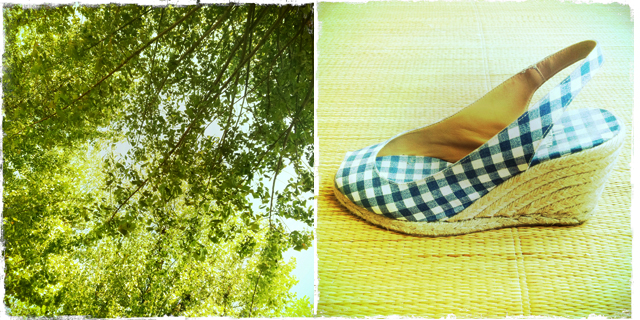
This year, my heart was seized (it was love at first sight) by a blue-and-white checked pair of Casteners with open toes. If you’re familiar with the “Gilligan’s Island” test, these are definitely Mary Ann, not Ginger. Last year, I bought a cheap pair at Zara with black bows for a combo seaside/evening wear look, and a more expensive pair in a boutique in France. This summer I’ll rotate all three…and when they are threadbare and in need of re-treads, I’ll know that autumn has replaced my favorite season, and it’s time to get down to business again. Until then, it’s free, easy and breezy. And if you want to throw some Latin in there: pulchra. Quite pretty.

Posted in FRANCE, ITALY, WHAT WE WEAR | Tagged , | 6 Comments

Salsa di pomodoro

Let’s just say it up front: tomato sauce shouldn’t be thick. I don’t know how many of you were raised in America in the 60’s and 70’s, but back then what we called “spaghetti sauce” was thick with tomato paste and dense with McCormick spices out of a packet. It wasn’t my mother’s fault. We weren’t of Italian descent, and food culture being what it was, that’s the way we ate it, in fact, gobbled it. As I’ve eaten now countless pasta dishes and pizzas, I continue to marvel at how unadorned, un-thick, and un-tampered-with a true, pure tomato sauce really should be. Emphasis on the “un”— it’s all about the tomato.

I was reminded of this simple fact yet again last Friday when we went to eat at my (now) favorite restaurant in Milan, the Trattoria Milanese in Via Santa Marta. I don’t know what possessed me other than the fact that the place is a temple to the great comforts of Milanese and Italian cooking, but I ordered meatballs. And, in a moment of weakness, I asked for them to be accompanied by that other universally appreciated comfort food—no, not spaghetti; that’s an American combination—mashed potatoes, or as the creamy mass is called in Italian, puré (borrowed from the French) or purea di patate. When my plate arrived, I laughed at the soul-foody simplicity of what sat and oozed on its surface: a buttery cream dominating the center, three simple veal meatballs, and an overlay of a surprisingly acqueous tomato sauce. I was delighted; this was going to be good. It exceeded my expectations—it was excellent. And the crowning glory was that insipid looking sauce, in reality bursting with tomato flavor and very little else.

I know a country housewife who, not wanting to take the time, makes her own version of salsa di pomodoro as follows: She takes ripe tomatoes, barely sautés them in olive oil, adds a pinch of salt and a couple leaves of basil, and tosses her freshly cooked pasta in this rustic concoction. It is divine. But I’d like to share with you here what I take to be a fairly classic recipe for the traditional sauce. It is printed in Il libro di cucina (you have to love that title: The Cook Book), published in 1969 by l’Istituto Geografico de Agostini. If you ever see a copy of it on the street in Italy, buy it. It explains everything.)

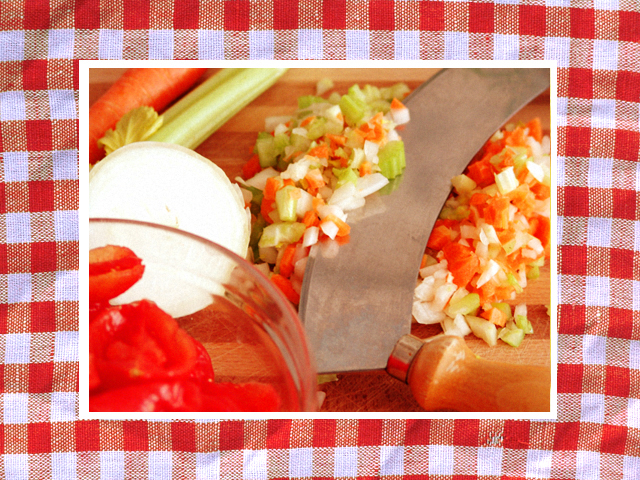
Ingredients for 4-5 people: (to use with pasta, gnocchi, rice, etc., or as a base sauce) a generous 2 pounds of fresh pear-shaped, or oblong tomatoes (about the length of your index finger or thumb), 50 grams of butter (I use olive oil), 1 stalk of celery, 1 carrot, 1/2 an onion, several leaves of basil, salt, pepper. Process: Dunk the tomatoes quickly in boiling water, then remove, rinse in cold water and peel. Remove seeds. Sauté in the butter (or oil) the finally chopped celery, carrot and onion. Add the tomatoes together with basil, salt and pepper and let the mixture cook over medium heat for 35 minutes or so, stirring from time to time. You can use the resulting sauce (below left) as is or, as is more commonly done here, passed through a manual food mill (below, right). Bon appetito.

[If you enjoyed this post, you might also like “Gnocchi”…and if you are so inclined, you can serve one with the other.]

Posted in ITALY, SAVORING | Tagged , , , , , | 7 Comments

Puntarelle

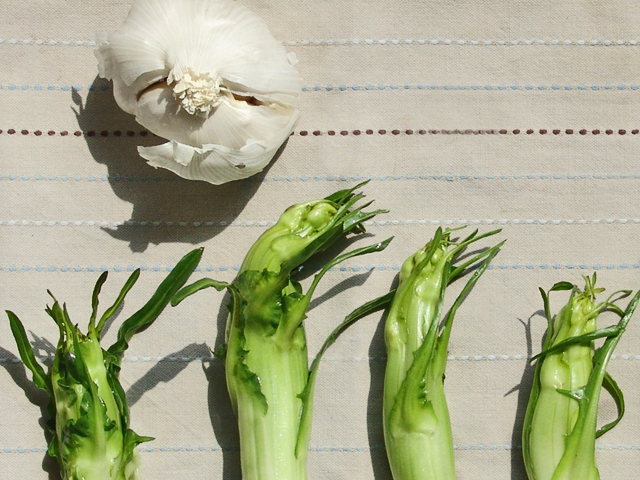
I’ve been wanting to write about puntarelle since I started this blog, and today is the day. This funny vegetable, which almost defies description and which I never saw in the United States, is the basis of one of my favorite spring side dishes. Puntarelle is the name given to these short stout sprouts of the asparagus chicory, also known as catalogna in some parts of Italy. They are a lively spring green in color, shaped somewhat like asparagus shoots (hence the name of the variety), and hollow on the inside up to the tips. Here and there darker leaves sprout randomly out of these tips like unkempt plumage.

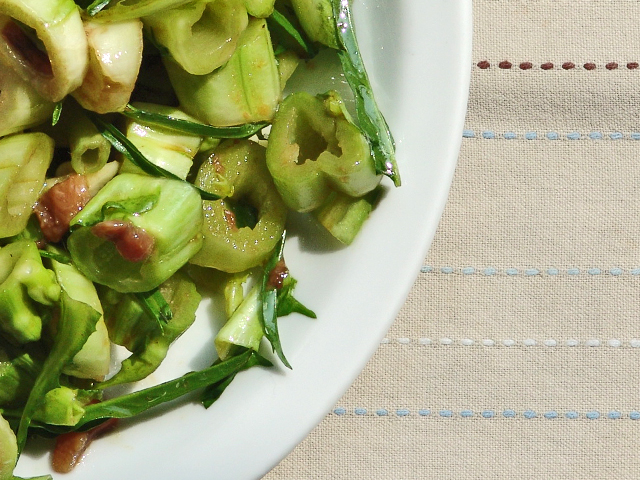
The crisp and crunchy shoots have a slightly bitter flavor, and are said to stimulate digestion and to have a diuretic effect. I believe this. There is something pleasingly challenging about eating them in their unadorned state, and that being the case, they should be good for you. But the challenge—for me, at least—ceases to exist when they are prepared in the Roman fashion: tossed with olive oil, vinegar (some recipes call for white wine vinegar, but I use balsamic), finely chopped garlic, minutely diced anchovy (it’s worth it to get the best your money can buy), sea salt and freshly grated pepper.

Please note: I have been remiss in my preparation of this dish—I always am! Laziness and eagerness to eat the puntarelle inspire me to take one short-cut in particular in the preparation. I tend to chop them cross-wise as you see in the photo below. But the preferred method is to slice them lengthwise in a hearty julienne and to soak the resulting strips in iced water before dressing so that the bright green strips curl up and become, I presume, more delectably crunchy (if such a thing is possible). To see images of the plant in its uncut state and the shoots properly sliced and soaked, this is an excellent site.

As I said, I’ve never seen these in the U.S., but you might want to check with Local Harvest to see if there is, by chance, a grower near you. Chicory or no chicory, this is a wonderful organization that deserves support and encouragement.

[If you are an anchovy-garlic-olive oil kind of person, you might also enjoy: “Sicilian—or is that Milanese?—slaw“]

Posted in IN SEASON, ITALY | Tagged , , | 4 Comments

Who has seen the wind?

“Who has seen the wind? Neither you nor I…” But we can marvel nonetheless, and call it by name. Actually, we can call them by name, as the winds—at least in Italy—are plural, and go by first names only. And what beautiful names they are. Poetic, evocative, mythic. I love living in a country where you can seasonally blame your headache on something as exotic as the “Scirocco.”

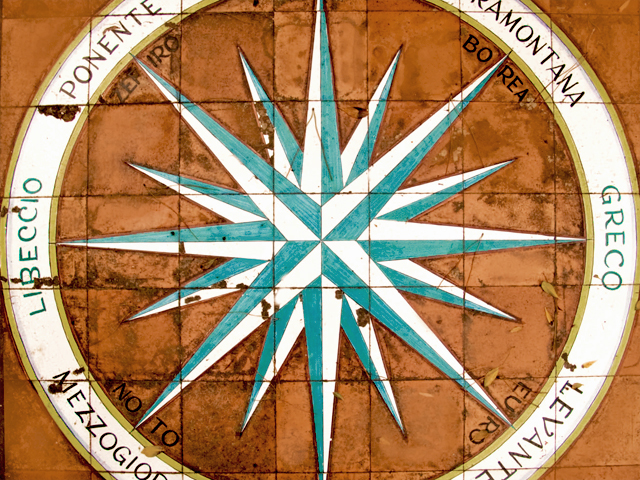
Here are the names of the winds. Try them on for size. Roll them on your tongue. Open your window and see if they respond to your call:

Tramontana. The polar wind that blows from—where else?—the north, bringing frigid, dry air to the Italian peninsula. The ancient Romans called it Borea.
Greco, Grecale. A cold, dry wind coming from the Northeast, bringing good weather and serene skies with its sometimes gusty blasts.
Levante. A weak winter wind coming from the East, bringing rain and storms to the Mediterranean. The ancients called it Euro.
Scirocco. A hot, Saharan wind, arriving from the Southeast, filling itself with moisture as it travels north over the Sea, causing prolonged periods of fog by the time it reaches Milan.
Austro, Ostro, Mezzogiorno. A weak wind coming from the South. Hardly felt at sea, it can nonetheless bring rains and storms. The ancient Romans called it Noto.
Libeccio, Garbin. The powerful Southwestern wind that blows itself in and out of existence with impressive speed, usually bringing high pressure and calm skies.
Ponente, Espero. The summer wind coming from the West, breathed into life by the warming of the Earth and the seas. The ancient Romans called it Zefiro. I love it that the name “Espero” contains the word spero, “I hope.”
Maestrale or Maestro. The bratty wind from the Northwest that harbingers the arrival of winter. It blows hard bringing cold, dry and calm weather.

These winds—these forces of nature, these personalities—inhabit the space we live in, moving through at their own speed and in their own time. They change our moods—lifting our spirits or filling us with foreboding. Who can resist a change in the wind? We are subject to these forces, though often we pay little attention to them. That is why I love knowing their names. It gives them their rightful place in the scheme of things. They require our respect.

Who has seen the wind?
Neither I nor you:
But when the leaves hang trembling,
The wind is passing through.

Who has seen the wind?
Neither you nor I:
But when the trees bow down their heads,
The wind is passing by.

—Christina Rossetti

Posted in AROUND US, ITALY | Tagged , , | 9 Comments