Fashion: the flip side

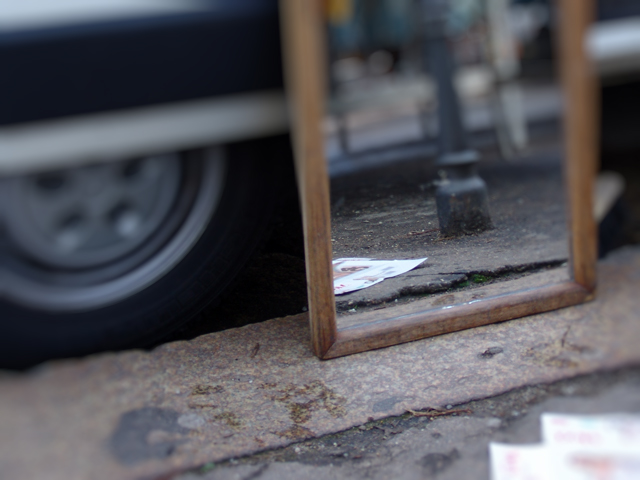
Thank goodness the world of clothes is utterly bi-polar, if not schizophrenic. Where there is high fashion, there is low. Where there are designers, there are people who brilliantly mimic them. While there are the boutiques of Via Monte Napoleone, Via Gesù, and Via Spiga, there are also the outdoor markets of Via Fauché, Via Vincenzo Monti and Viale Papiniano. At these street markets, gilt chandeliers are replaced by natural light (or the wintery lack therof). Silk clad dressing rooms are nothing more than mirrors propped against vans that line the market area. And hundreds if not thousands of euros evaporate into numbers—so easy to bandy about—like 15 and 20.

Don’t get me wrong: I know it’s not the same as Valentino or 10 Corso Como. And some of what hangs overhead is ghastly. But a woman with a keen innate sense of style can do wonders with items bought on the street. And some of the outdoor markets utterly blur the lines, offering the actual designer goods at close to street prices.

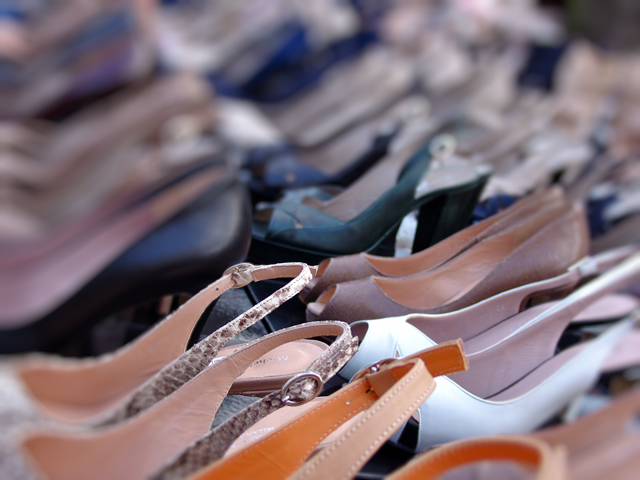
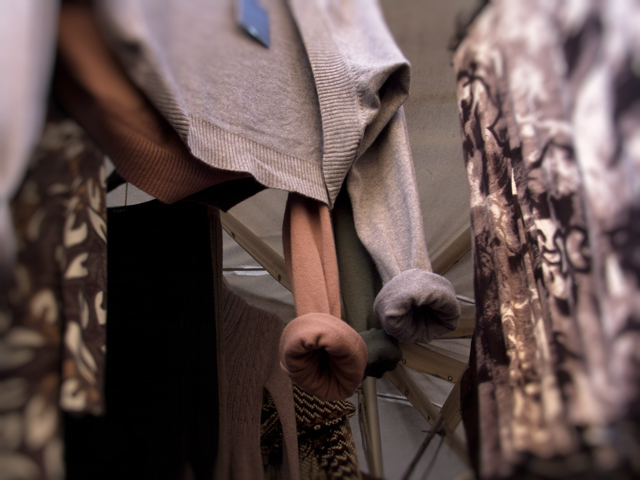
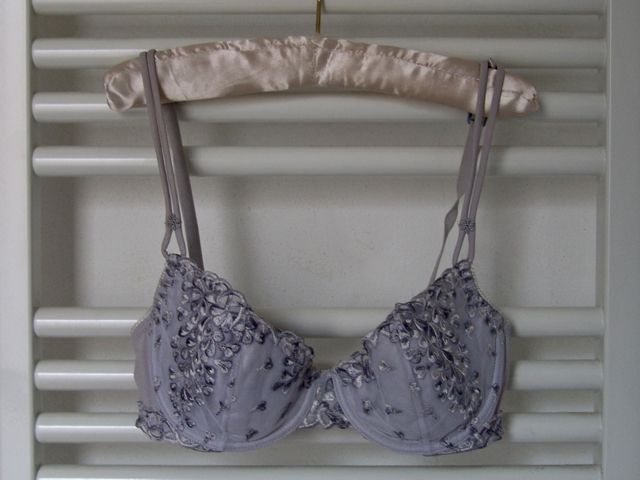
But it’s not so much the economics that interest me. It’s the atmosphere. I love watching a woman try on a pair of Pradas, their soles protected from the pavement by a piece of corrugated board tossed in front of a mirror. I love the hilarious landscape created by 100 bras of different colors and sizes displayed on a tabletop. I love watching vendors walk through the upside down labyrinth of dresses, coats and pants hanging under their awning. The cries of “Cashmere! 25 euros!” The vendors’ vans that line both sides of the market, serving as both warehouse and dressing room. The insane mixture of good taste and tastelessness. Energy. Interaction. Allegria. The whiff of a bargain. The possibility of a find. And somewhere in there, the exuberant spirit of a classless society.

NOTE: You can also buy housewares, kitchen appliances, linens, small pieces of furniture, bags, wallets, cleaning supplies, perfumes, incenses and African paraphernalia in the non-food portion of the markets. Although I’ve never been, I hear that the market of markets is the one in Forte dei Marmi on the Tuscan coast—supposedly the best for Italian linens.

Posted in ITALY, WHAT TO DO, WHAT WE WEAR | Tagged , , , , , | 2 Comments

Confession #2: Prison and flight

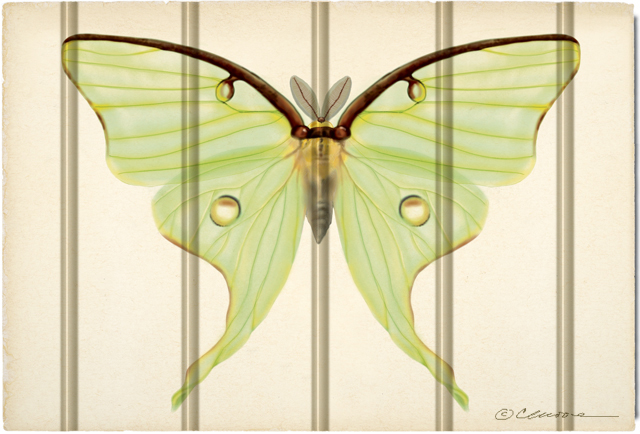
On February 1, an article about Nabokov and his scientific work on butterflies appeared in the New York Times. “Nabokov inherited his passion for butterflies from his parents,” it said. “When his father was imprisoned by the Russian authorities for his political activities, the 8-year-old Vladimir brought a butterfly to his cell as a gift.” This image is powerfully moving to me. It sums up everything I feel about living overseas. Or is it everything I feel about life in general? I’m not sure which.

There’s an expression in English: “Wherever you go, there you are.” Being an ex-patriot reveals the truth of this declaration. But is this a statement about limitation or liberation? I think both.

Initially, jumping boundaries and beating the bureaucratic odds (i.e. gaining permission to stay) seems a way of exercising the freedom you feel you were born with. I’m talking about the freedom that has nothing to do with being of any nationality in particular, but which flows in your human, you-can’t-help-it veins. Why should you be contained? Why should the world not be your oyster? Why shouldn’t you use your limited time on this earth to find out what it’s like to leave your mess in different corners of it? Or, as was my case: Why shouldn’t you be able to follow love wherever it leads? Doesn’t love write its own permission slip?

At first, you feel frighteningly free. Too free. You fly away from yourself, like the Village of Cream Puffs in Carl Sandburg’s story “How They Bring Back the Village of Cream Puffs When the Wind Blows It Away” from Rootabaga Stories (1922). When the wind plays rough, it blows this little village off the prairie into the sky. The village would be completely lost, if not for a thread that keeps it tethered, even when it’s been blown past the sunset, to its prairie home. This thread is wound around a spool in the town square, and when the wind stops blowing, the people of the village wind the thread back around the spool, bringing themselves and their town back down to earth.

This is how being an ex-patriot has been for me. The wind is the experience of living a far-flung life. My self is the prairie with its infinite number of roots pulling down and just as many growing things reaching up. And the work that’s required to become myself no matter where I am is that arduous task of re-winding my thread. The whole lot is attached to a world spinning in space. So anything is possible.

Some people don’t want to re-wind their threads. They keep moving around the globe from one exotic spot to another. When they inevitably bump into the truth that they haven’t changed one bit in Bali or Uganda or Tierra del Fuego, they look for another place to go and be.

To put it all another way, being yourself is a sort of prison. There’s no escaping it. No door. No window. No key. But learning who you are, letting your geographical location (be it your birthplace or the other side of the moon) shed light on who you are, and allowing yourself to be that person, must be the greatest freedom on earth. So geography becomes a tool. Your prison becomes your amazing flying machine. Your swaddling clothes become your wings. And you become you.

At least this is what I believe. And hope.

NOTES: The original illustrations for “How They Bring Back the Village of Cream Puffs When the Wind Blows It Away” are by Maud and Miska Petersham. My thanks to Ann Moore for copy-editing this post.

Posted in CONFESSIONS, ITALY | Tagged , , , , | 4 Comments

Closed/week in review


Monday
“Valentino: The last emperor”
On the documentary film about his
life’s work including the trailer.
(Read this.)


Tuesday
“Radicchio rosso di Treviso tardivo”
On the beautiful and tasty
red-striped member of the chicory family.
(Read this.)


Wednesday
The newsstand
On the surprises lurking
at the Italian newsstand.
(Read this.)


Thursday
“Postcard #9: A world apart”
On the other-worldly and inspiring
10 Corso Como, featuring the cafe.
(Read this.)


Friday
“When Toys really R Us”
On the beauty of good toys
as found in Città del Sole.
(Read this.)


Leave a comment

When Toys really R Us

If you’re like me, you’re sick to death of the proliferation of cheap stuff. And you’re even sicker of the way you get sucked into participating in the consumption of it, even when you’re philosophically and morally opposed to it. And if you, like me, have children or grandchildren or stepchildren or children-in-law or friends’ children to buy gifts for, you’re nauseated by the ever-growing heap of plastic, loud, aggressively __________________ (place your own adjective in the blank), commercially crass toys that shout to be purchased for them. When as adults did we replace our better judgment with the claims of marketing? (No, our daughters aren’t genetically programmed to need all things pink, princessy or sexualized.) And when exactly, as a species, did we confuse the act of playing with the accumulation of junk? Rant over. Deep breath.

Città del Sole wrapping paper. Can you find the logos?

Thank heavens, then, that there are stores, like the Italian Città del Sole, that sell—I would be comfortable using the word “exclusively” here—toys that are decent, age-appropriate and, at the same time, actually fun. My kids love going there. I love going there. The merchandise which includes toys, boardgames, books, science projects, creative hobbies, musical instruments, time keeping appliances and gardening paraphernalia may cost a little more, but it is beautifully produced, judiciously selected and tastefully packaged. There’s very little pink. There’s very little plastic. There are no scantily clad Barbie-boobs. Yet the children don’t seem to be suffering the absence of these globally over-sold characteristics.

Cover of this year's calendar, illustrated by David Pintor.

There’s an ethic at work in this store. All the locations I’ve visited, appropriate to the store’s name, are flooded with natural light. The logo is small and discrete on wrapping papers, requiring a “Where’s Waldo?” approach to finding it (see above). And whoever’s in charge of promotion has deemed it appropriate to give everyone who purchases in January a beautifully illustrated (and I mean that seriously) calendar which, in a perverse display of self-confident world citizenship, does not sell a single toy on any of the 12 months. I can buy toys from these people with a good conscience, because they have succeeded in recognizing who we really are and what we really need to play with. When Toys really R Us, our joy really is joy.

Nikolaj Popov illustration for June in the 2008 calendar.

Città del Sole. Milan locations.

[If you liked this post, you might enjoy “In praise of the grembiule.”]

Posted in ITALY, WHAT TO DO | Tagged , , , | 4 Comments

Postcard #9: A world apart

Imagine, if you will, one of those accordian-folded postcards with multiple images of the same place. This one is for you:

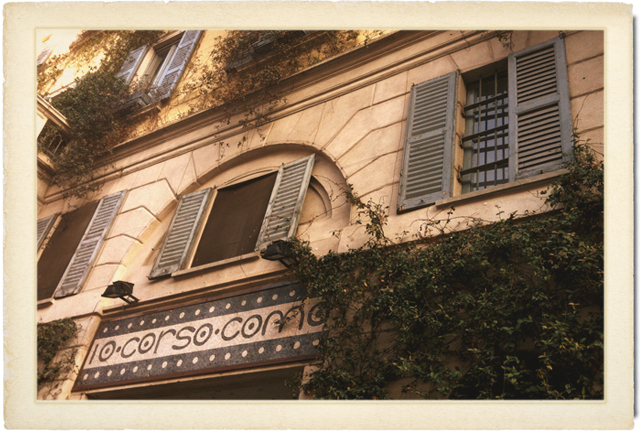
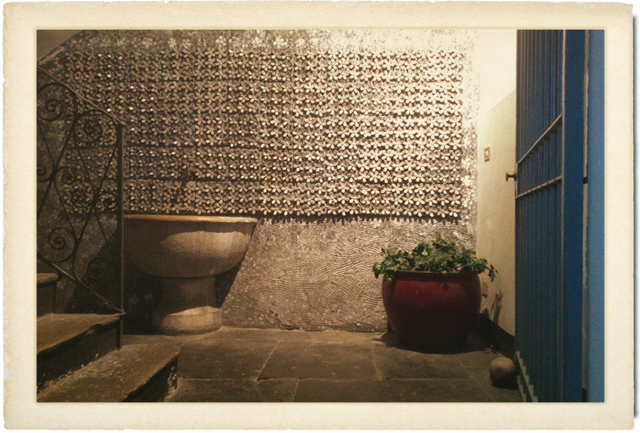
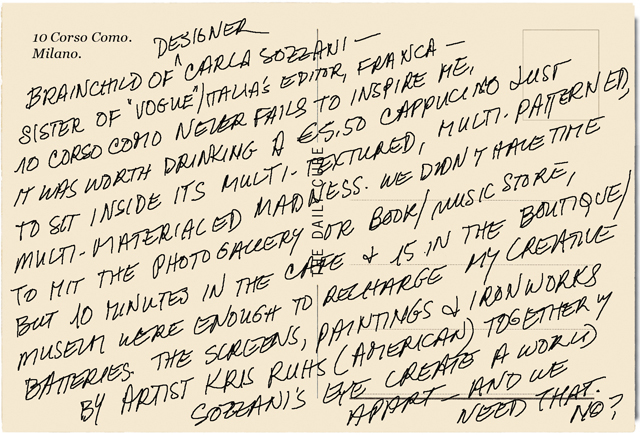
[Brainchild of designer Carla Sozzani—sister of Vogue/Italia’s editor, Franca—10 Corso Como never fails to inspire me. It was worth drinking a €5.50 cappuccino just to sit inside its multi-textured, multi-patterned, multi-materialed madness. We didn’t have time to hit the photo gallery or book/music store, but 10 minutes in the cafe and 15 in the boutique/museum were enough to recharge my creative batteries. The screens, paintings and ironworks by artist Kris Ruhs (American) together with Sozzani’s eye create a world apart—and we need that, no?]


IMAGES, from top to bottom: The entrance. One corner of the cafe/lounge. The cafe’s ceiling. Another view of the cafe/lounge. The upper portion of one corner (note the birds, who come and go at will). The entrance to “3 Rooms,” the boutique-hotel at 10 Corso Como which has, literally, 3 rooms.

Posted in ITALY, POSTCARDS | Tagged , , , , | 2 Comments

The newsstand

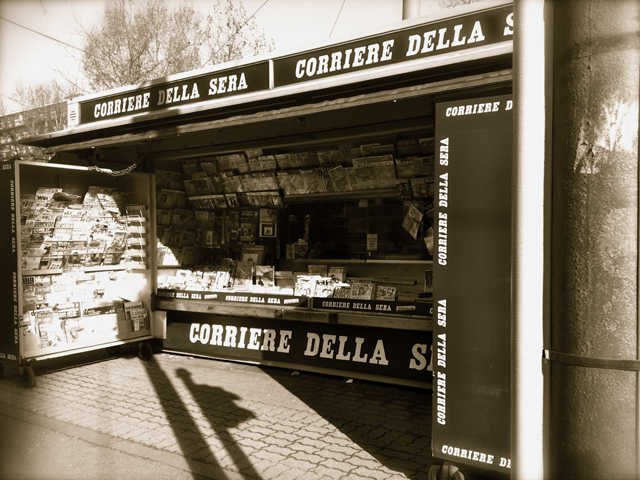
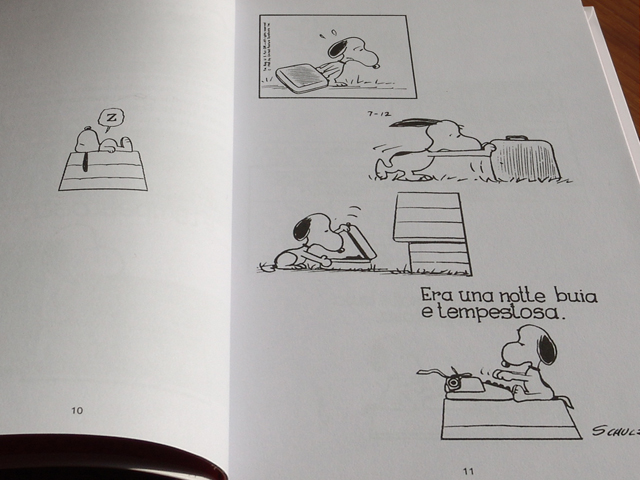
Era una notte buia e tempestosa. Although this might as well be the continual, extra bold headline at the top of all our newspapers all the time, it is in fact that famous line—translated into Italian—from Snoopy’s novel in the classic American cartoon series, Peanuts. “It was a dark and stormy night.” And it is on page 1 of the latest offering from my neighborhood newsstand. What decent American could pass that up? So even though no news is good news, it is often the case that bad news is accompanied by good entertainment of an entirely different kind. At least at the Italian edicola. Hence, “What To Do/Italy”—hang out at the newsstand.

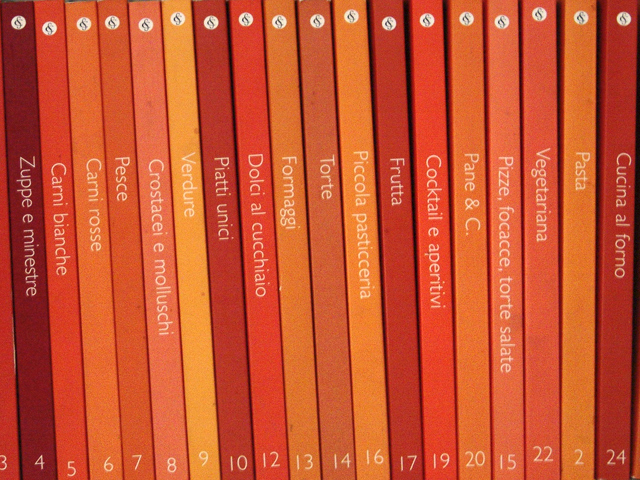
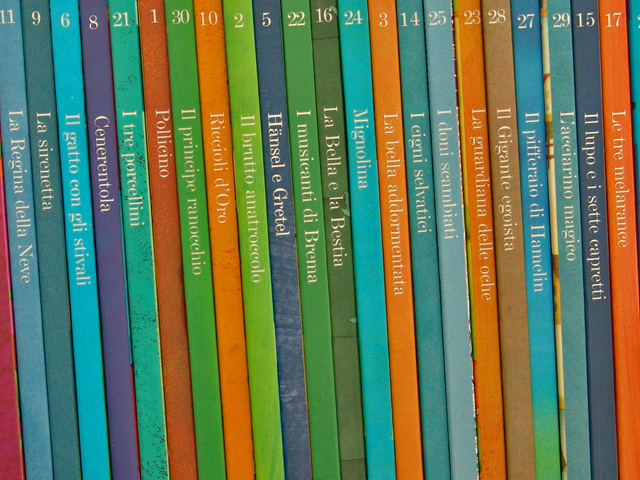
Next to newspapers in various languages (Beware! The International Herald Tribune often runs out before 10:00 in the morning), and the various Italian papers representing left, right and center, the edicole usually have a wide offering of Italian and international magazines, plus books, films whatever promotional series the newspapers are pushing at the time. The arias of Maria Callas, the complete songs of Edith Piaf, the films of Sam Peckinpaw—this is the type of fare you might be able to collect over time. We’ve purchased along with our newspapers at very reasonable prices—one a week over a period of months—entire series of cookbooks, beautifully illustrated children’s fairytales and botanical encyclopedias all at the edicola. You can also find literary classics, books on science and history, and—though I’d rather not say it—cheap toys. The latter is a trap of unimaginable proportions.


If, when in Milan, you are jonesing for the latest New Yorker, some Dutch design mag you’ve not yet heard of, the most current Apartamento, or the shots from the latest runway shows, the Edicolaccia (loosely translated: “big fat news stand”) is your destination. This indoor newsstand proudly sells just about everything, in every language 24/7. Piazzale Baiamonti 8, at the end of walking-friendly Via Paolo Sarpi (otherwise known as the heart of Milanese Chinatown).

I leave you with this image…

Posted in ITALY, WHAT TO DO | Tagged , , , | 3 Comments

Radicchio rosso di Treviso tardivo

Radicchio rosso di Treviso tardivo. a daunting polysyllabic mouthful referring to one of winter’s finer offerings: a variety of radicchio cultivated late in the growing season, November to February, depending on the weather. Perfectly crisp, pleasingly bitter and slightly sweet but with a more delicate flavor than other members of the chicory family, this radicchio—nicknamed Trevisana in most of the vegetable stands here—is my absolute favorite.

I first encountered this candy-striped beauty of a vegetable one cold winter morning about 9 years ago at the Wednesday market in Via Calatafimi. A short, stout woman whom I recognized as a portinaia in the neighborhood was purchasing it before me. I was entranced by its loosely compacted head and the fanciful flounce of the leaves. The vendor mentioned under his breath to her that the Japanese were snapping it up for import at an astronomically high price. “It’s a delicacy for them,” he said. Before the woman turned to leave, I asked her what she did with it, and she answered precisely, giving me one of my earliest and most valuable on-the-street cooking lessons.

“You sauté some onion in un filo d’olio*. I prefer cipolla tropea to the regular type; the flavor is more subtle. When the onion is transparent and sweet, you add your chopped trevisana and sauté until it begins to soften and the moisture is cooked off. Then you add the rice and stir over the heat [until the edges of the rice become transparent]. A splash of white wine, and when that cooks off, you begin to add—one ladle at a time—hot broth stirring constantly until the rice is almost ready. It’s best if you mantecare* with…oh what is the name of that cheese?…” (Here she turned to the vendor and they began a discussion about the best cheese for finishing the risotto.) “…Yes, castelmagno. That’s it.”

NOTES: I have made this recipe countless times since then. She’s right that the tropea onion is superior (these are red-tinged oblong onions with a sweet delicate flavor not unlike a Vidalia), but when I can’t find them I substitute regular red ones. And as I can’t always conveniently lay my hands on castelmagno, I also make this risotto with taleggio, but you would have success using simply a good-quality parmigiano or grana padano added in with a knob of butter at the right moment. Once in the dish, finishing off with freshly grated parmigiano and on-the-spot ground pepper is also a good idea in my book.

There are many dishes that highlight this beauty. Filled fresh pastas. Dried pastas. It’s lovely raw, chopped with shavings of parmigiano and a simple dressing of olive oil and balsamic vinegar. Braised, it makes a delicious bed under monk fish. It’s perfect, grilled alongside other vegetables with or without smoked scamorza And it marries well with stinky, delicious cheeses such as the aforementioned taleggio or the well-known gorgonzola. I am imagining some variation on bruschetta as I write this. In any case, it inspires one to create and to re-make, again and again, the tried and true.

*I’ve given two expressions an asterisk here, because they are used all the time in Italian. The first—un filo d’olio or “a thread of oil”—is used constantly to refer to that exact amount of olive oil that you would put in the bottom of the pan to begin a sauté. It implies a light hand. The second—mantecare—refers to the finishing process when making a risotto or a pasta that leaves the dish with a slightly reduced and decidedly creamier, silkier base. To say simply “finish” or “reduce” isn’t sufficient. I once saw Gordon Ramsay destroy a risotto with a half-cup of butter and heavy cream, in a gross bastardization—or at the very least misunderstanding— of what it means to mantecare. All you’re doing here is exalting the flavor, and perfecting the creamy texture that is already born from the natural starchiness of the rice if cooked properly.

Posted in IN SEASON | Tagged , , | 7 Comments

“I love beauty. Eez not my fault.”

Funny. Elegant. Bitchy. Genius. And totally over the top. That’s Valentino as seen in Valentino The Last Emperor. A great documentary about the career and life—virtually one and the same—of designer Valentino Garavani. A truly touching story about a lifelong friendship and partnernship. A compelling (and convincing) view of the ability of one man to occasionally say “Fuck you” (pardon my English, French and Italian) to the corporate biggies. A story of the victory of creativity and beauty in a world that, more and more, for the sake of money, would snuff them both out and never look back.


Once again, this post defies easy categorization. I’ve put it in “What We Wear/Italy” for obvious reasons even though I myself am still more of a jeans and boots girl (Valentino is much too rich for my blood). But I have to applaud the sheer force of his personality and passion.

Posted in ITALY, WHAT WE WEAR | Tagged , , , , | 4 Comments

Closed/Week in review


Monday
“Il bagno”
On Milanese bathrooms and why they qualify
as a Daily Cure.
(Read this.)


Tuesday
“Introduction to Confessions”
On a new category regarding the flip-side
or the dark underbelly of being an ex-patriot.
(Read this.)


Wednesday
Confession #1: My father’s ashes
On bathrooms, law-breaking and
spreading ashes in Lake Como.
(Read this.)


Thursday
“Taking comfort where you find it”
On the simplest of Italian comfort foods,
focaccia and panini alle olive.
(Read this.)


Friday
“Present-past perfume”
On time, memory, growing up and
the power of perfume to contain it all.
(Read this.)


Leave a comment

Past-present perfume

How do you categorize a post that belongs to the world of today, yesterday, scent, memory and the obliteration of geographical borders and time zones? What title do you give a subject that is big enough to fill your imagination but small enough to fill a tiny bottle? I don’t know.

I’m speaking of perfume—specifically, the perfumes of Annick Goutal—which have accompanied me in my journeys back and forth across the ocean and the North American continent. I first met her (in the form of her scents), bizarrely enough, in Portland, Oregon at the Perfume House in the Hawthorne neighborhood of the Southeast district of the city. In those days, toward the middle of the 90’s, I lived on 32nd Place, and often as I beat my familiar path to various cafés and grocery stores, I would pass the forlorn, oddly renovated structure at 33rd Avenue and Hawthorne. Portland was full of weirdness then (hopefully it still is), and I wrote the place off for months as a lair of the New Age too extreme for my tastes. But one day, I went in. Recent divorces are the best motivation to try new things, and this was one. I was in for a heady surprise.

The woman inside told me that the store was located here because the house had been built in 1906, a significant year in the history of Parisian perfumes. I don’t remember why exactly, but a quick check with Google tells me that a lot did happen that year: The first Van Cleef & Arpel boutique opened in Paris; Jacques Guerlain created Après L’Ondée; and Coty introduced La Rose Jacqueminot to name a few. On the spot, I had my first lesson in the difference between natural and synthetic perfumes (Chanel No. 5 was the first, most famous perfume to use high doses of synthetic material). And I learned that this dark, ungainly house was one of the largest purveyors of the world’s best perfumes in the United States. (The Powell’s Books of olfactory pleasure.) Utterly taken by this new world of thought and frivolity—dragged helplessly by my very senses—I bought bottles of Chanel No. 5, Chanel No. 19, Annick Goutal Eau de Camille and Annick Goutal Eau d’Hadrien—each of which seduced me in its turn. Good thing I was single and earning well.
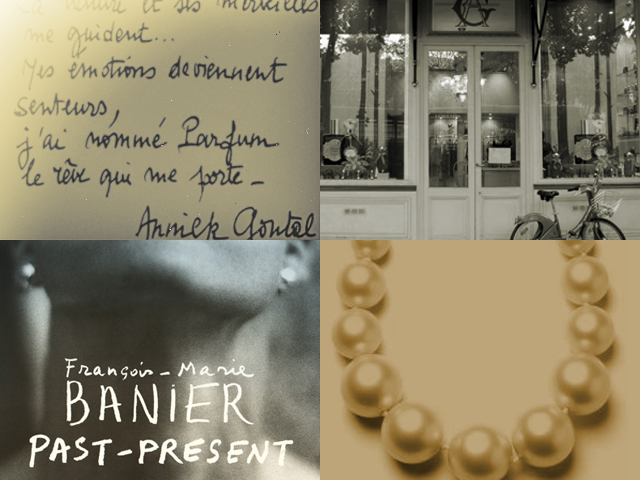
I wore all these perfumes alternately, but the Goutal scents spoke directly to my heart. Early on the light, asexual Eau d’Hadrien was my favorite, but as I grew up (not old) in the post-divorce years, I found myself tending toward more challenging concoctions. I had transferred to Amsterdam, fallen in love again, and moved to Milan when destiny, timely as ever, threw me another chance to up the ante on my perfume passion. A dear friend, Suzi, from the U.S. was coming to Paris. Would I meet her there? Bien sûr. That’s what trains are for.

It was one of those visits—inevitably too brief—when you realize that time is flying, friendships are precious, and you have 48 hours to create memories that will hold you together for the next decades. Accordingly, we found ourselves in the Annick Goutal boutique in Saint-Germain-des-Prés. We must have been there an hour or more, talking with the loquacious clerk, a modern day Wilma Flintstone (it was all in the necklace) well versed in aromatherapy, philosophy, photography and the finer points of being a “real” woman. (Andie McDowell did not fare particularly well in her assessment, as I recall.) We left buzzing with new ideas about art and ourselves via the vehicle of perfume. In short order, the clerk pegged me as a Folavril-Heure Exquise-Eau de Camille-Eau de Charlotte woman. Suzi, she said, was more the Ce Soir ou Jamais-Grand Amour type. (How gloriously over the top is that name: “Tonight or Never”?) We had been seen, recognized, understood and placed on pedestals. It felt amazing.

Last spring, my mother fell ill, and I had to fly back to New York via Paris to be with her in the hospital. I found a new Annick Goutal scent to carry me across the ocean and through the difficulty of the weeks to come: Ninfeo Mio. How bizarre and wonderful it is that a scent can give you the push, the strength, the lingering comfort you need…

A few days ago, Suzi pulled out the notes she’d taken that day on the backs of perfume labels. We discovered the photography book Past-Present by François-Marie Banier. I will be ordering it soon. What could better sum up the power of these delicate liquids than those two words. The past and the present are inside them—memory, emotion, passage—a purely Proustian thing.

Final notes: 1. My mother is well and thriving and frequently edits my posts. 2. I named my first child Camille. 3. Today is a Folavril day.

Posted in FRANCE, ITALY, WHAT WE WEAR | Tagged , , , , , , , , | 4 Comments