Closed/Week in Review

Monday
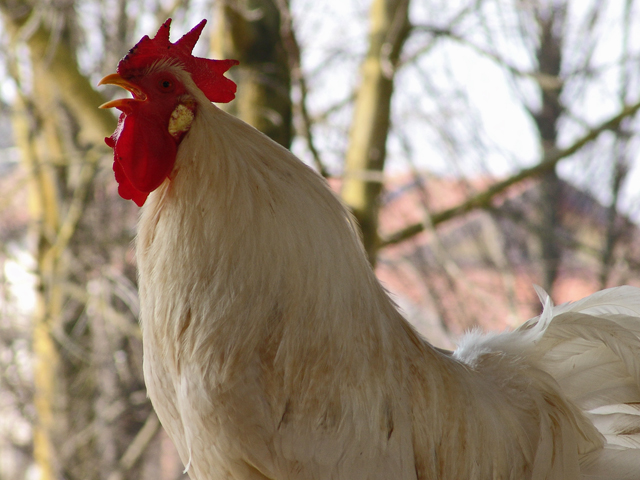
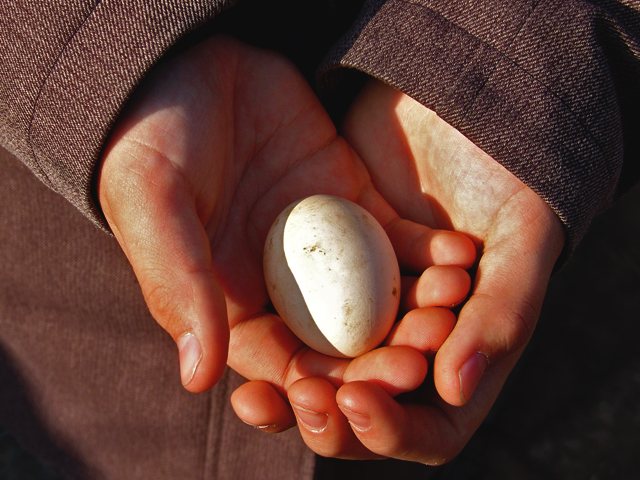
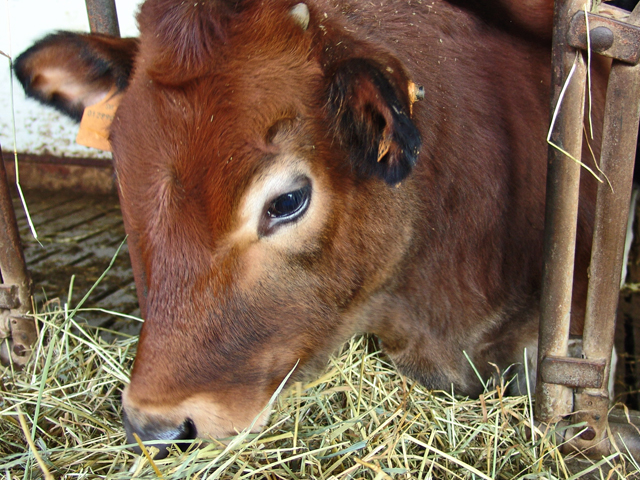
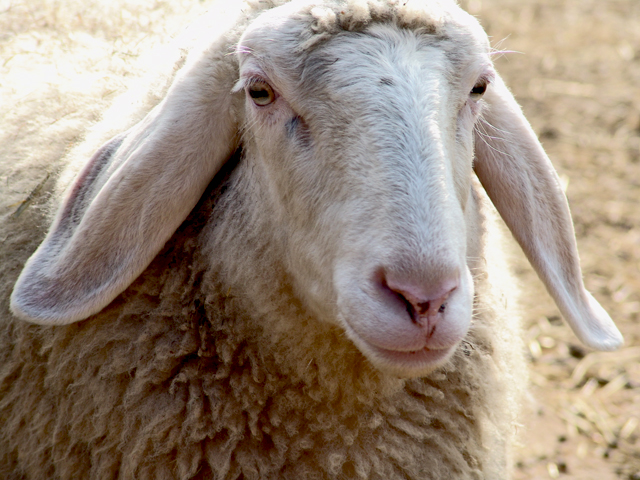
“Animal nature”
On the benefits of hanging
out at the farm.
(Read this.)

Tuesday
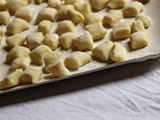
“Gnocchi”
On what you can do
with a few leftover spuds.
(Read this.)

Wednesday
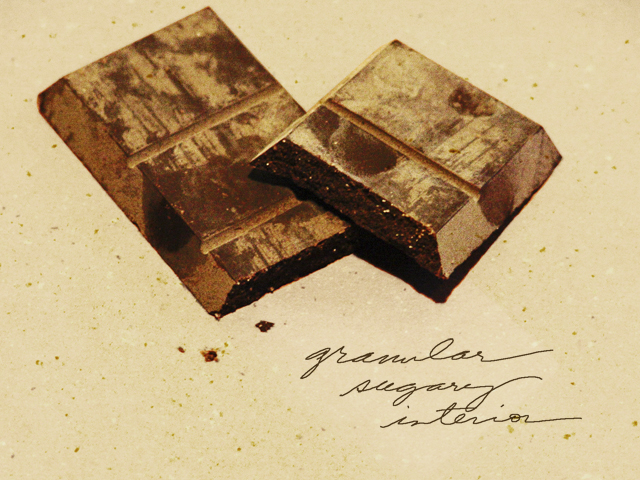
“A new (old) love for the chocolate lover”
On an old Sicilian fix
for the serious choc-a-holic.
(Read this.)

Thursday
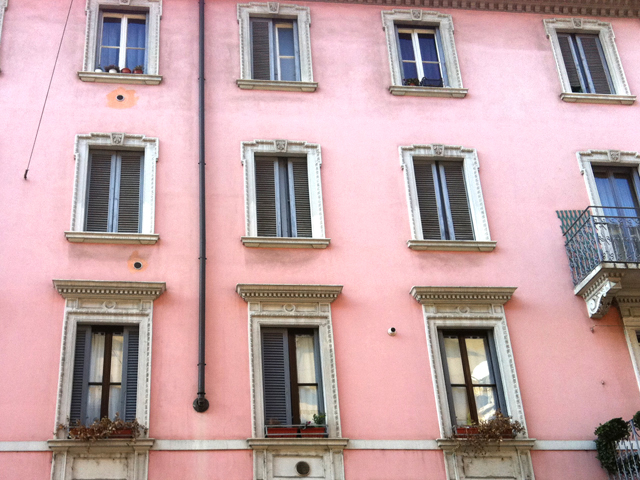
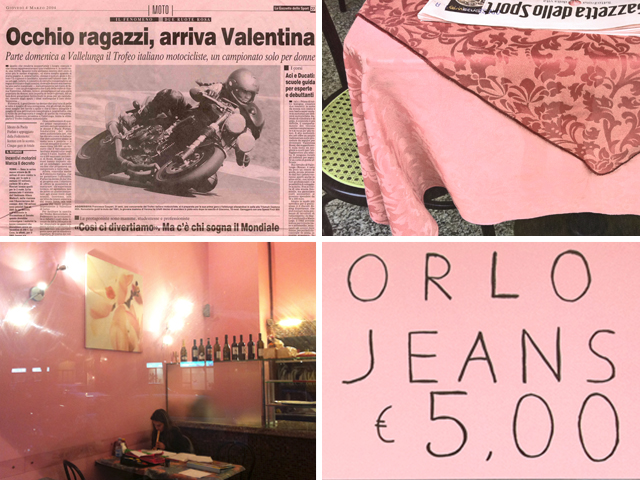
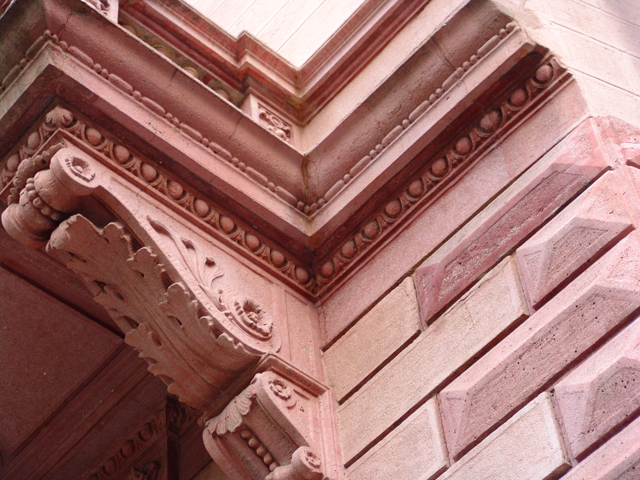
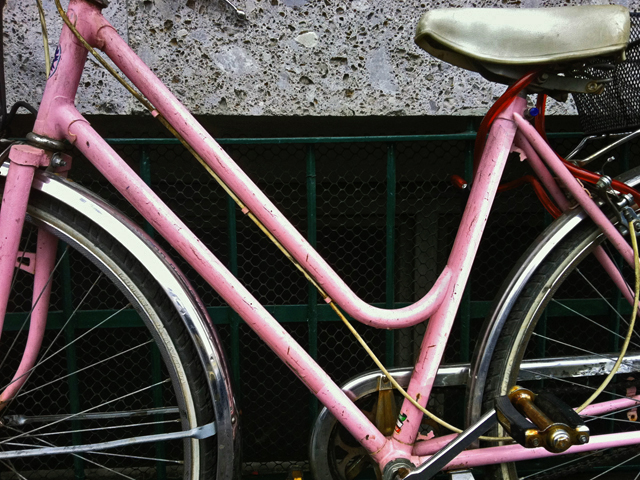
“Milan color story #3: Pink”
On the Italian version
of “La Vie en Rose”.
(Read this.)

Friday
“100 times Thank You”
A heartfelt “Thank you”
to the readers after 100 posts.
(Read this.)

Leave a comment

100 times Thank You

Dear you, dear friend, this post will be short and sweet. The small type on my stats page tells me that as of yesterday, there were 100 posts on “The Daily {French-Italian} Cure.” That is cause for celebration. A small landmark, but a landmark nonetheless. Thank you so much for hanging in there with me, for sharing your comments, for encouraging me to keep on keeping-on. In honor of your steadfastness, I give you 100 lire. They won’t buy anything, but if you put them in your metaphorical pocket, they might remind you—when you need a reminder—that joy lurks in the smallest, overseen corners. Thank you, again, for being here with me.

7 Comments

Milan color story #3: Pink

Pink is not my favorite color. Never has been. But, I have grown to like the pinks that pop up here and there in Milan like peonies out of season. I am in love with the beat-up, pink Vespa that cruises my neighborhood, but which escaped my lens. I admire the judicious use of pink tablecloths in traditional Italian restaurants. I am tickled (yes, there’s that color again) by the entirely pink interior of the mad pizzeria “Playtime” (I assume it’s named after the Jacques Tati film by that name) in via Ravizza.


The best thing about Milanese pink is that it’s not just for girls. Its usage is either too dignified or too funky or, pardon the color metaphor, simply too “out of the blue” to be considered strictly a feminine indicator. Take for example the ubiquitous sports daily Gazzetta dello Sport. It’s been pink forever. In fact, it’s nicknamed “La Rosa,” and it proudly bears the tagline Tutto il rosa della vita (literally, “all the pink in life,” but meaning “all the good things in life”). You don’t see men shunning it because of its color. Quite the opposite.

My favorite pinks are those of the palazzi—the water stained, mottled pinks of old plaster. The deep rose of carved stone. These pinks are civil and genteel, indomitable and self-assured. They make me feel—yes, this is the thing about pink—optimistic. Things will be okay. Or, as the Italians say, “Il futuro è rosa.”


[If you liked this post, you might also enjoy “Milan color story #2: Gray Lady,” “Milan color story #1,” or “The Importance of Blue.”]

Posted in AROUND US, COLOR, ITALY | Tagged , , , , , | 6 Comments

A new (old) love for the chocolate lover

Chocolate-lovers must be made, not born. I never required chocolate fixes before coming to Europe. Now, alas, I’m a helpless (though relatively controlled) addict, and my addiction (alas again, because it sounds so snobby) seems to be for really “good” chocolate. It’s my husband’s fault. He brings home the best stuff from Switzerland, and seems to be University trained in the necessary percentages of cocoa butter, cocoa and sugar. I’m illiterate on such matters; I just know what my mouth likes. And my mouth, just last week, discovered a chocolate that made it sing arias. It doesn’t come from north of the border. In fact, it comes from the opposite direction. I’m talking about the Sicilian Cioccolato di Modica.

Here are the basics. When you take this 15 cm. (the traditional length) chocolate bar out of its wrapper, you wonder what’s wrong with it. It looks funny. Wrong. It’s not sleek and smooth and uniformly brown like its Swiss cousin. It is—instead—smudgy, discolored, and slightly crumbly around the corners. Breaking it apart is akin to cracking open a geode, as the rough exterior conceals a crystalline, twinkling interior that—in the mouth—has a pasty, granular texture, punctuated by intact crystals of sugar. The chocolate is intense, slightly bitter, “whole” (if such a word can be used to describe a taste). Like whole-grain bread or un-homogenized milk, this chocolate delivers a delicious punch derived from the fact that it is distinctly less refined and therefore closer to its natural state. When you eat it, you taste what it’s made of. You sense the process, or lack thereof, that went into its creation. You might like these more primitive preparations; you might not. I love them.

Modica, in the southeastern tip of Sicily, is the home of this chocolate which is actually made using an Aztec method brought to Sicily by the Spaniards around 1700. It involves making a paste of the whole cocoa bean, without separating out the cocoa butter, and working it together with sugar at a low temperature (never exceeding 40° C) so that the sugar remains undissolved and unamalgamated in its crystalline form. This is called, in Italian, lavorazione a freddo. The result is rich and fulfilling, surprising and engaging—larger than the sum of its parts, but preserving the beauty of each part for your hedonistic pleasure.

Posted in ITALY, SAVORING | Tagged , , | 6 Comments

Gnocchi

Ah, the humble potato—that earthy lump of satisfaction and possibility. About once a year, I study the potatoes waiting patiently in the bottom of the vegetable drawer, and I tell myself it’s Gnocchi Day. The kitchen becomes a laboratory of boiling pots and floured surfaces. And about an hour later, if I’m working at a good clip, there’re warm little dumplings steaming in our bowls, covered with sauces of tomato or fontina or gorgonzola, or a simple grating of parmigiano over scant butter and sage.

1. Take a kilogram of potatoes (2.2 pounds) and 2. boil them whole. When they are tender, take them out of the water. When cool enough to touch, peel and 3. place the meat of the potatoes in a ricer. (I suppose you could just as well use a masher or a fork.) 4. Process the potatoes until you have a heap of soft, milled fluff. 5. Add 300 grams of flour (10.5 ounces), an egg, and scant salt. 6. Working on a well floured surface, knead with your hands, adding flour as needed to prevent sticking, until you have a soft, relatively elastic ball. 7. Roll the ball into a number of finger-width cylinders, then 8. cut into tiny pillows. (You can then take each of these gnocchi and roll them between your thumb and a fork to make a more ornately finished product, but the stomachs in this house have no patience for such elaboration.)

Cook the gnocchi in a large pot of boiling, salted water until they float to the surface or otherwise seem ready. Dress them according to your tastes. Lovely with a simple sausage sauce or the aforementioned classics (tomato, fontina, gorgonzola). But as I said, my favorite version of this peasant meal is with simple butter melted with fresh sage and a shaving of parmigiano. As I write this, I imagine it with a lovely glass of red wine and spicy rucola salad. But that’s just me.

Posted in ITALY, SAVORING | Tagged , | 6 Comments

Animal nature

This weekend, we had to escape the city, our routine, and ourselves. It was time. We needed nature, animals—stuff that has nothing to do with our M-F everyday fare. And we found it, at the Fattoria Pasqué outside Varese, an easy 45 minutes from Milan. This is just one of many places along the lines of an agriturismo not far from the metropolis, where you can take city-weary kids to working agricultural establishments, and let them be one with farm animals of every description. But it’s not just the children who are healed by such outings. My first glance at the baby goats was as good as a Xanax.


Being in the presence of animal nature and animal intelligence is a great way to shake off the rather meaningless ambitions that accumulate in my mind over time. Watching the cows chew their hay or the free-range chickens scratch out a hollow in which to lay an egg calms the nerves. Even the smell of animals is sweet to my nostrils. I like being with them. I like, too, what happens to my children when they are surrounded by chickens and geese, pigs and sheep. They seem happy in a pure, uncomplicated way that has nothing to do with being entertained or having “fun”—as if they, too, are returning to their natural state. They run. They serenade peacocks. They whisper sweet nothings in the donkey’s ears. They glow with exertion, and work up healthy appetites for hearty food.


And hearty food is in abundance here, served simply in a no-frills restaurant featuring the products of the farm. I’ll remember the ice cream that topped off my meal best, though— just the cold, creamy essence of milk. Fresh, simple, good. But then again, that is how I would describe the whole experience. At one point during lunch, I asked my husband, “Do you think this all tastes so good because we’re here at the farm? Or would this taste amazing anywhere?” He didn’t know. It was impossible to unravel the “delicious” from the “happy.” And, honestly, who would want to?


Posted in ITALY, WHAT TO DO | Tagged , , , , | 9 Comments

Closed/Week in review


Monday
“Confession #2/Prison and flight”
On limitations and liberations
of living overseas.
(Read this.)


Tuesday
“Fashion: The flip side”
On the opposite of haute couture
the open air market.
(Read this.)


Wednesday
“A little here, over there”
On surviving and emerging Italian
food culture in San Francisco.
(Read this.)


Thursday
“Memories of: Les frites de ma mère”
One woman’s memories of
a French mother in a Florida kitchen.
(Read this.)


Friday
“Torno subito”
On the use of a most common phrase:
“I’ll be right back.”
(Read this.)


Leave a comment

Torno subito

For Janet.

Here’s an Italian phrase worth knowing. Simple. Useful. Completely analogous to its English version. And constantly in fashion:

Torno subito.

“I’ll be right back.” I expect that in every culture in the world it means exactly two things. One: “Wait here. I really will be right back.” And, two: “I have no intention of ever coming back, at least any time soon, but I don’t want to hurt your feelings.”

It’s the subito that’s so questionable. That word that means “immediately.” Or “never.” Ask any Italian child what their mother means by subito and they’ll answer the same way an American child would. Or an Australian. Or a Brazilian.

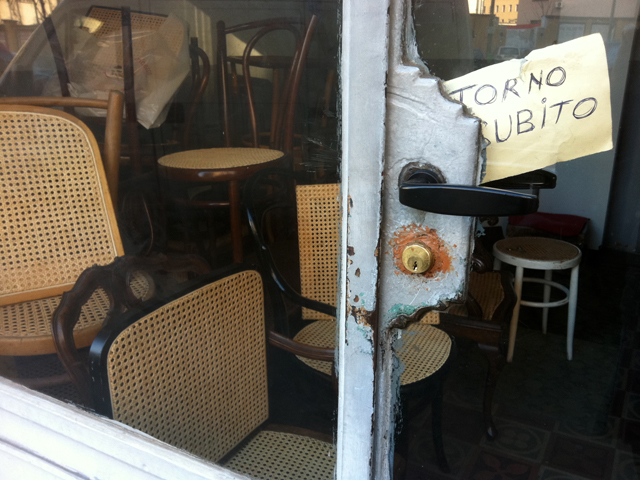
That’s why when we showed up at the laboratory of the man who re-canes our chairs, we were stymied by the sign in his door. Did he mean that he’d just gone to get a quick caffè and would return right away? (Not a very consistent behavior with this choice of profession, if you ask me.) Or did he mean that he’d gone to get a caffè corretto (i.e. with grappa) and that he’d come back when he damn well pleased? (Seemed more likely.)

In any case, we waited. And it turned out to be a perfectly delightful wait. Life on the Italian street rarely disappoints. A young woman had parked her car over the tram track and disappeared, so the tram was stuck, with nothing to do but honk its weird little horn. The tram driver got out, studied her vehicle. Scratched his head. She hadn’t hung a torno subito sign on her car, but she might as well have.

As destiny would have it, both our chair-fixer and the car-parker did come back, if not immediately, then within the chronological realm of feasibility.

Torno subito.

[If you liked this post, you might also like “Monday: Living the rhythm.”]

Posted in ITALY, THEY SAY | Tagged , , | 4 Comments

Memories Of / #3

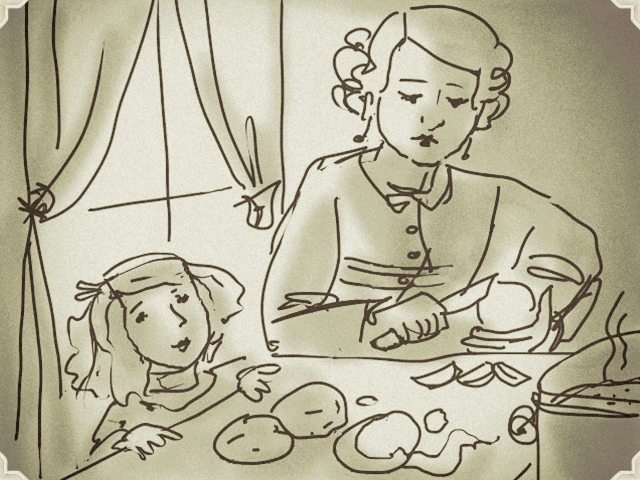
My thanks to dear friend Anna Harrison for contributing this post. I’ve had it for ages, and I’ve just now gotten around to publishing it. My apologies. It was my original intention to try and make these frites in my own kitchen and photograph the process, but I knew I would never get the flick of the wrist right. So I’ve drawn a picture instead. My attempt to capture someone else’s memory. Faulty at best, but done with love.

My mother made the absolute best french fries on earth, I don’t care what you tell me. The taste was completely different from any other I’ve ever had and I’ve tasted a few. What did she do differently? Nothing particular about the potatoes, she just bought regular ordinary old potatoes, the big ones, though not the baking kind. No, it’s just that, well, she knew how to cut them first of all. The French don’t just peel and cut them in long french fry-looking strips. They peel, then insert the blade of the knife into the potato and then sort of twist the wrist upward, cutting just the right amount off to form the french fry, or rather frite.

Okay, and then there’s the oil. I think in France they use vegetable or olive, but my Mom used peanut oil. (Is it healthy? Probably not.) So she heated the oil in the frying pan, about an inch or so of it, and then when it was nice and hot (you test it by tossing in one small frite and if it starts sizzling right away you know the oil is hot), she gently placed the potatoes into the oil in handfuls until they were all in there.

Once they started to turn lightly brown, she scooped them out with one of those flat round thingies with holes in it, allowing the oil to drip out with each scoop, and put them into a colander over a paper napkin and just let them sit there for a minute or two. Then plop back into the oil again where they finished browning and became just the right caramelly shade and needed to be removed to the serving bowl, scooping them out the same way as before. Then a dusting of salt and onto the table. Amazing: toasty on the outside and just the right semi-softness on the inside. The delicious flavor of the potato, like no other.

NOTE: I first published this post with an embarrassing error in it. I used “Hines” as Anna’s last name instead of “Harrison.” Long story. Wrong has been righted. Sorry, Anna. Old habits die hard.

Posted in FRANCE, MEMORIES OF | Tagged , | 4 Comments

A little here, over there

This is a lovely little video about surviving and emerging Italian food culture in San Francisco. Makes me wonder: if I did move back to the States, how would I carry this experience with me? How would it influence my American life? Where would I live that would feel like home? Would the life I’ve had here still inform the way I would go about finding peace and happiness or would I just recreate myself? Food for thought. And speaking of food:


Film by Jeff Diehl of Spots Unknown.

Posted in ITALY, SAVORING | Tagged , , , | 1 Comment