Taking comfort where you find it

Time today has been short; not more than 15 minutes for blogging. But what I have to say takes about ten words or less. Don’t hold me to that, but here goes: Comfort food Italian style doesn’t get any better than focaccia and panini alle olive. OK, that was fourteen words, and I’m about to blather on a bit more. But these lovelies warrant it.

I don’t let my children or myself indulge in this stuff often; you can imagine why. But there are times when nothing else will do. Yeast, olive oil and sea salt are most surely the ingredients of a deep, cozy conviction that life can be okay if only you’ll let it. In moderation, this is the stuff of a happy tummy, the antidote to a stormy mood, and one of the loveliest (and cheapest ways) to welcome yourself back to Italy after traveling elsewhere. Yum.

Posted in ITALY, SAVORING | Tagged , , , | 2 Comments

Confession #1: My father’s ashes

I’m afraid I’ve opened the floodgates with “Confessions.” So before returning to milder fare (next stop: focaccia and olive bread in “Taking comfort where you find it”), I’m going to share this—my first confession—with you.

A few years ago, my father died. It was in March, the very month in which he’d been born. Now, with March approaching again, my heart and mind are gearing up for the extra emotional load that seems to fall squarely upon them when the hands of my psychological clock sweep over this familiar time of year and its difficult events undimmed by the passage of time. My dreams of him will intensify, my memories will sweeten. His presence will increase. And I will remember, laughing, how one Sunday afternoon that very Spring, my little family and I scattered his ashes on Lake Como.
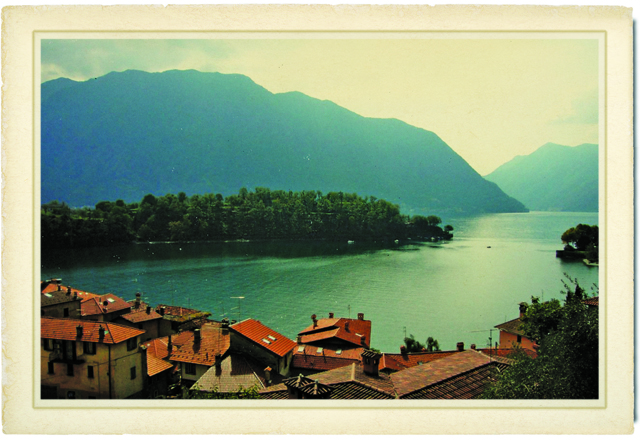
Rewind. My father had always been a timid traveler. He was a British historian, and his trips to England over the years were happy events for him. But I don’t think he’d ever anticipated having a daughter in Italy, a country of dark-haired people with Latin temperaments and—egads—a language that wasn’t the King’s own English. That said, coming to visit me twice a year, which he did religiously, became a mark of his elderly courage and spirit. In his 70’s he overcame his linguistic timidity and traveled here despite it, so strong was the paternal bond and need. The journey seemed to free him. It opened new doors. It gave him better stories to tell when he went home. And, most of all, his lady companions loved coming with him.

One year, when he came alone, before the children were born, we went to Bellagio on the banks of Lake Como for an afternoon. Somewhere on the winding road that day—I can’t say precisely where—we stopped at a bar which was built half on the hill, half overhanging the Lake itself far, far below. The WC, in fact, was in that portion of the ancient structure that vaulted out over the gorge, and the “toilet” was the type that consists of a hole in the floor flanked on both sides by raised, treaded slabs of porcelain, where you plant your feet while squatting above the hole. I don’t know if this real or imagined, but I remember catching a glimpse of the pine trees clinging to that precipitous slope through the small hole, then relieving myself over them, fresh air circulating around my naked haunches. My father did as well, and he emerged from the bathroom with a grin on his face for all the world to see. He had a well-developed scatalogical sense of humor, and this bathroom suited him to a T.

Later, we ate at a restaurant. I don’t remember what we chose, but he probably had spaghetti alle vongole. He loved them. Meals never failed to thrill him here.

I took two pictures of him that day, and in both of them he looks unusually at ease and deeply happy with windblown hair under his jaunty tweed British cap.

Fast-forward to the year he died. My father was cremated, as had been his wish. Most of his ashes were scattered behind the church he attended in Chattanooga, Tennessee. I reserved a portion of them to bring back to Italy with the specific intention of scattering them on Lake Como, the site of that perfect, happy day. I had visions of arriving at a lovely curve by the lake’s side, making my way gently through sweet-smelling underbrush, and casting his ashes upon the silvery waters while murmuring a private prayer of peace.

But as has so often happened when I’ve expected “the romantic” in Italy, things took a dramatically different turn. Half way to Como from Milan, my husband told me simply that spreading ashes wherever you wanted to was illegal in Italy. I was shocked. “What are we going to do?” I asked with a sinking heart. “We’re going to spread them,” he said. “We just have to make sure no one sees us. That’s all.” This typically Italian proposal to work creatively around restrictions both comforted and upset me, but I needed to go with the flow on this one, if I wanted to leave a part of my father in the Lake.

The in-car navigator cheerily conducted us up and down a wildly winding road, at one point heavily trafficked by racing bikes plying tenaciously towards the Madonna of Cyclists (La Madonna del Ghisallo), perched at the top of the mountain. Past the Madonna we flew. Up and down we went, up and down, in and out, now near the Lake, now far from the Lake. But every time we approached the Lake’s edge, one of two things happened. Either it was, in actual fact, much too dangerous to stand at the edge as it was high above the Lake and dropped off sharply, or there were throngs of tourists and the buses that had disgorged them. Again and again, we stopped the car, but we never found the right place to perform our little ceremony in private.

I was losing hope, but my husband had an idea. “We’ll cross the Lake on the ferry, and we can spread the ashes from the boat.” My sense of romance restored, we made our way to the ferry landing in good time, bought our ticket, and got in line to drive onto the massive conveyance. What I had conveniently forgotten, however, was that ferry boats aren’t constructed for the poetic broadcasting of ashes. They are built for function and safety. Being a beautiful day, the upper decks were crowded with tourists. (There would be no ash-tossing from there.) And the parking level, where we were, was being regularly patrolled by ferry staff. Not to mention the fact, that in the narrow space between our parked car and the walls of the ferry, there were no vast open spaces for viewing the lake, just the occasional porthole or narrow opening to allow for ventilation.

In the end, I distributed the ashes between myself, and my children, and like mad people intent on committing a petty crime under the radar, we jabbed (scattering would have been too slow a process) my fathers ashes in great unceremonious fistfuls toward the lake, through the portholes, every time the coast was clear. The wind blew many of them back towards the boat. Others made it into the water. But even after this vigorous, coordinated attack, when we’d reached the other side of the lake, I still had ashes in my possession.

There’d been no prayer, no thoughtful words, no time to watch the ashes waft toward and become one with a pearlescent surface of the famous Lake Como. No. Bone bit and biological material had just been thrust into the air, either to end up back on the boat or at the dark, weedy bottom of a lake. Fish food. And yet, and yet—

We were giddy with happiness. We’d broken the law. Many of my father’s ashes were in Lake Como. It had been—yes—it had been very fun and funny. And, most of all, my Dad would have loved it.

With light hearts, we went to eat at a lovely restaurant perched picturesquely above the Lake. The food was delicious. The wine was light. The lake sparkled like a jewel. After coffee, I went to the bathroom, carrying my father’s ashes with me. Then I returned to the table, we payed our bill, and we headed home.

Back in Milan I realized that I’d left my father’s ashes in the bathroom of the restaurant. This final indignity was even more perfect than the previous one. He would have been perfectly happy spending the night in such a place, and the well-rounded comedy of the day would have deeply satisfied his sense of the ridiculous and the ironic. We went back the next weekend and retrieved what was left of his ashes.

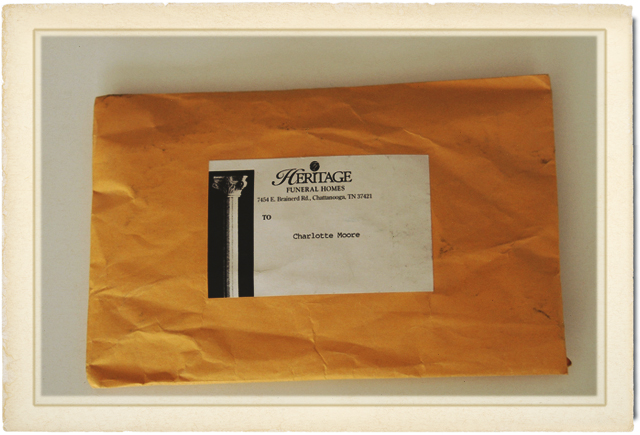
They are still in the desk drawer next to me, in a plain manilla envelope from the funeral home.

Posted in CONFESSIONS | Tagged , , , , | 8 Comments

Introduction to “Confessions”

Something about this blog—my blog—has been bothering me for a while. I attempted to address it months ago, but had technical difficulties pulling off what I had in mind. What irritated me was this: by focusing only on those things that I love about France and Italy (and the list is long), I was somehow laying a facade, or a sheen—a sort of perfectly smiling mask—over what is often a deeply flawed and comical existence. Like any human existence. You can’t be the “foreigner” in a situation without being simultaneously the one who doesn’t get it or the one who says the wrong thing at the wrong time or, simply and most painfully, the one who sometimes doesn’t belong.

There are also, despite the countless reasons to feel that your soul has literally been saved by shifting continents, many things about your adopted country that drive you virtually mad. Sometimes, you can’t stand it. You can’t help it. You are what you are, and in some very surreal ways, you become more deeply what you are as time goes by in a strange and foreign land—no matter how much you love it, and no matter how much you feel that it is where you belong.

No honest ex-pat story is complete without this side of the affair. No rollicking tale of paté and open-air markets, Alessi design and French wines, can go for long without the—let’s be honest here—more interesting human underpinnings: confusion, alienation, fear, hilarity, and the pharmaceutical cocktail that makes it all okay in the end. One part patience/one part persistence, shaken, on the rocks.

The fairy tale has two protagonists—a fair princess named Sometimes and her awkward, pimply twin, Reality. “The Daily Cure” is my way of giving thanks for those Sometimes moments that make life amazing. “Confessions of an Ex-Patriot” is my way of putting those thanks in a context that helps them make sense. There’s a reason I love trams and bicycles so passionately, and it’s not just environmental conscientiousness. It has as much to do with never having grown comfortable navigating Italian streets in a motorized hunk of metal. I drive, yes, but I’m not a native behind the wheel. I sweat. I panic. I lose my sense of direction. I stall, freeze, break laws flagrantly. Voilà—the seeds of a story, the beginnings of a confession yet to be told in its entirety.

Some confessions will be memories of things past. Others will be “live.” In any case, I hope you’ll hang in there with me through these unavoidable aspects of Life Abroad that most certainly were not, are not, and will never be ready for their close-ups but which are nonetheless a part of this struggle called happiness.

My thanks to Ann Moore for copy-editing this post.

Posted in CONFESSIONS | 9 Comments

Il bagno

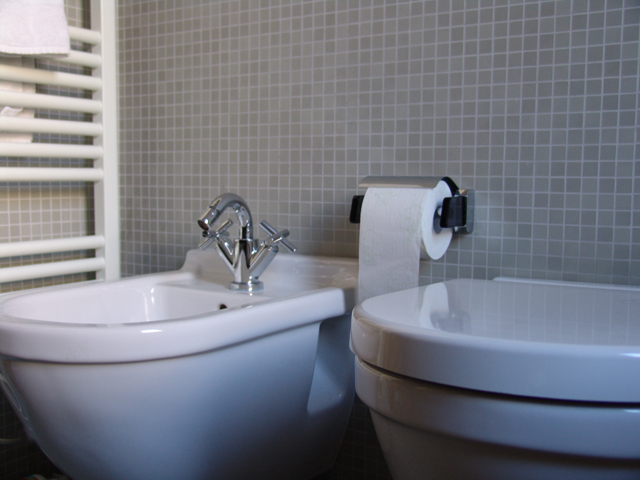
My first Milanese bathroom was in the old Diana Majestic Hotel in Viale Piave which has, alas, been spruced up since by Sheraton. I thought I’d died and gone to shabby-chic, single-girl heaven. The bathroom was enormous by any familiar standards, covered in tiny blue tiles from floor to ceiling. The bath, towel warmer, toilet, bidet and sink were swallowed up in this undersea space, which would have been dark and somber had it not been for the stately double window that opened out toward the street.

I occupied this room a mere two nights while shooting a Microsoft commercial in the Stazione Centrale, but the impression it made on me in terms of what a proper bathroom should offer—finances and space permitting—has never faded: a deep, long tub; a bidet; a towel warmer; and sufficient wall space for artwork.

I grew up scoffing at bidets. We all did, if we even knew what they were. Like so many American assumptions, my notion of whether something is “okay” or not was linked to the associations I made with it. Hence this train of thought: bidet – bottom-washing – icky stuff – bad.

Well, let me tell you right now, not only is a bidet great for below-the-waist hygiene (which is, believe it or not, luxuriously refreshing midday), it’s also fabulous for soaking sore feet, washing things by hand, giving the dog water, and occupying bored children. (Do you know how many Barbie dolls can swim in a bidet?)

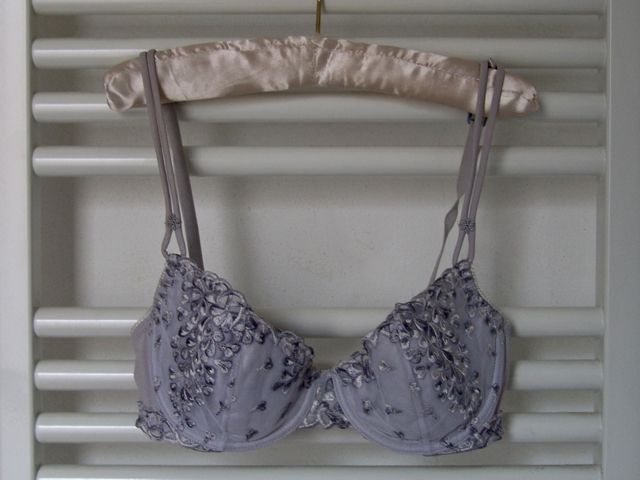
Conveniently, in our bathroom, the bidet and toilet are situated next to my other favorite bathroom installation: the towel warmer. Again, something which once seemed quite antithetical to my austere Puritanical roots, the towel warmer is a multi-functional appliance that gives the bathroom and its lucky inhabitants a near constant source of radiant warmth and dryness. Hand washed delicates or bathing suits dry on it instantly. And towels stay warm, dry and free of mustiness. But most of all, when you go to the potty in the middle of the night, your bum doesn’t come in contact with frigid porcelain (ouch!), for everything within the towel warmer’s radiant reach is nice and toasty.

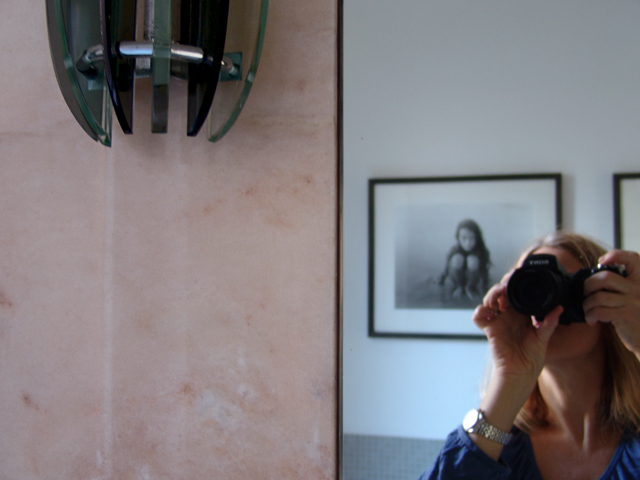
A final note: the other aesthetic quality I’ve grown to love in the Milanese bathrooms I’ve known, is a funky mixture of absolutely modern functionality together with the graphic remnants of times past: marble, mosaic tile, and mod light fixtures. The photographs in my bathroom are the work of Jock Sturges and Guzman.

A question for my readers, many of whom have more experience in Europe than I do: Can you tell me why I see more bidets in Italy than in France, even though the bidet, I presume, is a French invention?

My thanks to Ann Moore for copy-editing this post.

[If you liked this post, you might also like “Ode to linen.“]

Posted in IN THE HOUSE, ITALY | Tagged , , , , , , , , , | 8 Comments

Practicing what I preach

Yesterday’s post was what it’s about today. Hope you’re doing a lot of the same; i.e., nothing in particular. See you Monday.

Leave a comment

The all important “far niente”

I know that whoever adapted Elizabeth Gilbert’s Eat Pray Love for the screen got there before me with the phrase “il dolce far niente,” but you can never explore quite enough the importance of this idea. Besides, in the film (which disappointed me no end), the phrase is introduced in a barbershop by a man who somehow equates it with going to sleep with his friend’s wife while a listening Julia Roberts eats nonstop and grins—a collection of actions which pretty well sums up the meager point the film-makers wish to make about this country: you eat, you have sex, and you’re happy. Not that these activities don’t contribute to one’s well-being, but how one-dimensional and off the mark can you be?

Il dolce far niente. Il bel far niente. Literally, “the sweet, or beautiful, (act of) doing nothing.” In the film, it’s translated “the beauty of doing nothing” because that’s about as close as you can get in English. But it’s not really correct. The noun here—and the nugget of the idea—is not beauty. It’s the infinitive “to do” (fare)…far niente…to do nothing. Sweet idleness is what we’re talking about here.


To me, il dolce far niente deserves a more serious expression of its depths. Doing nothing isn’t about recklessly wasting your lunch-hour in the act of adultery, which is, in my book most certainly a way of keeping yourself busy. It’s about fermentation, meditation, and observation. It’s about being mentally still long enough for life to wash over and through you. You may be briskly walking or lazily stroking a dogs head or gazing absently at the sky, but your mind isn’t focused on ticking items off the endless To Do list that becomes the script of our lives. It’s about allowing the gathering clouds of your own thoughts to pile randomly one upon the other until they can’t help but release the blessed rain. It’s the opposite of doing and keeping busy. It’s the absence of mindless productivity. It’s the liberation from duty, from “must.”

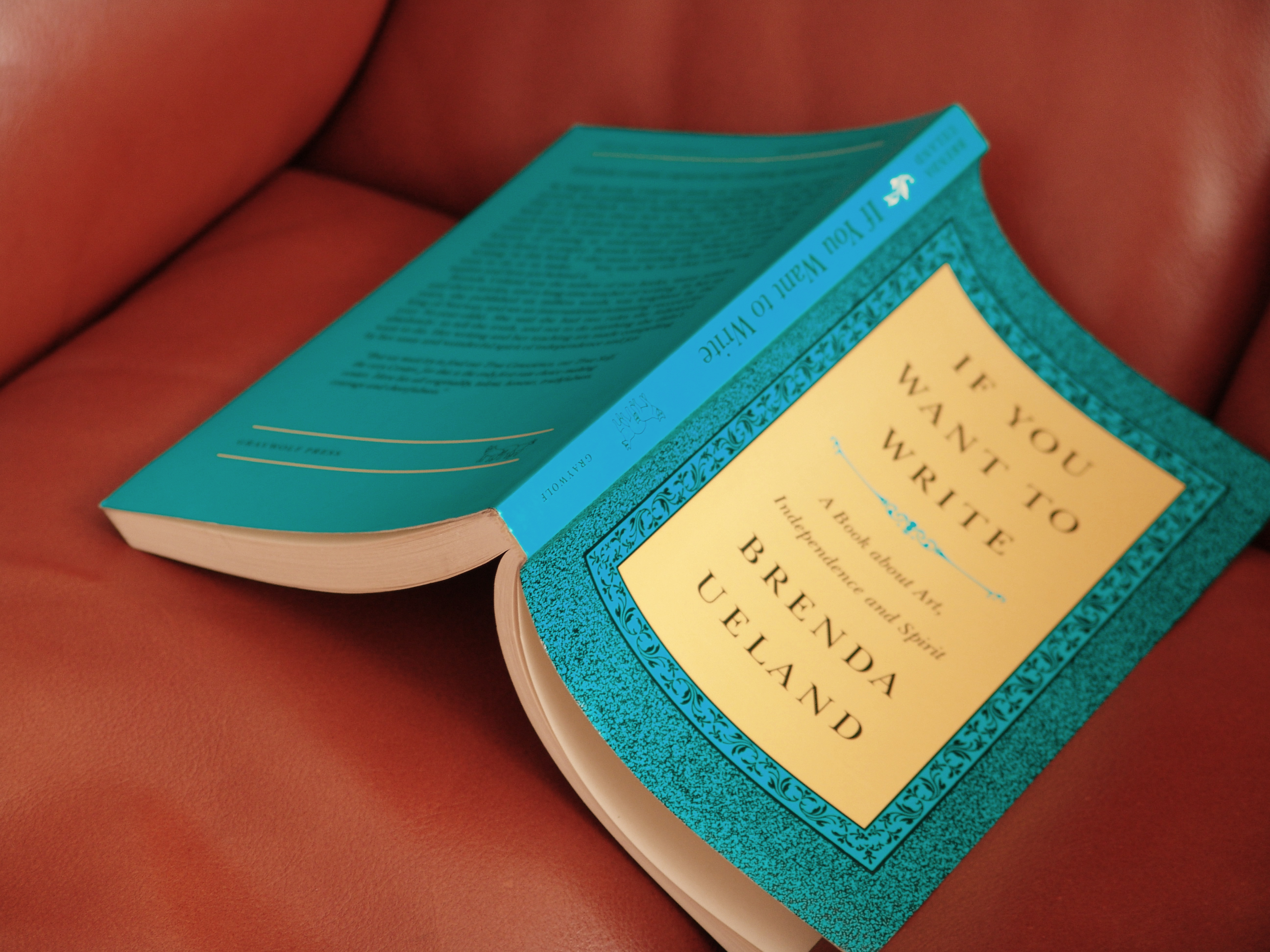
The presentation of the notion was so horrifically superficial in the film, that I didn’t give it another thought. But this morning, while re-reading Brenda Ueland’s magnificant book If You Want To Write (1938), I was overcome with the desire to revisit it. Ueland’s aim is to encourage would-be writers to write. But in taking on this task, she lovingly wraps her arms, mind and heart around the whole difficult issue of creativity and freedom of spirit. She challenges—without once ever falling into the by-now hideous rut of self-help parlance—everything about our lives that enslaves and paralyzes us. She speaks eloquently and convincingly about setting yourself free, and a huge part of that effort is giving yourself time, as she charmingly says, “to moodle.”
You won’t find il bel far niente or il dolce far niente translated as “moodling” anywhere else on the internet, but I’m going to suggest it here. Ueland writes: “I don’t want to warn you against action. I just want to cheer you up by saying that nervous, empty continually willing action is sterile and the faster you run and accomplish a lot of useless things, the more you are dead.” She says, earlier, “…great and creative men know [that] what is best for every man is his own freedom so that his imagination (it can also be called the conscience or the Holy Ghost) can grow in its own way, even if that way, to you or to me, or to policemen or churchgoers, seems very bad indeed.”

It is not easy advice to follow. We are hard-wired not to do nothing. And yet, how much richer we might all be—richer in spirit and art and love and human cooperation—if we stopped and contemplated and let the freedom of non-accomplishment loosen our creative powers and insights. The gift Italy gives us is not endless meals and bottomless bottles of wine and carefree idiotic laughter (thank you Hollywood). Italy’s gift to the world is a cultural predisposition toward understanding, allowing, even encouraging—at times—the doing of nothing which is inextricably linked to the creation of art and healthy human relationships and simple mental health. And if that sentence is too cumbersome, there’s this: when I finally get around to letting myself do nothing at all, it is very, very dolce indeed.

[If you enjoyed this post, you might also like “Tranquility.”]

Posted in ITALY, THEY SAY | Tagged , , , , | 9 Comments

Here’s looking at you, kid

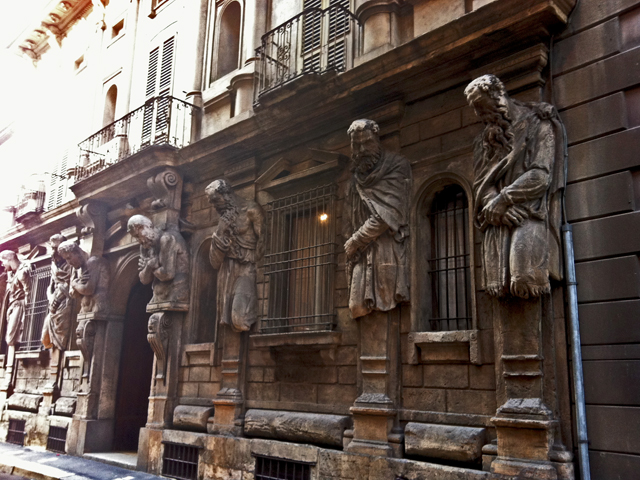
As you’ve probably figured out by now, walking around the city is for me a cross between a sacrament and an hour of therapy. Nothing—nothing—lifts my spirits like being “out there,” observing. And I am always tickled and surprised when I find spirits from the past observing me in return. They are everywhere, peering down on us from hundreds of years ago with the weight of a building—if not the world—on their shoulders, or perching insouciantly on a window ledge taking aim with mirth and full (albeit marble) bladders.

Sometimes these figures flirt. Sometimes they look down in severe judgment. Sometimes they merely observe with the philosophical intensity (or is it detachment?) with which the real life philosophers, scientists and Olympian gods that inspired them most likely regarded humanity. The most famous series of such telamons in Milan is this one: Casa degli Omenoni (The house of the big men), Via degli Omenoni, constructed around 1565.

I wonder. If we had to sculpt such a house now, who would we put on it to represent our times? Sarah Palin following us in the sights of her hunting rifle? I think, and hope, not. I prefer cherubs and enlightened thinkers.

[If you enjoyed this post, you may like “Milan Color Story #2: Gray Lady”]

Thanks to Ann Moore for correcting my spelling! And please see this blog for more information and a closer look at the “Big Men” of Milan.

Posted in AROUND US, ITALY | Tagged , , , , , , , | 3 Comments

Postcard #8: The Armani Wall

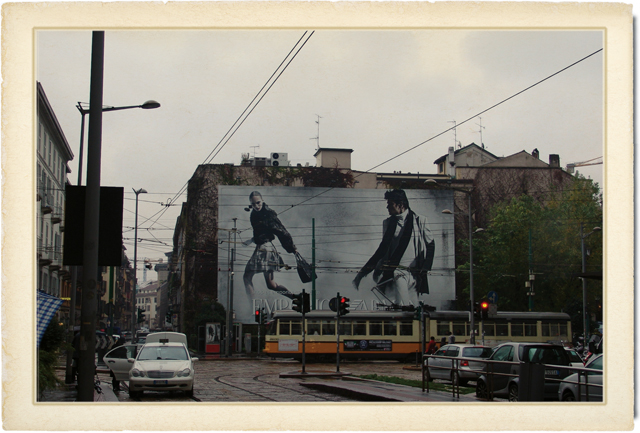
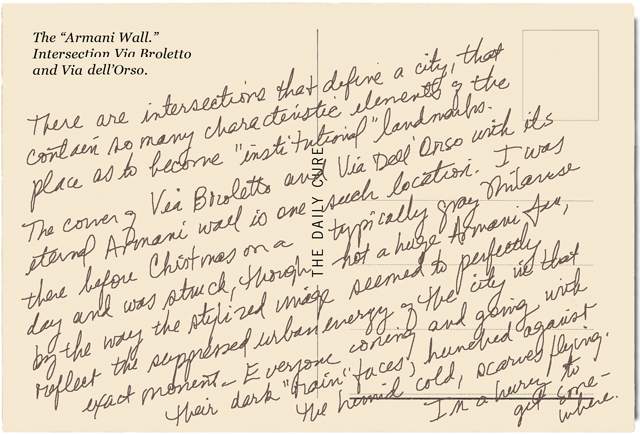
[There are intersections that define a city, that contain so many characteristic elements of the place as to become “institutional” landmarks. The corner of Via Broletto and Via dell’Orso with its eternal Armani wall is one such location. I was there before Christmas on a typically gray Milanese day and was struck, though not a huge Armani fan, by the way the stylized image seemed to perfectly reflect the suppressed urban energy of the city in that exact moment—Everyone coming and going with their dark “rain” faces, hunched against the humid cold, scarves flying. In a hurry to get somewhere.]


[If you enjoyed this post, you might also enjoy: “Postcard #5: Wilde Posting.”]

Posted in ITALY, POSTCARDS | 3 Comments

The smallest of businesses

I have written before about the importance of small scale business to the quality of life in Italy, but I’ve concentrated more on the well-established neighborhood “Mom and Pop” enterprises than I have on those that might well be even smaller or itinerant. As a child growing up in the United States, I was delighted by the eery recorded calliope music of the approaching Ice Cream Truck during the sweltering heat of summer. And I remember my mother masterfully managing door-to-door vacuum cleaner and encyclopedia salesmen with their elaborate in-home demonstrations and displays. These people along with the human transaction they required, though perhaps irritating to my parents, were fascinating to me and added to the texture of my early years.

In Italy work on this scale is alive and well, or so it seems, in the form of negozi ambulanti or itinerant boutiques and services. Tiny three-wheeled trucks (api, or “bees”) ply their way through the city streets selling goods and services at your doorstep, calling their wares as they go. “Arrotino! Arrotino!” This is the cry of the knife-sharpener, who often also repairs umbrellas or supplies replacement parts for gas stoves. Another “pick-up” model of the same small truck sells house plants. I love seeing the tiny truck zip through town laden with palms like so much plumage on an exotic bird. In the summer, an ape comes by our street with crates of Pugliese strawberries. And there are fleets of others that buzz through the city, spending different days in different piazzas, selling everything from linen to cashmere to beach clothes.

But my favorites by far, and I can’t say exactly why, are the men (there may be women as well, but I’ve never seen any) who re-cane chair seats. They themselves are not always visible, as they seem to leave their posts often to take coffee- or grappa-breaks. But they leave the signs of themselves, their craft and their business in full view, though randomly, around the city sidewalks. I’m referring to the image you see above: the plastic chair with a strip of caning taped to it. Usually, there will be business cards distributed there as well. If you have chairs that need repairing—we always seem to—you pick up a card and call later to make arrangements. I, who also try to make a living by selling what I do, am in awe of the simplicity and efficiency of this arrangement. I’m sure annual earnings are low, but there is, somehow, great dignity and honesty in this lo-tech self-promotion. “This is what I do. If you’re interested, call. Basta.”

[If you liked this post, you may also enjoy “Small scale production” and “The hood—Italian style.”]

Posted in AROUND US, ITALY | Tagged , , , , | 3 Comments

Le macaron

For Suzi.

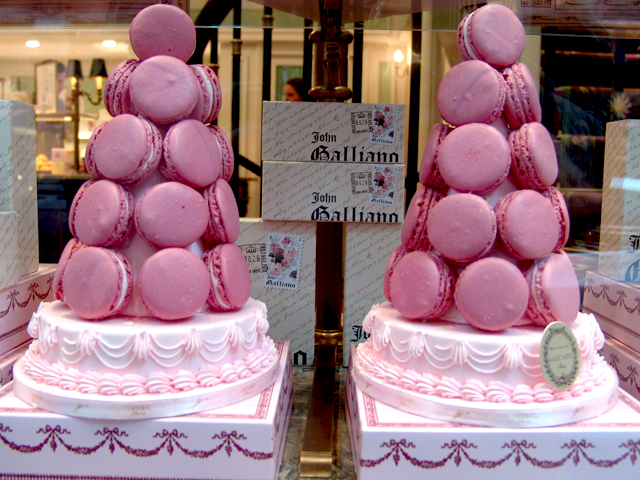
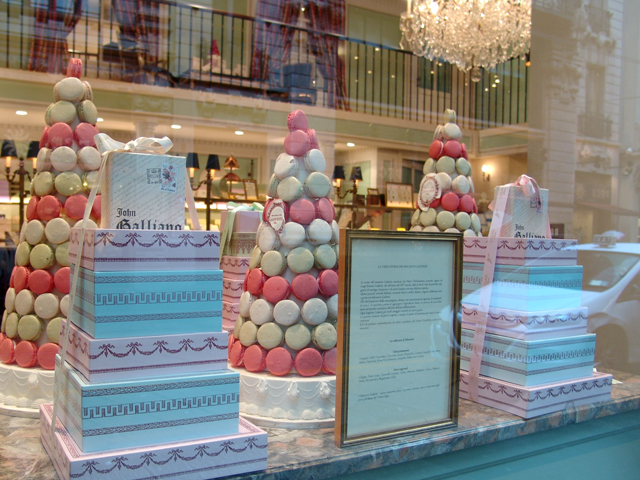
Perhaps it seems odd that this is categorized “What to do in Italy.” But as of last Spring, Ladurée—that star of the French confection le macaron—is also here in Milan. And as far as I’m concerned, going to Ladurée is not about eating. It’s about “doing,” or rather “experiencing.” You don’t eat these macaroons; you are simply overwhelmed by them. It’s a process of succumbing to essence and texture. Slightly granular, soft on the inside, crackly on the outside, and downright gooey in the middle—these little babies are flown in daily from Monaco, and priced accordingly. It almost suffices to merely look at them.

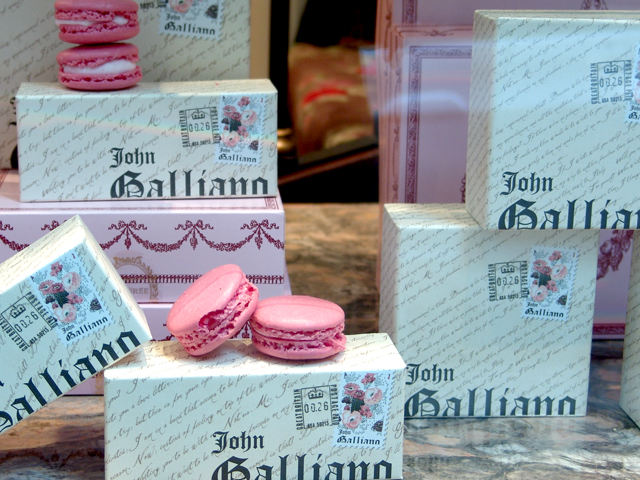
The store itself is as much a frothy confection as what it sells. It is, as they say, over the top: beautifully, almost comically, ornate—”French” in the extreme—with crystal chandeliers, a small galleried tea room overhead, and painstakingly arranged pyramids of the sweet in question. On the day that I took Tram 27 to the Center for the sole purpose of buying a box of macaroons, they were promoting their John Galliano line. I find the whole idea almost as absurd as John Galliano’s mustache, but you have to love it.

Needless to say, those particular goodies were out of my range. No, I was after something much more economical and representative of Ladurée’s wide array of flavors, or parfums (you inhale their scent as much as you eat them), and I wanted to get some that would appeal to my children. Rose. Cassis. Citron. Caramel. At home, the packaging was almost too beautiful to unwrap, but sometimes you just have no choice! You’ll notice the intense and unusual colors of these little delicacies. I’m happy to report, that their flavor is even more so. But, like sushi, I’m sure “take-home” just isn’t the same, so next time, I’ll take my girls with me on the 27, and we’ll indulge like three modern-day Marie Antoinettes in that little over-head tearoom.


Ladurée
Via Spadari
Milano

NOTE: April 16, 2011. I have since been back to Ladurée with my children in tow, and noticed that the overhead tea room which I mention is “faux,” a design feature for appearances only. I apologize if I’ve misled anyone.

[If you enjoyed this post, you might also like Spadari.]

Posted in ITALY, WHAT TO DO | 5 Comments