
 The Fisherman always says—so I assume it’s an Italian saying although it might just be his—“Look back. Go back.” He means, if you practice the ritual of looking back as you’re leaving a place you love, you will be there again.
Raised on heavy doses of Greek Mythology, I can’t help but think of the story of Orpheus and Eurydice, and I wonder if maybe he hasn’t gotten his own much more rigorous classical training confused. (He’s a son of the ex-Roman empire for God’s sake. They take their classic literature and its antecedents very seriously.) Or maybe he’s just ignoring it.
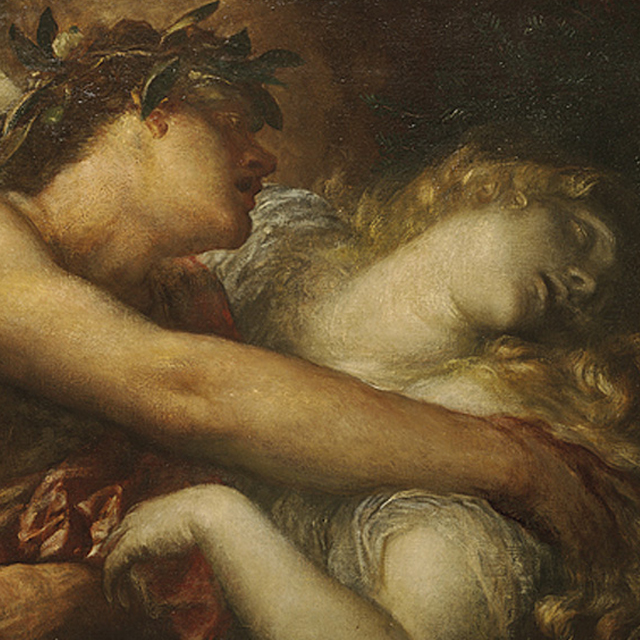
Orpheus and Eurydice, by George Frederick Watts
If you don’t remember the story of the lovers tragically separated on the day of their wedding, let me, well actually Wikipedia, refresh your memory (the underlining is mine):
In her efforts to escape [a] satyr, Eurydice fell into a nest of vipers and suffered a fatal bite on her heel. Her body was discovered by Orpheus who, overcome with grief… travelled to the underworld and… softened the hearts of Hades and Persephone…who agreed to allow Eurydice to return with him to earth on one condition: he should walk in front of her and not look back until they both had reached the upper world. He set off with Eurydice following, and, in his anxiety, as soon as he reached the upper world, he turned to look at her, forgetting that both needed to be in the upper world, and she vanished for the second time, but now forever.
It seems then, that at least in literary terms, looking back is a no-no. It prohibits you from moving successfully into your own future. Ditto in real life, I’d say. Unless you can look back with a non-longing remove, the past is likely to lure you out of the fullness of your own present tense. I have a hard time with this, personally. The past is so easy to embroider, simplify and quite frankly rewrite. You can remember events unwinding with a seductive perfection that didn’t actually exist at all. Looking back is dangerous enough; doing it with rose-colored glasses is calamitous and addictive.
But back to the Fisherman’s good-bye ritual. So strong is his conviction that no ill will befall us as a result of the over-the-shoulder glance, we all look back intently until what we’re leaving vanishes out of view—around a corner or beneath cloud cover, depending on our mode of transportation.

Saturday we said goodbye to France. I bid a heart-heavy “until next time” to every single object in the house that I love. Dark corners, emptied drawers, the bathroom mirror, the antlers with the mistletoe, the spider by the door. And then, outside, to the ramshackle potting bench I built two summers ago, the compost pile and the wintering plants. Personal goodbyes doled out silently, wordlessly along with those pregnant glances that beg each and every thing to “stay safe.”
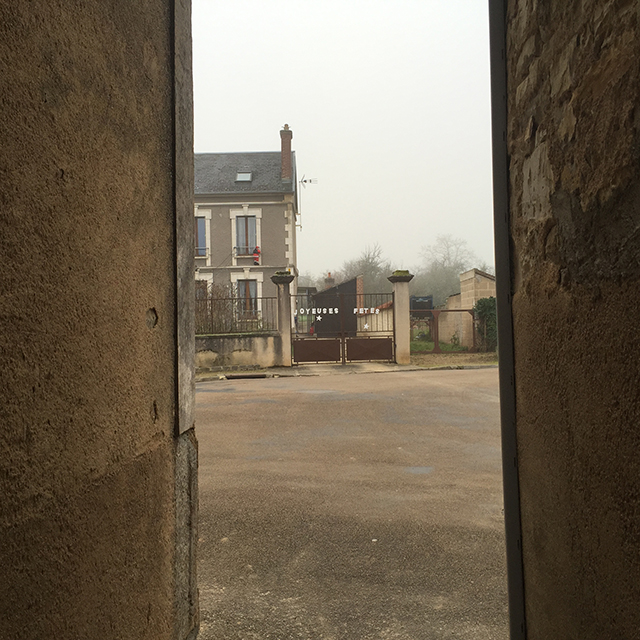
We packed into the car, lugging our last items, and we looked—back. At the house. At the gate. At the rain falling. And then it was all of Burgundy diminishing into a rear-view mirror until next time and me hoping that my Fisherman was right. There is something powerful in believing—hoping—something so strongly that eventually you know it will happen as you foresee it.
Forty minutes down the road, we remembered that we’d forgotten to shut off the gas in the house. We turned around and went back—wish fulfilled in the way we least expected it.
It was a long day.































 The Daily Cure