Moldy goodness

Just before Christmas, we stopped in at the Caves de Bailly where we annually stock up on Crémant de Bourgogne, Irancy, Ratafia, and Crème de Cassis. It’s literally a journey into the center of the earth, and even in the summer months, it’s best to go wine-tasting there with an extra sweater (or deux) to keep you nice and warm, as the temperature remains a wine-friendly too-cool-for-comfort all year round. At Christmas, deep beyond the tasting area, there’s a market that winds its way through the deep, dank passageways, lit by tiny white lights and the warm lamps of individual vendors. Handicrafts, fine angora wools, and local foods line the tunnels.

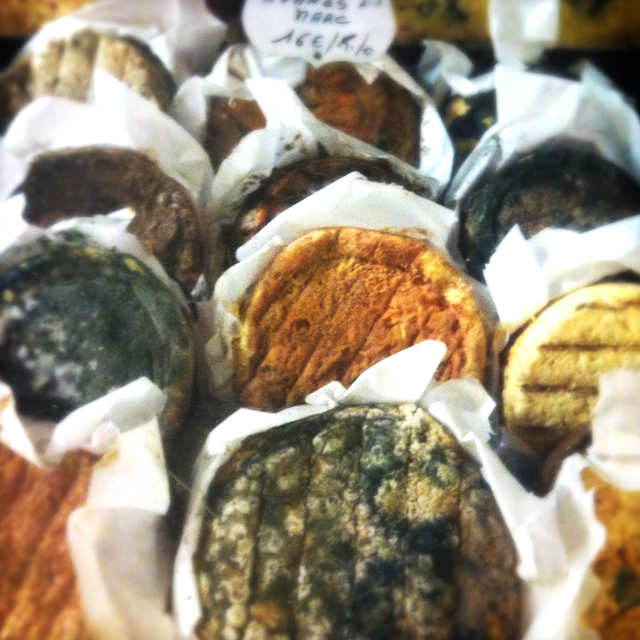
This year, I gave my personal “most beautiful” prize to the organic cheeses—each more spectacular than the last—propped one against the other like common objects of no particular notice. No doubt dripping with flavor on the inside, they were crusted on the outside with the most spectacular array of mold and crud. Deep ochres, ambers, aubergines. Cinder-color, blue, and black. Like geodes from the earth itself, beautiful-ugly lumps of splendiferous yum. Our haul? An organic Tomme de Chèvre and something else quite delicious whose name I have already misplaced in the messy attic (or is that a wine cellar?) of my mind.

This seems an excellent time to introduce you to another friend’s blog: Domaines & Terroirs. Here you’ll learn more about French cheeses than I could ever hope to tell you. Happy tasting, and happy holidays.

Posted in FRANCE, SAVORING | Tagged , , , , | 9 Comments

Happy day, happy tram.

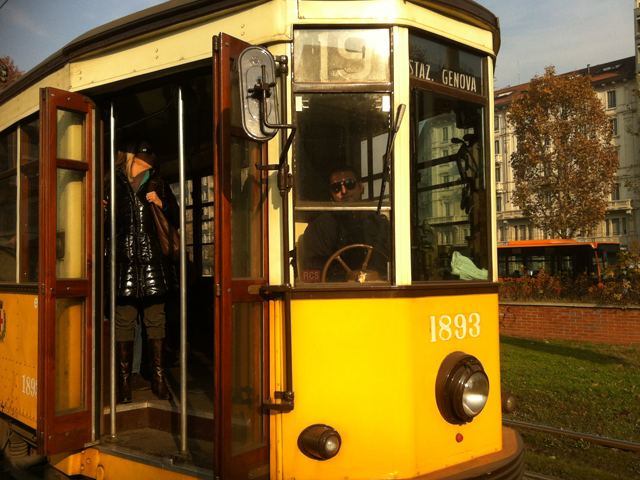
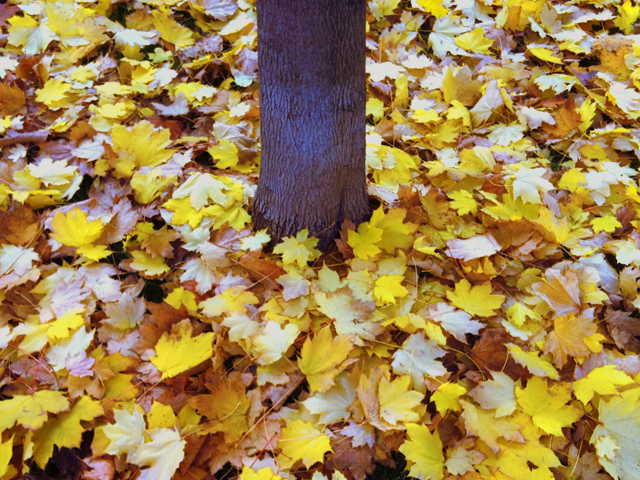
I’ve written about the Milanese tram before. But I couldn’t resist taking a closer look, yesterday, when all things conspired to make it a perfectly, perfect morning to do nothing but ride up and down line 19 on TRAM No. 1893. OK, I confess. I was going somewhere, but the “where” stopped mattering, when I realized how happy I was just getting there. I mean, which was yellower? The sun? Or the leaves on the ground? Or the tram when it pulled up to the stop? Which was more pleasing, the crisp of dried leaves underfoot, or the creak of those old wooden stairs folding down so that I could get up?

I love these old conveyances, and it will be a sad, sad day when they are gone. Just look at the details: wooden benches with fold up seats (I’ve often wondered what’s inside). Glass windows with the old metal fittings that passengers can slide up and down as desired. Lovely glass light fixtures, in wood mounts, that go right down the center of the trim, lined on either side by handrails, attached by gracefully curving supports. Grips that still hang on leather straps. A slatted wooden floor, that lets grit and moisture slide down away from your feet. The older Milanese often say, “It’s not like it used to be. Living here used to be so…beautiful.” I think I know what they mean. And I’m holding on to the last shreds of it with all my might.


And the beautiful old signage. Don’t get me started on how much I love that. “Don’t lean out the window” (above, photo on lower right). No smoking. No spitting. Exit prohibited. (Certain doors are intended for getting on, others for getting off—the idea being to avoid conflict and bottlenecks.) They even tell you how many seats are available: a modest 29.


There’s one sign that isn’t there, but in my opinion it should have been. Yesterday, when the sun was brilliant, and the leaves were theatrical, and the world was not yet under winter’s cold, determined stare like it is today. I saw it, a phantom sign, and this is what it said, “It’s a nice day, isn’t it?” And I had to agree.

Posted in AROUND US, ITALY | Tagged , , , | 7 Comments

Il pomodoro sardo: The Sardinian tomato

I love tomatoes. And the more tomatoes there are to love, the happier my heart. Lucky, then, that I am in the land of the tomato. The land where pizza came into being to showcase the San Marzano. The land where, if you have nothing more than a package of spaghetti and a can of tomato sauce, you’ve got a meal. The land where the reddest of reds is called “rosso pomodoro.” Pomo=ball, d’oro=of gold. Golden ball. You can’t get more precious than that.

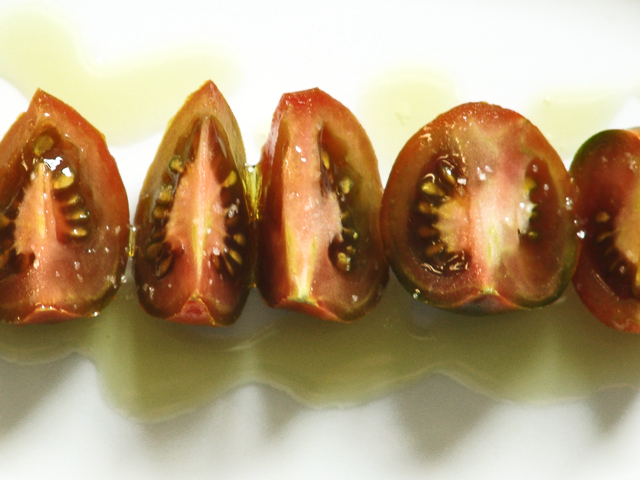
So we have many varieties: ciliegie (cherry), datteri (date tomatoes—to die for), San Marzano (oblong), ramati (the garden variety, still on the vine), cuore di bue (beef heart), on and on and on. My favorite is the pomodoro sardo, or the Sardinian tomato. It’s slightly larger than a cherry tomato, but smaller than the normal garden variety. And it runs in color from red to dark green, often streaked as if it couldn’t make up its mind.

These little jewels are tomato-ey, but tart—crisp and juicy, finishing with a mouth-puckering kick. I love them in salads, but anything I find this delicious I prefer to eat practically in its pure state. That is to say, with a drizzle of fine olive oil and a scattering of sea salt.

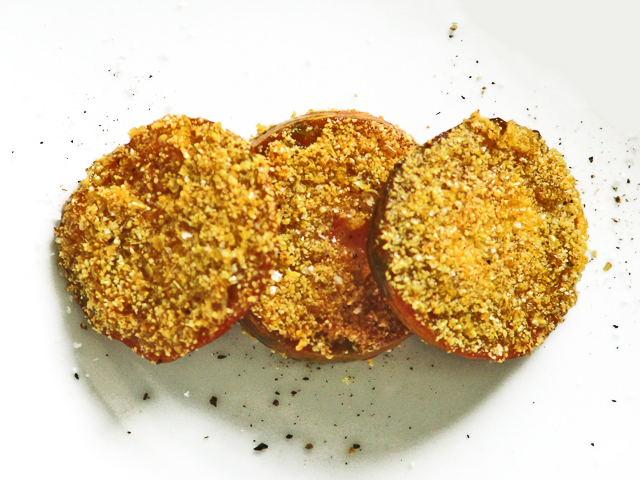
Today, as I was popping them willy-nilly into my mouth, it dawned on me (being a Southerner) that they would be excellent fried. So I sliced the one remaining tomato, coated its moist cut sides with polenta (corn meal) and fried it quickly in olive oil, until the meal began to turn gold. A generous grating of pepper and a pinch of salt later, I was experiencing the savor of my favorite tomato elevated to an nth degree. The pert tartness was still there, but balanced (or was it challenged?) by a juicy sweetness encased in crunch. Poor me, there I was caught in the crossfire! What was already intense, was more so. I call this bliss.

If you’re ever here, and happen to wander by a fruit and veg vendor, give them a try. You’ll be happy you met them.

Posted in ITALY, SAVORING | Tagged , , , | 7 Comments

Closed for the weekend

“The Daily Cure” is closed for the weekend, but please feel free to come in and browse. See you Monday.

Posted in WEEK IN REVIEW | Leave a comment

To tell the truth…

I hate blogging, I really do. I don’t particularly like writing, and photography bores me. I don’t care if anyone reads my blog, either, because what difference does it make? It’s just communication, and that’s not high on my list of “What’s Important in Life.” Also, how does anyone know if I’m telling the truth? Or if I’m just lying lying lying, my pants burning to cinders, like I’m doing right now?

Yep. Lying. That nasty art that Italians are said to be very adept at. There are (1) big, political lies, (2) little white ones, and (3) that other type that takes the form of creatively working your way around various rules and regulations. (I once heard that a great deal of money was made in Naples selling t-shirts that had life-sized, fastened car seat belts printed on the front).

I’ve not had much first-hand experience with the first variety, though the papers are full of them. Meanwhile, little white lies are a dime a dozen and an integral part of everyday life, not so much because deceit is admired, but because hurting feelings is not. (If you’re ever invited to a party here and you’d rather not go, the American “I’ll try”—usually followed by non-attendance—or “Y’know? I just don’t really feel up to it” will not do. You must create, on the spot, a damn good reason why you cannot be there, even if there isn’t one. The third variety of lie is often so ingenious that it seems to qualify for admiration. Except you have to wonder: what if all that creativity were put into something truly positive and constructive? And besides, wouldn’t it be better to actually wear a seat-belt then just to have one printed on your shirt?

That said, I’m fairly certain there’s a strong link between bureaucracy-laden society and creative rule-breaking. It’s a way of maintaining your sanity and your dignity when every inch of your life has been codified. This axiom is a given in Italian society. It’s why traffic cops turn a blind eye in the face of small infractions, and why Milanese citizens feel free to discuss and negotiate with the very same men or women in uniform when they don’t.

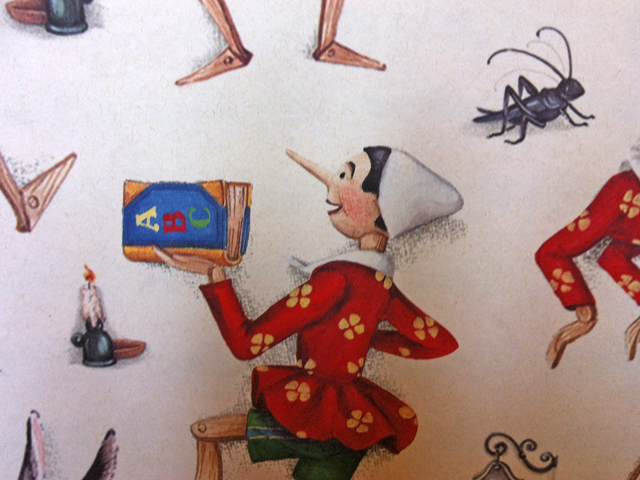
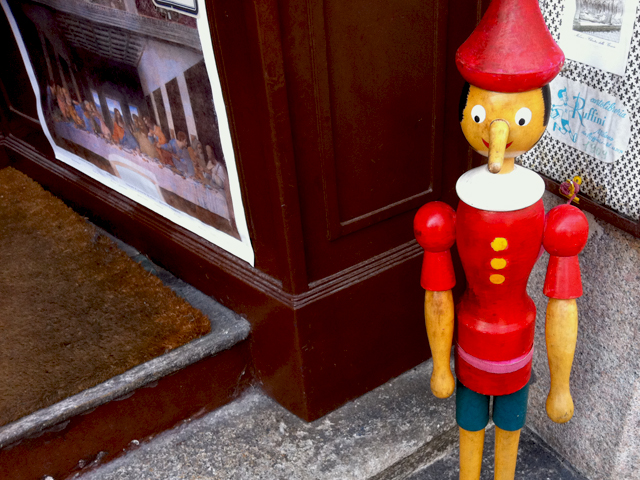
Why bring this up now? Because, with Christmas upon us, one of Italy’s most famous liars is back in vogue, and seeing him has brought all this to mind. If you go to the lovely Antica Cartoleria (paper, office, and school supply store) in Via Ruffini, he stands sentry at the door. He sits on the Christmas wreath. He adorns wrapping paper. And he comes in miniature to hang on your Christmas tree at €2 a pop. His red cap and wooden body are Christmas-y by nature, but he’s a national treasure all year round.

It’s not that dishonesty is well-regarded. It’s that lying is understood, especially in children. It’s also understood, as the story of Pinocchio tells us, that, aside from the little white lies that are invented to save feelings, dishonesty isn’t generally a good trait in the adult of the species. Best to nip it in the bud. All the above, in my opinion, makes Pinocchio an odd and rather complex symbol to hang on the Christmas tree, but I’ll do it nonetheless. Despite his tell-tale nose, he’s undeniably cute.

Posted in ITALY, WHAT TO DO | Tagged , , , , , , , | 12 Comments

Another orange food

Mother Nature knows what she’s doing, doesn’t she? Throwing us warm colors and soothing tastes when we need them most. Case in point: the pumpkin. I’ve almost missed the chance to mention another autumnal jewel, but here it is before the seasonal window of opportunity slams mercilessly shut until next year: the persimmon, or caco in Italian.

A few years ago at an excellent Milanese restaurant called Trattoria al Matarel I had my first taste of this orange indulgence. Prior to that moment, I’d only thought of it as something my grandmother might have eaten once upon a time. The waiter brought it to the table after the meal, unadorned—unless you consider a spoon and a knife culinary embellishment—on a white plate. I lifted the spoon to begin my attack on the unfamiliar stuff. (Why he’d brought me a knife I had no idea. The fruit looked soft and submissive despite its aggressive color.) The waiter rushed back over to the table before I’d begun my assault, and showed me how “it” was done.

The persimmon is flipped upside down so that it’s sitting on its leaves. Then with a knife, you make two perpendicular cuts across the flesh, so that it falls in four even quadrants, skin-side down. That’s it for the knife. Next, you pick up the spoon and scoop out the delicious, sweet, almost gelatinous flesh. Every time I eat this fruit, I experience something close to ecstasy. And every time, I think, “Who needs dessert when there’s this?” Cold, it’s utterly sinful. My neighborhood restaurateur likes to offer it with Grand Marnier poured on top. It’s almost gilding the lily, but, yes, it’s damn good.

The caco gives us more than an after-dinner thrill though. The tree itself is a graphic performance-artist. The fruit starts to develop in the summer when the leaves are green, but ripens to its brilliant orange when the tree is utterly bare. Stark, dry, desaturated branches hang heavy with exotic orange balls—like a Japanese ink drawing revisited by a kid with an orange magic marker.

NOTE: As for the restaurant I mentioned in the first paragraph, I highly recommend it, should you visit Milan. Trattoria al Matarel, near Corso Garibaldi. It’s an excellent place to experience genuine Milanese cuisine, and it’s the first place I ever saw a restaurateur inspecting and negotiating the price of white truffles in the dining room.

Posted in IN SEASON, ITALY | Tagged , , , , , | 10 Comments

Fairy-tale middle

We love to talk about fairy-tale endings, where everything is wrapped up neatly in a bow. Love is requited all around regardless of sexual preference. Bills are paid. Unemployment is a non-existent concept. Economies hum along nicely without creating abuses. No animals are sacrificed. Those in power respect their underlings and, strangely, vice versa. Food isn’t toxic. The sun usually shines. And war is an other-wordly rumble far from the peaceful interior of our impenetrable castle walls.

Il Castello Sforzesco, Milan

We grow up with these images and all their ancillary parts, with romantic notions, and unrealistic hopes that fade over time like heavy velveteen drapes. In (what was it?) 1992, Janet Champ and I wrote an insert for Nike Women’s fitness that began like this:

You were born a daughter.
You looked up to your mother.
You looked up to your father.
You looked up to everyone.
You wanted to be a princess.
You thought you were a princess.

And that ad ended up on refrigerators all over America. We’d grown up wanting to be princesses. And we were in the process of becoming, hopefully, as Janet eloquently wrote at the end, “significant to” ourselves which had nothing to do with wearing a crown and sparkly shoes. But there it was, right at the outset: that notion of being at the center of a fairy tale—the lovely young princess, up in the highest tower, waiting for Prince Charming, or il principe azzurro (as Italians say) to carry her away.

One of the time-stained towers of the castle.
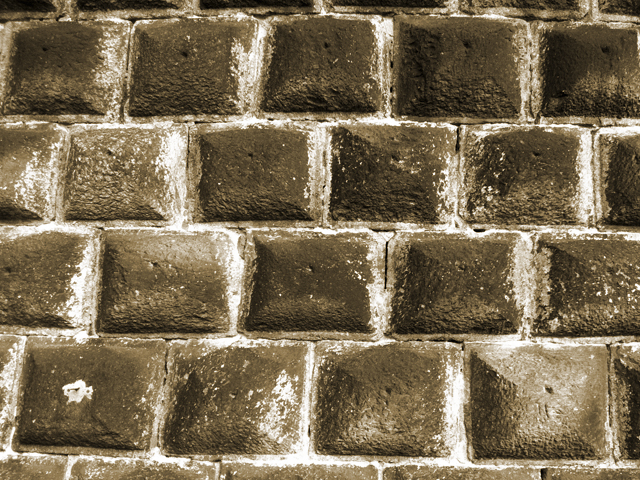

There'll be no breaking through these walls.

I saw my first real castle after that ad was written. I was traveling through Portugal with a friend, and we stopped at every castle we could fit into a three-week tour. That was when my true love affair with the castle began. Not because seeing real castles in varying states of decay furthered any romantic notions I’d fostered as a child, but because it put an immediate end to them. Castles are physically challenging spaces. They are hard, cold and damp. Their stone stairs are uncomfortably proportioned, challenging the most aerobically fit climbers on the way up. Their internal spaces are often large and echoing or tiny and cramped. And their intense fortifications remind you of one thing: how vulnerable you are. Vulnerable to your enemies. Vulnerable to airborne mischief. Vulnerable to the ravages of time.
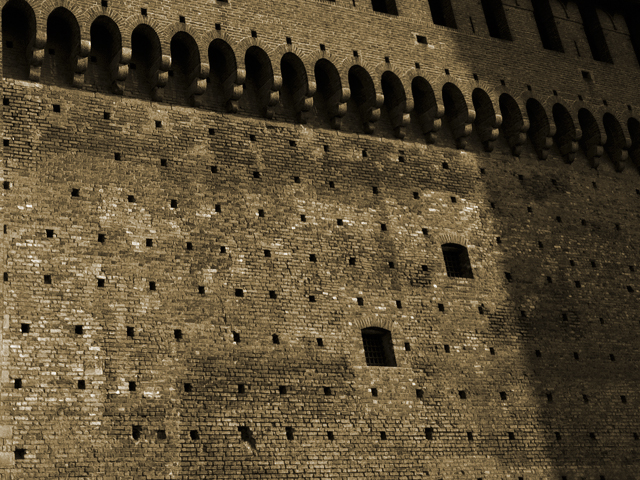
The walls go up and up...


...and pigeons have made their homes in the holes.

Now, I live in a city with a castle at its center, the Castello Sforzesco, a massive hodgepodge of renovation through the centuries. It sits squarely in the middle of Milan attracting tourists, stray cats, and residents like me who can’t resist its pull. Two or three times a week, I walk around it and study its infinite (if discordant) architectural features. Sometimes I walk through its vast, empty middle. I once heard McCoy Tyner play here. It was August 1997, and he berated the audience for talking too much. I felt stung by his disappointment. It was hot and sticky—a typical Milanese August. And the fact that we were in a castle did nothing to sooth our nerves.
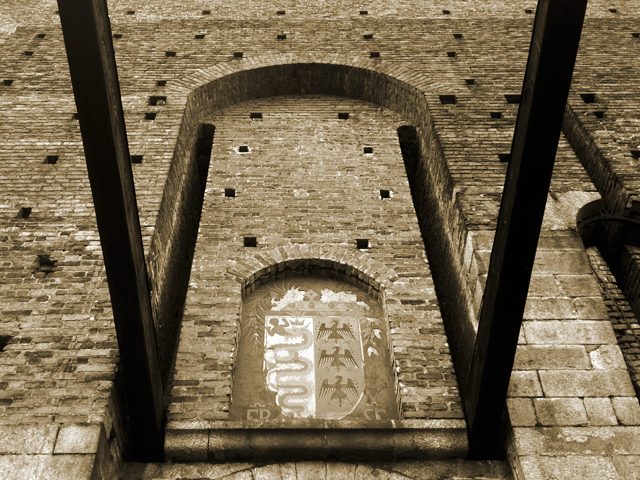
Some of the draw bridges are still intact over a grass-filled moat.


Come inside...

So what goes through my mind when I walk around the castle now—as I weave around its ruins or short-cut through its empty heart? What do I think when I see the heavy wrought-iron detailing and the caged windows? The soot-stained stones and the faded mosaics? I think this: there are no fairy-tale beginnings or endings. There are only fairy-tale middles. And the fairy-tale middle isn’t what is—or ever was—inside the castle walls. It’s the life outside it. The day-to-day stuff that makes up our lives. The real, flawed relationships. The exuberant Italian chatter at an American jazz concert. The misunderstandings. The coming and going of the seasons. The weak, yet still piercing, sun on a winter day. What came before and what will come after don’t really matter. The fairy-tale middle is now.
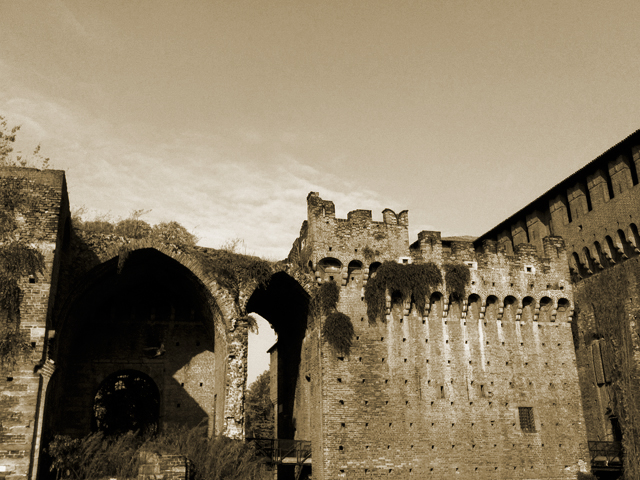
Parts of it lie in ruin.


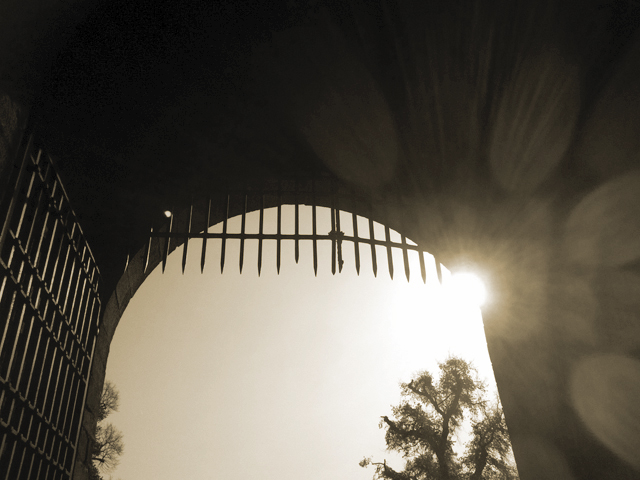
Looking outside, straight into the winter sun.

[If you liked this post, you might also enjoy “Time Out for Quiet Contemplation.“]

Posted in AROUND US, ITALY | Tagged , , , , | 10 Comments

New-ish and hopefully improved-ish

A quick administrative note to alert you to some small changes at “The Daily {French-Italian} Cure.”

First, the links which have disappeared from the sidebar have been placed on a “Links of Interest” page which is still under construction. You can access this page by clicking either the menu item which appears in the black strip above this blog or the appropriate apothecary jar in the sidebar. The links which are already in place aren’t active yet, and there are still more to come. The idea is to give you a robust list of resources for cooking/eating, language, news and travel related to both France and Italy.

Second, the sidebar as you can see has been turned into “The Daily Cure Apothecary”—a place to dip in quickly for the aforementioned links or for recipes, food photography, and Daily Cure postcards (culled from all the blogs). Some of this is still under construction, but if you browse around, you’ll get the idea.

And last but not least, if there’s something you’d like to see here, but don’t, please let me know! International air travel doesn’t come cheap these days, so if I can fulfill your desire for a taste of “over here” with a humble digital offering, I’d love to try. Ciao, Charlotte

Posted in SO NOTED | Tagged , , , | 2 Comments

Closed for the Weekend

“The Daily Cure” is, as the sign says, closed for the weekend, but please feel free to come in and browse. See you Monday.

Leave a comment

When Food = Home

Home is a lovely warm word, isn’t it? As round and enclosing as the womb. Womb, home—the two almost rhyme, but not quite. And what is home exactly, if not, in the end a metaphorical womb? A sensation. An instinct. A blessed lack of fear and discomfort and uncertainty. Home is being where you belong—wherever that may be. It’s not a constant, the feeling of being at home. Some days it’s stronger than others. Sometimes the yearning for the feeling inspires day dreaming our way into the past—armchair time-traveling—in search of old anchors and roots and ties. Sometimes home is in a taste. This week, for me, it was the warm orange flesh of a pumpkin.
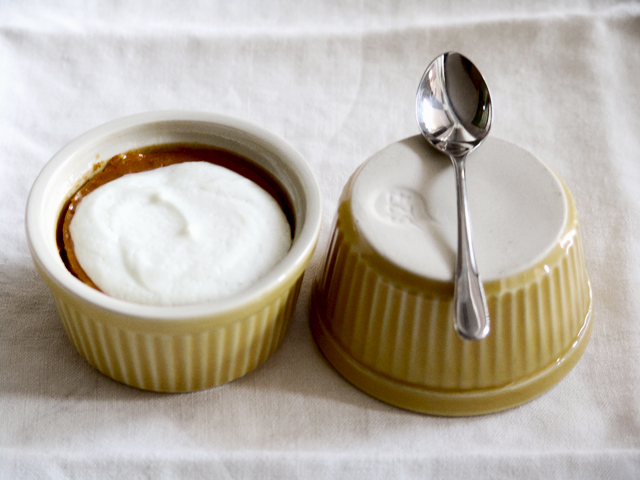
The pumpkins back home were—and I imagine, for the most part, still are—orange. I seldom ate them though I loved them. They were so wedded to their associated festivities, that it was hard to imagine eating them at other times. So I savored spicy pumpkin pies at Thanksgiving and Christmas, as if it were impossible to eat them on other days of those long, cold winters. How ridiculous that was! Here, in Milan, I most frequently see the zucca mantovana — a squat, drab, military green squash, as hard as rock, with vivid orange insides that fall outside the category of “web safe colors.” ‘Tis the season, and Italians are eating them with or without a party.

I’m the only one in my little bi-cultural, nuclear family who likes pumpkin, even though Italians have a long and lovely tradition of eating it in spectacularly inventive and soul-soothing ways. (Pumpkin ravioli with sage or hazelnut sauce. Pumpkin risotto finished with a knob of butter and freshly grated parmigiano.) But yesterday, with Thanksgiving still days away, and a slight seasonal melancholy beginning to nag at my innards, I needed a “hit” that could be quickly whipped together, and there it was, delivered to my inbox by one of my favorite cooking blogs, Smitten Kitchen.

Pumpkin puddings with a sour cream topping! I’ll let you go to the source for the recipe, if it interests you, as I wouldn’t want to take credit for such a delicious anti-depressant. Suffice it to say, that it was just what the mood doctor ordered, and it was ready in no time at all with some slight modifications (NOTE: I am not a diet-obsessed cook, but seeing as I had decided to eat my dessert for lunch (!) some modifications were necessary):

1. Instead of canned pumpkin, I baked pieces of fresh with scant olive oil, then squashed them with a potato masher before uniting them with the sugar, egg and milk.
2. I used no cream, just non-fat milk, and the recipe came out well.
3. I substituted non-fat Greek yogurt for the sour cream and diminished the sugar quantities all around with no ill side-effects whatsoever.
4. I took great liberties with all the spices.

This is not to say that I am sad. Nor that I am homesick. I am not. It is not to say, either, that I find solace in french fries and hamburgers and all things (edibles) American. It is just to say that sometimes, just sometimes, you need to taste that thing that carries you back to the safest, the warmest, the dearest of times, even if in reality those times weren’t any sweeter than the ones you’re lucky enough to be living through now.

Posted in IN SEASON, ITALY | Tagged , , , , | 7 Comments