Spring Cleaning #3: The change of season

A small one-week feature on what happens when we clean our houses. What bubbles to the surface. What reveals itself to be true. What our junk says about our current state and next steps. What the season does to us.

I’ve been feeling off lately. Slightly anxious. Slightly depressed. Very tired, as if there’s not enough energy (or heart) in me at the beginning of the day to make it to the end. And to hear people talk in Italy, I’m not alone. In fact, I’m right in line with the entire population of this crazy, boot-shaped peninsula. Everyone’s sharing the same tale of woe— clicking their tongues, nodding their heads and intoning:

È il cambio di stagione.

In other words, whatever your problem, deficiency, or malaise, there is a reason for it, and the reason, quite simply is this: The change of season. When I moved to Italy, I poo-poo’d this theory along with its ilk involving cold drafts of air, bare feet, the all-healing powers of sea air, and a full moon’s effect on a haircut. But I have to say, that as time goes by and I allow myself to recognize the way I feel season-in, season-out without viewing it through that American “I can control everything and anything” filter, I do notice that I feel, inside and out, despite my own best efforts, different when Spring comes on. That season characterized by sap rising, saps me completely. Me and everyone around me.

It’s odd. There you are finally surrounded by electric blue skies, acid green buds, life surging relentlessly—everything you dreamed of during the long, winter months—and peculiarly, you feel out-of-it. Not quite able to engage with the sudden eruption of positivity and potential. Out of step with your own life and planet. And the fact that you aren’t glowing with brilliance makes you feel all the worse. But it’s comforting to know you’re not the only one and to be among an entire population that allows Nature to have this rightful, inexplicable power over our inner and outer workings.

It feels good to have friends and strangers alike express the notion that contrary to my feeling that “it’s all my fault,” this time, just maybe, it’s not. There are bigger forces at work. There’s an upheaval taking place. So what to do? Take it a little easy, take stock, clean, rearrange. This is not a call to give up or yield responsibility in situations that you can change, it’s just to say that perhaps there are days and weeks that require something from us other than charging ahead because accomplishment, doing, and busy-ness are the names of the game. There’s a massive transition afoot, and it’s taking something out of us. In a couple week’s time, things will be back to normal, but for now, perhaps it’s best to watch, although tired, and marvel.

Posted in ITALY, THEY SAY | 9 Comments

Spring Cleaning #2: Dusty dreams

A small one-week feature on what happens when we clean our houses. What bubbles to the surface. What reveals itself to be true. What our junk says about our current state and next steps. What the season does to us.

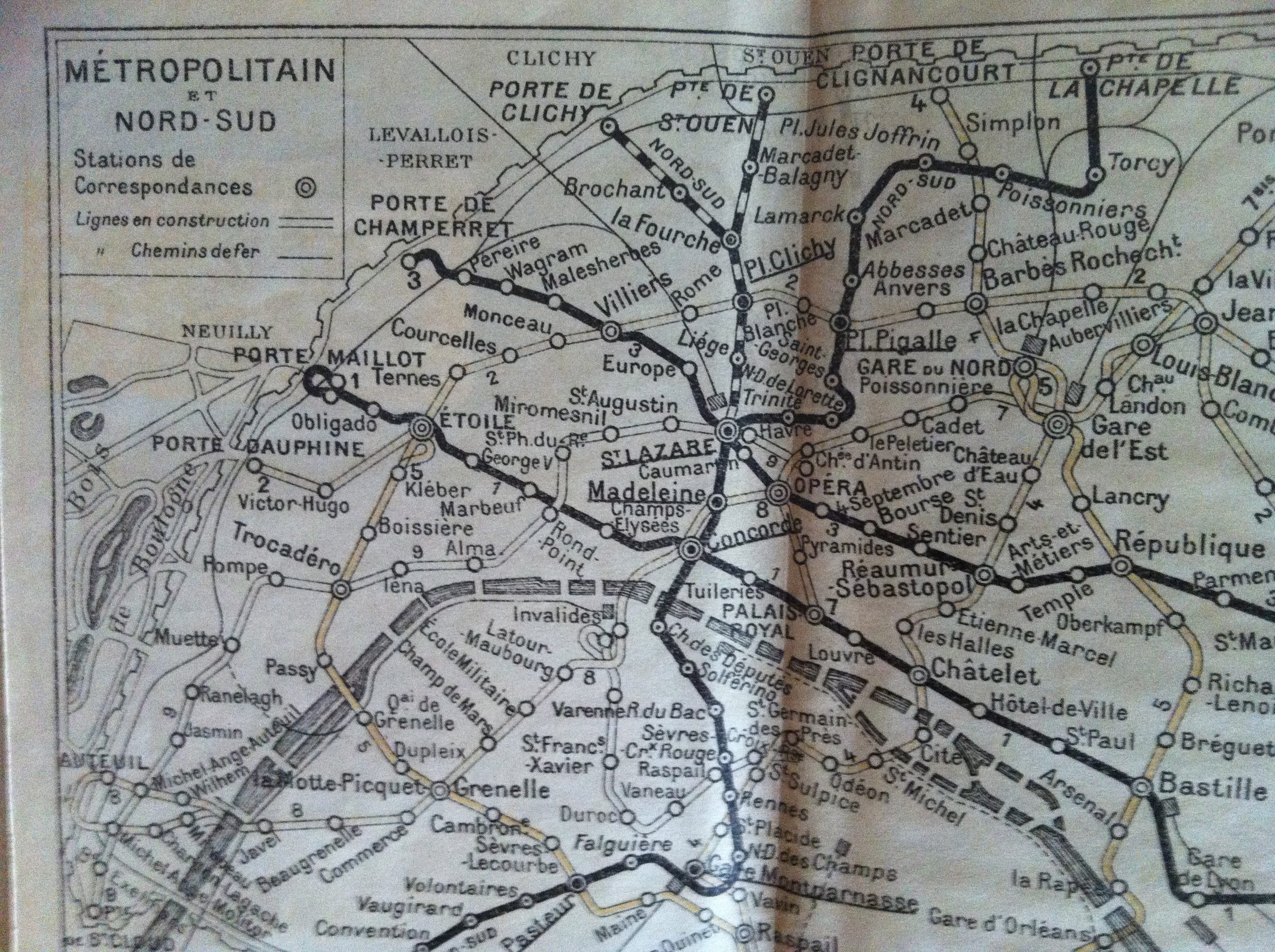
As I mentioned yesterday, in the box of palm-sized books that I’ve accumulated over the years, I stumbled upon my tiny book of the arrondissements of Paris. I bought this in Powell’s Books in Portland, Oregon in 1995, two years before my move to Europe was even on the radar screen. It cost $7.50 and was missing several plates. In other words, it was utterly unsuitable as a “real” map.

I didn’t dream specifically of living in Paris, but I dreamed vaguely and achingly of living “more.” Of having some sort of experience that would give me license some day in the far-off future to lean back and say with my eyes closed in contentment, “Yes. Now I have lived, really lived!” Of course, that was folly. Contentment is an ebbing and flowing affair and has more to do with internal voyaging than external, I believe. But still, it was a dream. And there, in the heap of things that spring cleaning asks me to reconsider once a year, is the physical manifestation of it. And every year, I will see it, blow off the dust and save it again.

I was also drawn to this book, I know, because I love maps. I am one of those daft people that can entertain herself for a long, long time looking at a road map or an atlas. My mother is the same. Perhaps it’s an inherited trait. I’m interested in the real, raw physical information about a place, but I’m also drawn to the graphic laciness of maps. Either to the random intricacy which corresponds to a reality in a place I can’t see with my own eyes. Or to the studied geometry, radial or gridded, that inspires visions of people living with order, harmony and piped in Baroque music. But most of all, I love maps because I feel as if I can see the future in them. I have the idea that maps are actually “mapping” something else—”where to go” existentially speaking. I once drew a map: two lines making a perfect intersection. One was the road “Need,” and the other was the road “Desire.” I was hoping to stand where they crossed.


I think I must have seen my future, sort of, in these out-dated maps of Paris. If I bought the little book, if I owned it, maybe I would internalize where it was telling me to go. Some years later, in an antique store in Savannah, Georgia, I bought a handful of snapshots of Rome, taken in the 1950’s with a brownie camera. The work of a tourist with an adoring eye. They were—every one of them—beautiful tiny black and white images surrounded by those lacy edges photos used to have. They, too, were a sort of map for me. My spring cleaning this year hasn’t turned them up, but I need to find them. Who knows, maybe those photos and this map of Paris brought me to this life half in Italy, half in France, and punctuated by trips back home. Where need and desire don’t always intersect, but sometimes they do. And beautifully.

Posted in IN THE HOUSE, ITALY | Tagged , , , | 7 Comments

Spring Cleaning #1: The game

A small one-week feature on what happens when we clean our houses. What bubbles to the surface. What reveals itself to be true. What our junk says about our current state and next steps. What the season does to us.

Yesterday was the first day of Spring, and accordingly, because our temperaments wouldn’t allow us to do otherwise, we “cleaned house.” I’ve put that in quotation marks because I refer to a rearrangement of our personal effects that had to do as much with mental health and domestic peace as it did with uncluttered space. Families are messes, by definition, and every now and then you, as a collective, have to try to redefine yourself if only temporarily.

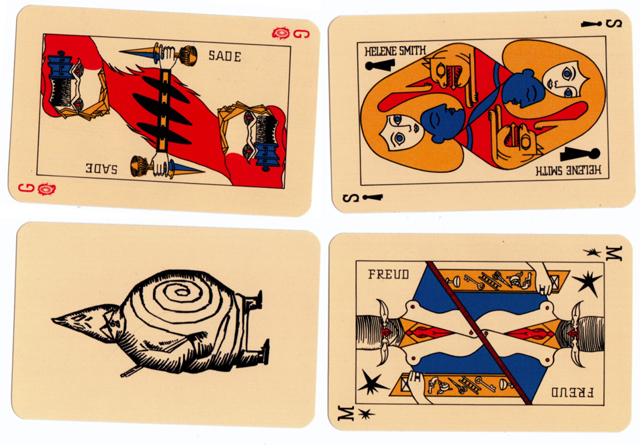
In the process, I located a basket of “small things” I have been keeping for years. These things are mostly books—small enough to fit in the palm of my hand—which have a certain significance to me. One is about live oak trees. Another about Dutch tulips. One is the Declaration of Independence and the Constitution of the United States of America. Another is an antique pocket manual of the arrondissements of Paris. There is also a keychain of great symbolic, personal importance. And a deck of cards—Le Jeu de Marseille.

My husband gave me this deck of cards some time ago, knowing that I was interested in Tarot cards. I don’t do Tarot readings, nor do I ask for them, but I am fascinated (as an observer) by the pursuit of the metaphysical and by the very graphic—often beautiful—iconography associated with it. The Jeu de Marseille was the re-invention of the Marseillaise Tarot deck, by André Breton and other surrealist intellectuals, who were in exile in Marseille during the 1940’s. In March 1941 they “re-drew” the traditional colors/categories with the flame, the black star, the bloodied wheel, and the keyhole which signified (in order):

Love (Amour)
Dream (Rêve)
Revolution (Révolution)
Knowledge (Connaissance)

These were the abstract forces that seemed most important to them at the time, and I write them here, apart, because as I see the words isolated in white space, I realize that they are also the words of our time and our current struggles.

The face-cards (royalty) were replaced with historical or literary characters of importance to the surrealists in the group, each of whom was responsible for choosing and designing two. Instead of Kings, Queens and Knaves, there are Génies, Sirènes et Mages (genies, sirens and wizards) and they include Baudelaire, Freud, Hegel, and Pancho Villa. (I wonder who we would choose, if we were to re-draw this deck today?)

Wikipedia gives a detailed explanation of these cards, their origin, and their deeper significance (in French). But what interests me is the power of such objects to inspire an immediate reaction in me, even if I don’t understand them fully. They speak of a past that seems present. Of concepts that have only gained in importance. Of desires and ideals that remain unfulfilled. And of the immense role of chance—despite our best efforts—in creating both destruction and delight in our lives.

I am also stunned, sifting through these cards and the other objects that occupy the basket with them, that the detritus of my life, once thoroughly American in origin, is now a mix of American (in the broad sense), French and Italian, with references to my year in Amsterdam and my own roots in the American South. To be continued (as all house-cleaning is)…

Posted in IN THE HOUSE, ITALY | Tagged , , , , , | 7 Comments

Closed/Week in review

Monday
“To top it off”
In which we examine
the perfect cappuccino.
(Read this.)

Tuesday
“Somber”
In which blogging seems
inappropriate given world affairs.
(Read this.)

Thursday
“Unified, sort of”
On the 150th anniversary
of Italian unification.
(Read this.)

Friday 1
“Monk’s beard/Barba di frate”
On the peculiar deliciousness
of a seasonal offering.
(Read this.)

Friday 2
“Happiness is foraging for dinner”
On the mood altering powers
of the open-air market.
(Read this.)

Leave a comment

Happiness is foraging for dinner

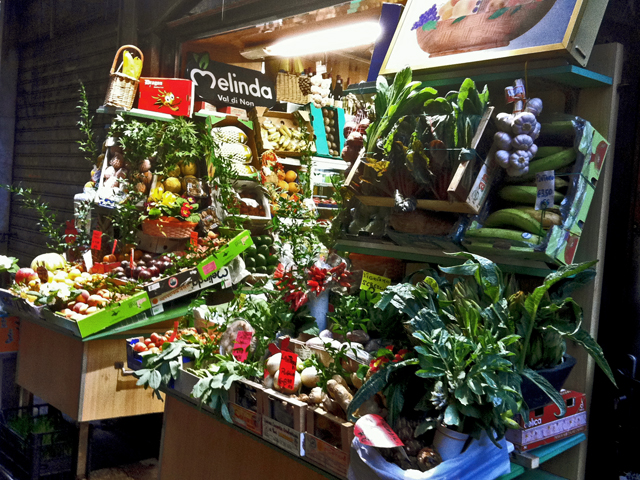
I admit to being a bit blue this week. Hence the lack of a post to the “The Daily {French-Italian} Cure” on Wednesday. Somewhere between the earthquake, the fuming nuclear plants, the continual rain and maybe the shifted axis of the Earth, I felt too down to write. I wasn’t good company. This morning, I was still not good company, not even to myself. So I pulled myself out of bed and did the next best thing to overdosing on anti-depressants: I went to the market. And, as always, it worked its magic. This is what “The Daily Cure” is supposed to be about. Tell me, what would you buy? And what would you make for dinner?

The (partial) overview.


Sicilian pomodorini. The blues are dissipating.


Sardinian, spiny artichokes. Getting happy.


Already-cleaned artichokes. Happier still.


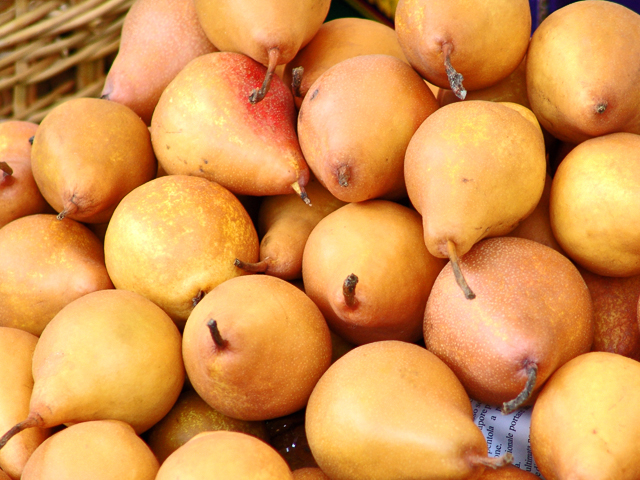
Pears. The color of a good mood blooming.


Two of my favorites. I'm getting downright happy.


Bingo. Tonight's dinner, a plan. Real contentment sets in.

[If you enjoyed this post, you might like to compare it to the French country market in “Vendredi = Market day = bliss.”]

Posted in IN SEASON, ITALY | Tagged , , | 7 Comments

Monk’s beard/Barba di frate

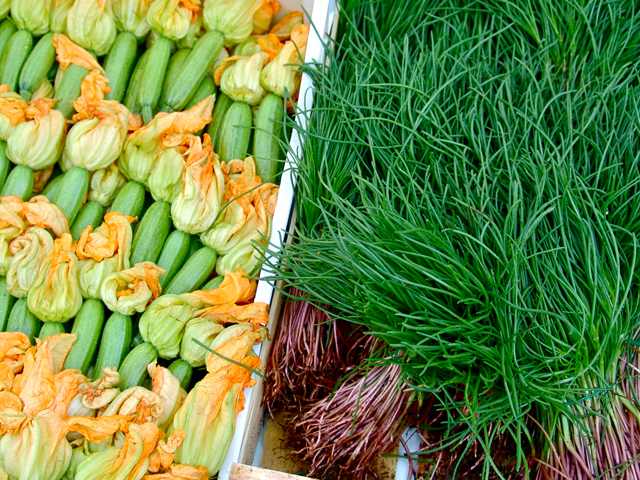
For a few weeks in early spring, I have the pleasure of eating one of those vegetables I didn’t know existed before coming to Italy. Barba di frate or agretti in Italian. “Monk’s beard” in English. This lovely, dense, grass-like vegetable of a deep green color combines the flavors of spinach and seaweed. It’s slightly resistant to the tooth, if not overcooked, but lacks the grittiness that can be a part of the spinach experience. And given its shape, it marries beautifully with long pastas like spaghetti or linguine, although it is delicious simply sautéed with peperoncino and garlic.

When preparing it with the aforementioned pastas, start a sauté (or soffritto in Italian) in olive oil of onion and pancetta affumicata, or speck, cut into a relatively small dice. Add a half cup or so of white wine and keep at a simmer, so that when the pasta is cooked, the sauce is ready, free of alcohol and hot. At some point during this process—I’m whimsical about when exactly—I add a generous pinch of red pepper flakes. Meanwhile, boil a pot of abundant, salted water. When the water is rolling, add the pasta together with the washed monk’s beard, and let them cook together, simultaneously. If you find that your onion/pancetta mixture is becoming too dry, ladle liquid off the pasta water to keep the moisture balance correct. When the pasta is nearly cooked, strain it and the monk’s beard, then sauté quickly together with the waiting sauce to finish. Serve immediately with fresh grated parmigiano.

This is just one recipe of many for pasta in which the principal vegetable in the accompanying sauce can be cooked together with the pasta. These preparations are easy and delicious. I will follow up with others shortly.

Tagged , , , | 9 Comments

Unified, sort of

Today marks the 150th anniversary of Italian unification. To me who continually experiences Italy as an ancient place (I thought America was the spring chicken), this all feels very odd. But history is a mysterious and continually turning worm. And the fact is that Italy hasn’t been Italy-as-the-rest-of-us-know-it for very long. A fellow blogger explains it in user-friendly terms here, but if you are interested in a more in-depth, editorialized, psycho-historic, insider’s view, please read The Italians, specifically “Conclusion,” by Luigi Barzini. In the midst of his depressing final analysis that nothing has really changed in Italy, he writes:

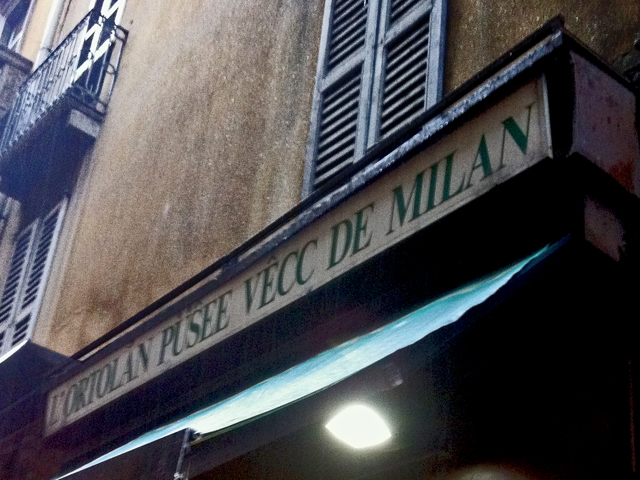
Milanese for "The Oldest Ortolano in Milan"

“It took three generations of patriots, thinkers, dreamers, soldiers, poets, musicians, statesmen, revolutionaries, and adventurers to achieve unity in 1861. And yet, in spite of the great number of people who contributed to it, it was not won by the Italians as a whole. No rising tide of popular indignation animated the movement. The people believing in the Risorgimento, or the rebirth of their country, were the liberal and progressive minorities of the aristocracy and the enlightened bourgeoisie. The great masses, the majority of the élite and the peasants, watched the events with scepticism and diffidence.”

Fruits and vegetables—only for the true MIlanese? Of course not.

I would say the scepticism remains. People still relate to a descriptor of themselves that is more rooted in the local and the tribal. The vestiges of the kingdoms are still there on the surface of the cities, and maybe still in the hearts of the people. The elderly hang on to their dialects. They make exchanges in front of my dumb, curious glances and regard me with a mixture of sorrow, secrecy, humor and pity. “You don’t understand,” they seem to say making no effort to translate themselves into modern Italian. They refer to the words themselves but also to the whole history behind them. They are right. I don’t understand, and one book and thirteen years living here aren’t going to solve that problem. But I will keep trying. And meanwhile, history continues to turn, and for the moment, we are all in the churn together.

Posted in AROUND US, ITALY | 7 Comments

Somber

It’s hard to know, when you blog, if you should or should not carry on business-as-usual when events elsewhere in the world are turning people’s lives upside down, when they are losing everything they have including life itself. You don’t know whether to stop your activities until it seems more appropriate to continue, or to carry on enjoying life as usual as a means, also, of giving thanks for it. You don’t know if you should say anything about what’s happening, knowing that words ring hollow and have the weirdest way of being self-serving in the end. You don’t know what’s right.

So I guess, like everyone, I’m just going around with my thoughts today. Doing what I normally do, but with a different feeling. A different sense. A different understanding (or utter lack thereof). The weather seems to speak for all of us. Appropriately, it’s raining. Or maybe those drops that keeping falling from the sky are the world’s tears.

8 Comments

To top it off…

As I mentioned several posts ago, my ritual of return to Italy involves, almost invariably, a cappuccino as soon as possible after passing the Mont Blanc tunnel. This last trip (Saturday) was no exception, and the cappuccino in question did not disappoint. As I sipped it, I asked myself why it was so sublime. But I already knew the answer.

The roast of the coffee itself was excellent—yes. But, the thing that made it perfect (and I’m not exaggerating) was the creamy milk-foam on top. There really isn’t a good word to describe it, because even though we use the word “foam” in English all the time to indicate this white mass that sits on top of the espresso, it shouldn’t really be foamy at all. It should be creamy. It should be dense with a rich milk flavor, and not in the least frothy.

Even Italian cappuccini go awry. Today's was a good example.

I’m not eager to slag off Starbucks, because when in the States, I line up with the best of them to order my cuppa Joe if there isn’t a better option available. But, I have to say that the fast food mentality behind a Starbuck’s management does not a great cappuccino make. What I usually end up with, if I order one, is too-hot espresso mixed with milk, topped off with a bucketful of tasteless, too-hot or too-cold, airy foam. This is, excuse me, all wrong!

Not bad as they go. But definitely not sublime. Alas.

The “cream” (let’s call it that) is not made by thrusting the steam spout randomly or deeply into the milk. It is the product of keeping the spout (1) within a half-centimeter of the surface of the milk (even as the milk expands with air) and (2) near and pointing toward the interior edge of the pitcher so that the milk is forced into a swirling vortex. It should be pulled out before the milk over-heats (at around 65 degrees centigrade).

And then, comes my favorite part. A good barista will beat the bottom of the milk pitcher down gently though decisively flat against a work surface to compact the bubbles that make up the foam, then give the pitcher several ample, careful swirls to amalgamate the foam with any remaining milk. If this is done properly, the creamy product can be poured directly over the espresso without the use of a spoon.

I have developed an almost pavlovian response to that beat of the stainless steel pitcher against the counter top. If the barista doesn’t do it, I’m already disappointed with the cappuccino. And that’s a sad—though very insignificant—state of affairs.

If you care to read a more thorough, albeit Italian, description of the proper montatura del latte, click here.

[If you enjoyed this post, you might also like “Moving and Shaking.“]

Posted in ITALY, SAVORING | Tagged , , | 7 Comments

Closed/Week in review

Monday
“Ritual of return”
In which bread and butter
remind us of where we are.
(Read this.)

Tuesday
“Of stone and flesh”
On our concepts of
what is “old”.
(Read this.)

Wednesday
“Time stands still”
On the power of stopped clocks
and old writing desks.
(Read this.)

Thursday
“Sign on the dotted line”
On the importance of the
hand-written word.
(Read this.)

Friday
“The send-off”
A tiny film about leaving
France until next time.
(Read this.)

Leave a comment