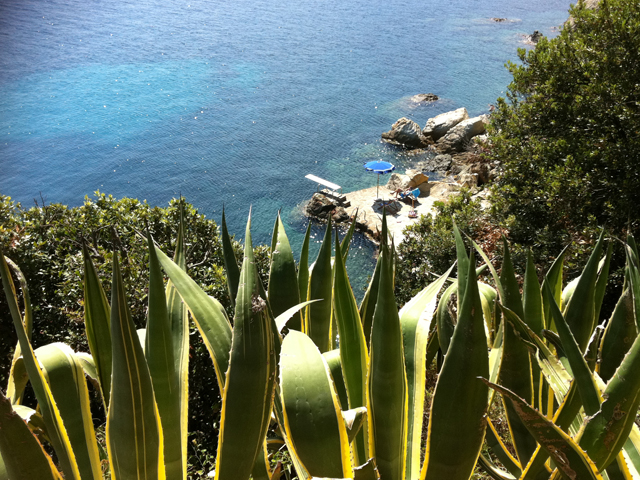
Afterthoughts

Elba is behind us now, a small green, ink splat in the Mediterranean that holds a special place in our hearts while the city of Milan and Life (again with a capital L) make other demands of our attention. And yet, and yet, it is hard not to “go back” on the mental ferry that shuttles one at no charge back to the memory of easier times and long hot days.

There were many things I could have written about the lovely Island of Elba, but I confess that time, oddly was short. When you’re busy trying to relax, the hardest thing to do is find time to do something that you’re supposed to do, even if it’s a self-assigned task that you love. It’s counter to your nature, your intuition. And when the internet connection is slower than slow, the odds are really against you. Further, I’m just not a travel writer. It has never been my aim. My focus is on things either smaller or larger than what a good travel writer would tell you…or just altogether peripheral.

That being the case, I’m left with disconnected memories and images that together are reminiscent of my time in Elba though they never found a home here. And I’m going to give them one now.

Several days ago, I blogged about the zaftig girls being featured in this month’s issue of Vogue Italia. Those lovely, Botero-esque women made it easier for me to make daily appearances in my bikini, but they also inspired a discussion with my husband—who is still after years working valiantly on my vocabulary—about the lovely Italian word, pannosa. Pannosa literally means “creamy,” and is used to describe girls of exactly that nature. Generous of body, simultaneously light and heavy, rich, abundant, desirable. And my mind connected the sweet new verbal acquisition with my absolute FAVORITE thing to eat on the Island of Elba: granita al caffè con pannapreferablysotto e sopra. Coffee granita with whipped cream under and over. Yes, this is a moment for expletives and euphoria, for misplaced religious experiences and deep, dark cravings.

In the image above, you see two of these beautiful concoctions, without their “under” cream. (Unfortunately, I forgot to specify.) These nearly-frozen vices are available all over Italy at any gelateria that happens to be offering coffee granita at the time (the most common flavor is lemon), but the best I have ever had in my life is at Zero Gradi in Elba. (A granita, if you’ve never had one, is the sublime Italian version of a snow cone—a sugary, naturally flavored syrup, brought to freezing, but constantly mixed to keep it in an eternal state of ice-y, crystalline, liquidity.
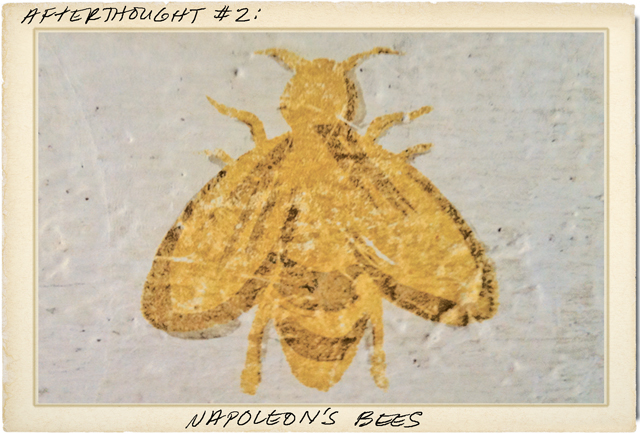
One of the first things that struck me about Napoleon’s country villa was the iconography peppered about. The entry gate is decorated with symbols that the modern eye sees as Fascist (the bundle of sticks and the eagle) which were actually, in Napoleon’s time, borrowed from the Roman’s. But my favorite icon, which is repeated throughout the house (on interior and exterior walls and ceilings), is the bee. Sign of immortality, industry, maybe borrowed from the freemasons, maybe from the Egyptians—who really knows?—graphically lovely bees buzz everywhere in this emperor’s personal spaces. Here, above, you see one of the hundreds of bees frescoed on the tea room wall.
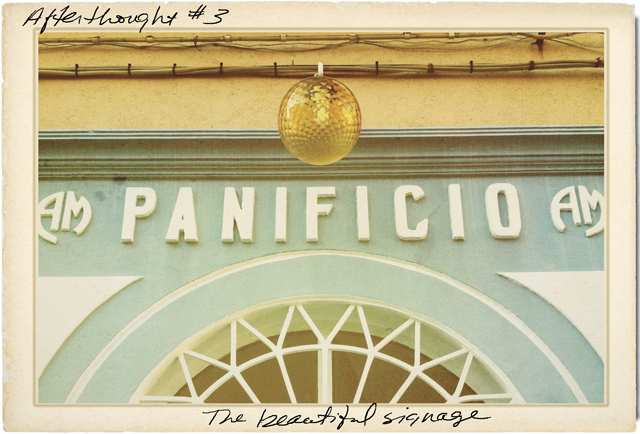
There is really nothing to add here. The island is full of beautiful signage and typography. So for those of us who are turned on by fonts you don’t see anymore, and beautiful design thrown around graciously for the sheer sake of beauty, this is a paradise. It is always a stunning feature of Italy: even when you are in places that are off the beaten path and out of the international spotlight, beauty reigns supreme. It matters here—like air itself.

I’m a sucker for a port, any port. I can’t take my eyes away from the massive cranes that lift containers onto the ships at Genova. I yearn for Depot Bay, Oregon, that claims to be the smallest harbor in the world. I am drawn to the edgy beat of Marseille. And I love the port of Portoferraio, with its mix of massive yachts, clipper ships and small fishing craft. Ringed by mountains in the distance and by pastel colored buildings along with the old Fort and Napoleon’s “city” villa in the near-ground, this does what all the best ports do: make you feel at once safe and on the edge of the often un-safe unknown.

And how could I leave my writings about Elba without writing about the restaurant that won our hearts and our guts: da Luigi. There are restaurants that excel others in their culinary arts. There are restaurants—and they don’t interest me much—that are designed to impress in every visual detail. And then there are restaurants that, although utterly unfamiliar, make you feel utterly at home. This is one. High above the coast, just tucked into the woody, mountainous interior, clings Luigi’s, an extended patio offering mountain cuisine, grilled meats, chestnuts, wonderful vegetables—all served by the man himself—a sun-touched islander of some years, with the sophistication of those who have seen the world and decided that the best place to be, nonetheless, is exactly where they are. And where he is, my friends, smells of dill, basil, sage, and freshly burned wood. And that’s before you get out of the parking lot.

Goodbye Elba. Until next year.

Posted in ITALY, OUT & ABOUT | 7 Comments

Life with a capital L goes to the beach

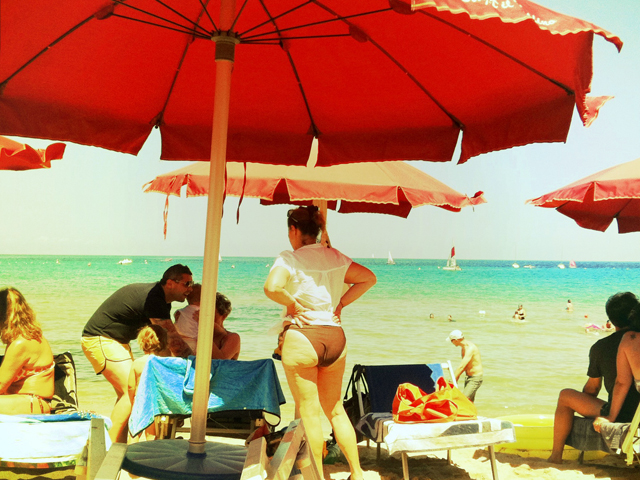
Sometimes, for a change of pace, it’s nice to take the more traditional route and make use of i bagni at the beach. While I definitely prefer the Mediterranean Sea in its naked, for-the-most-part un-art-directed form (please see “Now that’s a swimming pool“), there’s an anthropological pleasure in joining the masses (German, English, Italian, Rumanian, Austrian, Swiss, some Russian) under the umbrellas of Italy’s miniature kingdoms by the Sea.


I bagni. These are the stunningly well-organized establishments along the public beaches of Italy, that are mostly known to foreigners for their picturesque rows of brightly colored ombrelloni, lounge chairs and candy-striped cabanas. But they are more than that. They often also include life-guard services, showers (indoor and out), bathrooms, bars and restaurants. Everything one requires for a full day at the beach. At a price.

Two years ago at the smallish Biodola beach on Elba we rented our lounge chairs and umbrellas from a man known simply as Chicco (which means kernel, seed or small piece of fruit). Chicco, befitting his name, was small in stature, tightly muscled like a wound spring, and as brown as a coffee bean. He commanded (and I’m sure he still does) the small crescent shaped beach like a kindly dictator, saving the best spots for clients he favored and working real estate deals on the side. He was, without a doubt, a king in his own kingdom. “Bagni Chicco” was a simple affair compared to many. No facilities. Just chairs and shade umbrellas. But his large personality—a powerful mix of warmth and charisma peppered by a spotty ability to speak any language—more than made up for the elementary nature of his offering. Bronzed behind reflective aviators, he spent the day charming other men’s wives, correcting the behavior of unwieldy bathers, and negotiating god-knows-what on his cellphone.

For me, the bagni, more than anything, resemble 747’s or movie theaters (right before the flight or movie has begun. There is a non-stop festive milling about—families attending to their needs, each feeling privately invisible within the sphere established by its one or two umbrellas. Couples canoodle. Bikini tops are dropped. Diapers are changed. Summer homework is done. Novels read; crosswords completed or tossed down in frustration.

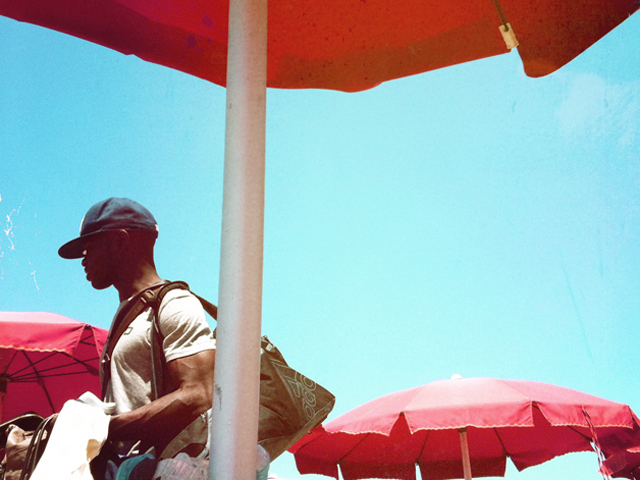
Vendors from the Ivory Coast and elsewhere, walk through the “aisles” selling their wares in multiple languages: beads, hats, pirated high-fashions, cigarette lighters, pareos. Some cry “Cocco beeeelllllllo!” (Beautiful coconut) “Ananas!” (Pineapple!) and for these, I always open my wallet. In other words, Life goes on and on in breathtaking living color between intermittent trips to the aquamarine reason for everyone’s presence: the Sea, the Sea, the beautiful Sea.

Posted in ITALY, OUT & ABOUT | Tagged , , , , , | 5 Comments

Island exile

Napoleon was here. On this island. In exile.

He had two homes. One above the main port of Elba, Portoferraio, and another, this one, in the “countryside.” I have put countryside in quotation marks, because countryside is scarce on an island mostly composed of mountains that slide to the turquoise sea in green mantels of pine, oleander, olive, myrtle, eucalyptus and azalea.

This slideshow requires JavaScript.

Napoleon’s house in the country, San Martino, affected me very much the way the other one did two years ago. Both homes are grand by this island’s standards, but there is something downsized and innocent about them. They are big, but they are not what you would call palatial. The internal spaces don’t intimidate; in fact, there is something cozy about them.

Both properties are wanting for care, yet there is something about the shabbiness of them that adds to their heart-rending appeal. Here, things are not manicured for us to see in their original splendor, but rather maintained just enough for us to imagine how it might have been while at the same time remaining aware of the ruthless passage of the time.

While I love the private spaces—the smallish bedroom with the sleigh bed and the enormous ruined mirror—my heart was most touched by the greenhouse. A lovely structure once kept warm with piped-in hot water, it has been left in shambles only to be taken over by plants—not the sort that were once raised to please an Emperor, but the those that rapidly rule the earth if no one is keeping watch.

Posted in ITALY, OUT & ABOUT | Tagged , , , | 1 Comment

Beauty, re-sized

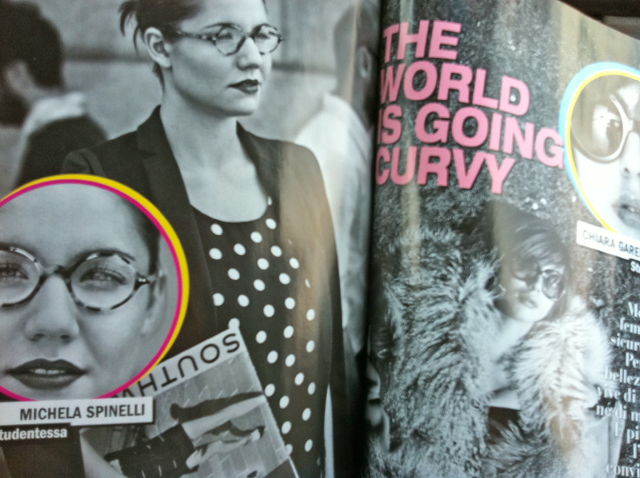
Not just in Elba, but all over Italy, the new Vogue Italia has come out, and it has, for the moment, left skinny girls all but out of the equation. And as I have been for the past week or so writing about a “vacation” from life as usual, I find it totally appropriate to include this, which is, also, a vacation from life as usual.

We are so accustomed to thin, no gaunt, faces and bodies that ours will never be, that laying eyes on this issue (main story: “Belle vere,” or “True Beauties”) made me breath a bit freer. Yes, these models are still beautiful. And one might argue that in casting them and in styling them in a Helmut Newton-esque fashion Vogue and photographer, Steven Meisel have just traded in one kind of perfection for another, but at least there is allowance here for a woman to be just that: a woman. It is progress to show something other than rail thin. It is progress to let a curve, any curve, replace a straight line.


Meisel’s story is the raciest of the three featured articles. Another was subdued and elegant, but with the same unabashed confidence, featuring women draped in lush colors and large, voluminous coats and dresses. Shape was everything, in a positive way. I’ve included a close-up from that spread just to celebrate a face that’s not reduced to bone and shadow.


The third story was about eyewear: the comeback of roundness in glasses. Here too, without exception, all the women were healthy samples of the female animal. And at no point did I look at the spread, even with my art director’s eye, and yearn to see something with less heft. No, this is a good move. Now, sadly, I’m sure they’ll return to business as usual, but at least the statement was made. I wonder how many saw it and “listened.”

Posted in ITALY, OUT & ABOUT | Tagged , , | 3 Comments

La pineta

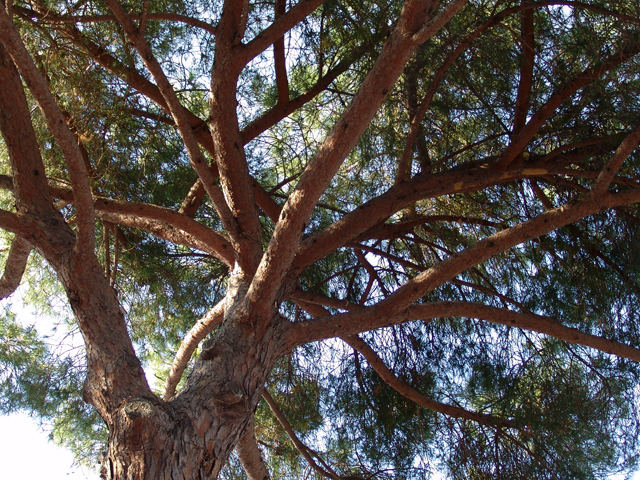
Running parallel to the Tuscan coast is a strip of pine trees called la pineta. These are, for the most part, Mediterranean pines—beautiful umbrella shaped trees with tall straight trunks that shoot up then open over your head in a wide, generous canopy of green.


The floor below them is clean and carpeted with pine needles, or, as on the coast of Elba, filled with smaller shrubs and lovely flowering plants. The pines scent the air, making one feel that every lung full is bringing better health.

For me, though, they have a Proustian effect. I look at them and remember my childhood, remember picking the dried husks of cicada skins off the pine bark, or sticking my fingers in the resin that dripped out of them in the intense summer heat. Here, though, they don’t frame the brick walls of my Chattanooga, Tennessee childhood home. They frame the Mediterranean Sea. And, once again, I have to wonder: how did I get here?


Posted in ITALY, OUT & ABOUT | Tagged , , | 2 Comments

Civil dressing for a deadly habit


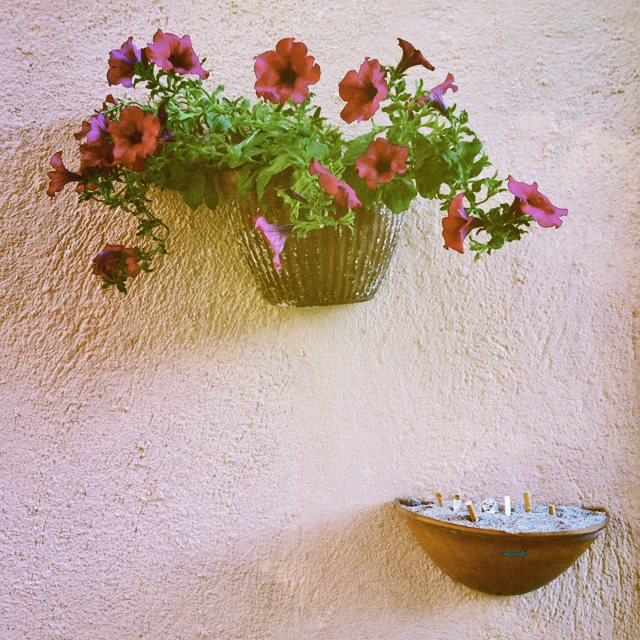
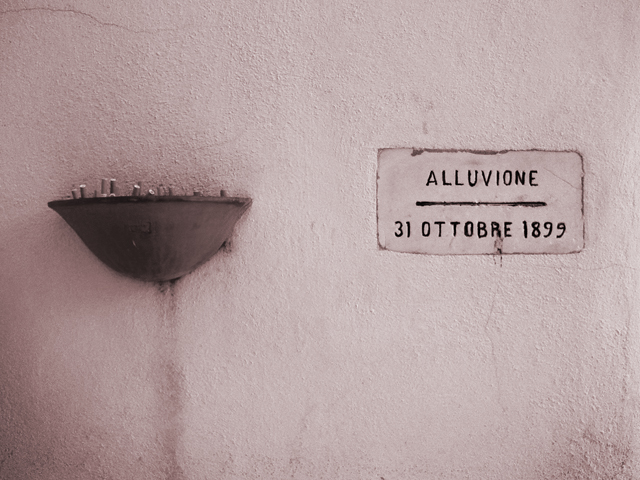
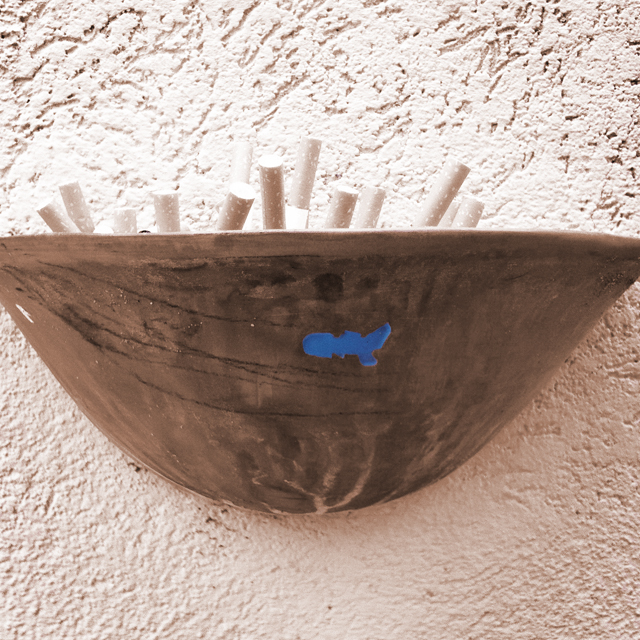
Smoking kills, but the Island of Elba doesn’t find that reason enough not to accommodate the smoker and everyone else at the same time. Terra cotta ashtrays, as pretty as planters, are everywhere. And if it weren’t for the crop of cigarette butts thriving in many of them (in other words, cigarette butts that aren’t littering the ground), that’s exactly what you’d think they were.


The first one I spotted was affixed to a lovely art gallery, so I assumed it had been put there by the property owners. Then I realized that they were everywhere—next to the doors of barbershops and butchers, by drainpipes and the carved stone marking the water-level of the great flood of 1899. And finally, on close inspection, I realized that they were public installations, for each ashtray is marked with an oddly shaped blue-blob: a minute Island of Elba.


Posted in ITALY, OUT & ABOUT | Tagged , | 5 Comments

The large, the small, and the public print


This is a visual addendum to the June 14 post, “A good day for green,” about the public referendum in Italy. As happens prior to all votes in Italy, the rules of voting and the points on the table are printed in public bans affixed by each community wild-posting style on street-level walls and billboards.

I love this visible, public, non-digital call to exercise your right in all its straight-laced bureaucratic elegance. The original Obama campaign may have dazzled us with it digital triple-flips and high-kicks, but I will always love the word printed on actual paper for all to see and, yes, touch. Because even if the internet is the ultimate public space, it still doesn’t feel like it.


Posted in ITALY, OUT & ABOUT | Tagged , , , | 2 Comments

Fresh.


As you may know, the “Slow Food” movement originated in Italy. People know, intuitively, passionately, that there’s something wrong with “fast” food. Nothing about eating, according to most Italians, really should be speedy…except perhaps how long it takes for the food to get from where it originates to your plate. This was recently overheard at the vegetable vendor’s:

CUSTOMER: “Do you have fresh green beans?”
GROCER: “Yes”
CUSTOMER: “How fresh?”
GROCER: “They got here yesterday.”
CUSTOMER: (Just shakes her head no.)

And if you want fish? Where better to get it than fresh out of the sea. Here, the smaller fishing boats head out in the morning (God knows how early), and return with their catch. Line up on the pier and the choice is yours. If you want triglie (pictured below), but they didn’t catch it, you’re out of luck. It’s fresh or it’s nothing.


Posted in ITALY, OUT & ABOUT | Tagged , , , , | 1 Comment

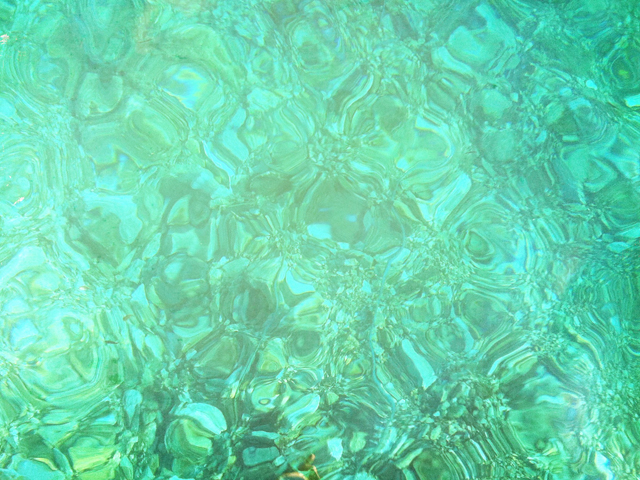
Now that’s a swimming pool.


Who needs
a pool
when there’s
a sea?


Posted in ITALY, OUT & ABOUT | Tagged , , , | 9 Comments

A good day for green

Taking time away from things and places to celebrate what may be the best day we’ve had in a long time in Italy. Referendums passed all over the country to support renewable energy. To keep water public, as it is considered a right of the many. To stay away from nuclear energy. In Milan, specifically, the part of the center that is limited to resident vehicles is being extended. Bike paths are to be increased by 200 kilometers. And the old canals are going to be restored. The use of oil to heat buildings must be stopped by 2015, and new buildings have to incorporate (I believe this is correct) 40% renewable energy. Electric cars are in. Gas guzzlers are out. I’m happy happy happy about this public voice…this public insistence…Perhaps Berlusconi’s days are numbered.

2 Comments